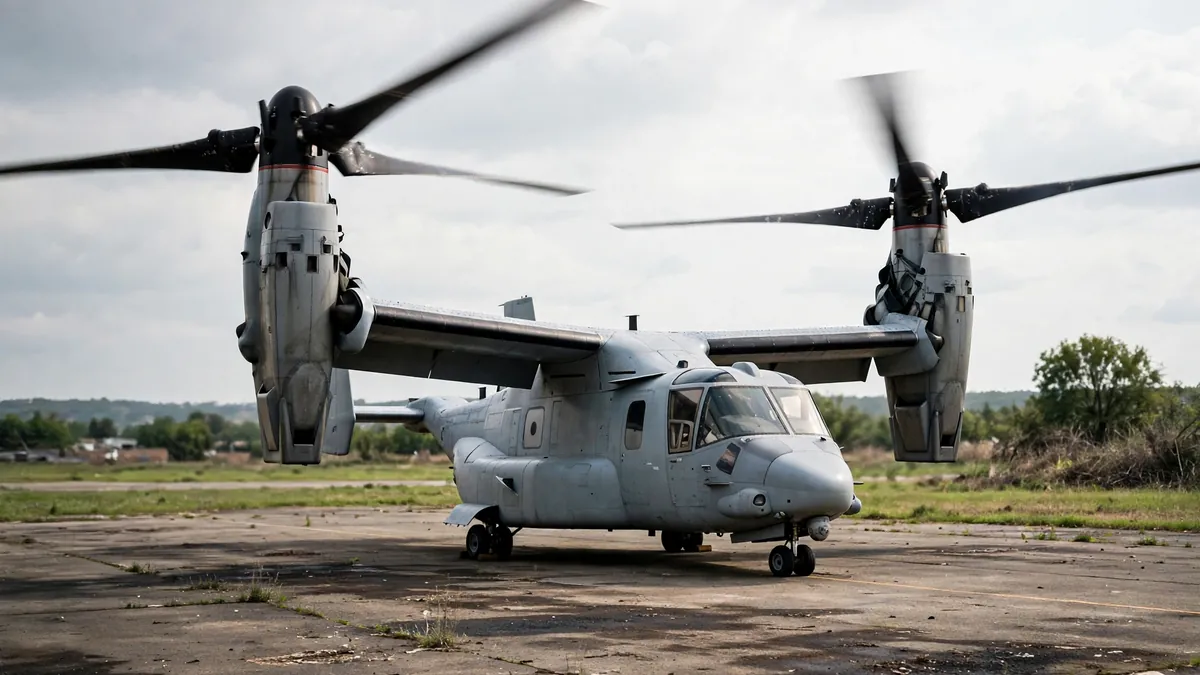
On the runway it looks like a helicopter that has lost its way. Two huge rotors sit on top of the wings, pointing straight up, and the aircraft lifts vertically off the ground with no runway at all. Then, as it climbs, something extraordinary happens: the two engine pods at the wingtips slowly tilt forwards, the rotors tilt with them, and the helicopter becomes an aeroplane. Within a minute it is flying at nearly three hundred knots, twice as fast as any helicopter, on a straight course to a destination hundreds of miles away. This is the tiltrotor, one aircraft that flies like two.
The tiltrotor was born from a simple frustration. Helicopters can take off and land anywhere, but they are slow and short-ranged. Aeroplanes are fast and efficient, but they need long runways. Engineers spent decades asking whether one machine could do both, and the tiltrotor is their answer.
How a Luxury Tiltrotor Works
1. Two proprotors, one for each mode
At each wingtip sits a nacelle containing an engine and a proprotor, a rotor so large it works as a helicopter rotor in one mode and as an aeroplane propeller in the other. The proprotors are about eleven metres across, with three broad blades each, and they are the most important part of the aircraft. In helicopter mode they point upwards and lift the aircraft vertically, like a helicopter rotor. In aeroplane mode they point forwards and pull the aircraft through the air, like a propeller. How the blades themselves are built is close to the craft described in our guide to how an electric aircraft propeller is made.
2. The tilt: ninety degrees in about twelve seconds
The transition between the two modes is the defining moment of a tiltrotor flight. After a vertical takeoff, the aircraft climbs to a safe height, and the pilot begins to tilt the nacelles forwards. The tilt takes about twelve seconds, and as the nacelles move, the aircraft accelerates forwards while still being supported partly by the rotors and partly by the wings. The flight computer manages the change, adjusting the rotor speed, the blade pitch, and the control surfaces so the aircraft never loses lift. By the time the nacelles are fully horizontal, the wings are doing all the lifting, and the aircraft is flying as a conventional aeroplane. Landing reverses the process, with the nacelles tilting back up as the aircraft slows to a hover.
3. Engines and the cross-shaft that saves the day
Each nacelle holds a powerful turboshaft engine, and the two engines are linked by a cross-shaft running through the wing, so that if one engine fails, the other can drive both rotors. That single feature is what makes the tiltrotor safe enough to fly, because a helicopter that loses a rotor is in serious trouble, while a tiltrotor with one engine can still land vertically on the power of the other. The transmission is a marvel of engineering, with gearboxes in each nacelle and in the wing centre, all turning at high speed and all needing constant lubrication and cooling.
4. Flight controls: helicopter sticks and aeroplane wings
Flying a tiltrotor means using two different sets of controls in one flight. In helicopter mode, the pilot uses a cyclic stick to tilt the rotors, a collective lever to change the blade pitch, and pedals to control yaw, just as in a helicopter. In aeroplane mode, the same stick works the ailerons and elevators on the wings, and the aircraft is flown like a normal aeroplane. The flight computer blends the two, so the pilot does not have to think about which system is in charge at any moment. The wing itself is straight and high-mounted, with flaps that help at low speed, and the tail has a large horizontal stabiliser to keep the aircraft steady in cruise. The vertical-lift idea has a smaller cousin in the unmanned world, as explained in our guide to how an eVTOL aircraft works.
5. Cruise: fast, high, and far
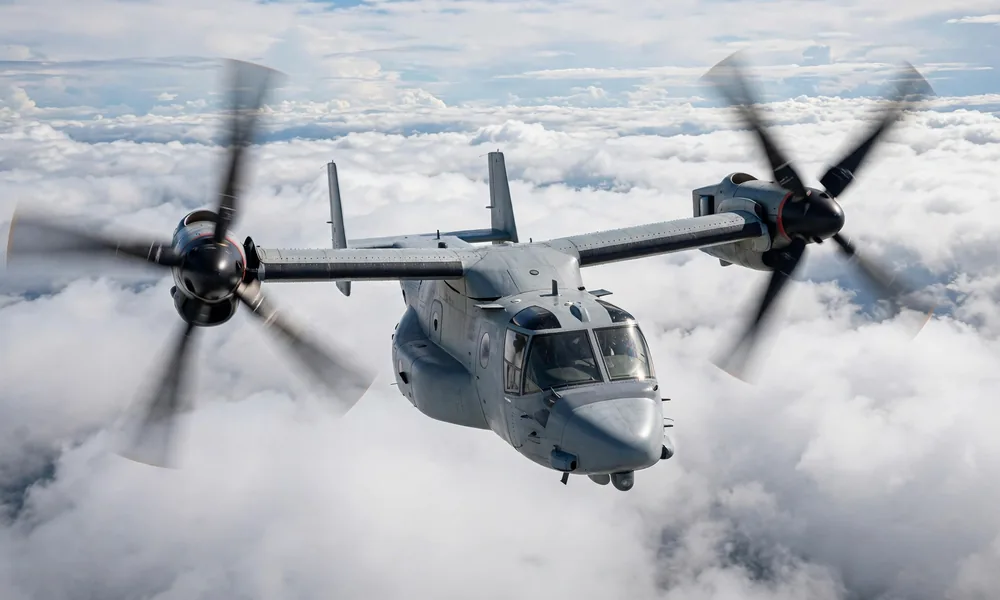
In aeroplane mode, a tiltrotor cruises at about 250 to 280 knots, at altitudes up to about 25,000 feet, with a range of around a thousand nautical miles. That is roughly twice the speed and twice the range of a helicopter of similar size, and it means a tiltrotor can fly from a city centre helipad to a destination that would need a helicopter to stop and refuel. The cabin is pressurised, so passengers fly in comfort, and the interior of a luxury civil tiltrotor is fitted like a private jet, with leather seats, a small galley, and large windows.
6. Landing anywhere, then parking like a helicopter
At the destination, the tiltrotor slows, tilts its nacelles back up, and descends vertically onto a helipad, a ship deck, or a clearing, with no runway needed at all. That ability is what justifies the complexity and the cost: the aircraft can serve places that no aeroplane can reach, from oil platforms to island resorts to hospital roofs, and then fly home at aeroplane speed. After landing, the rotors can be folded back along the wings on some designs, so the aircraft can be parked in a smaller hangar or carried on a ship. The deck it lands on has much in common with the landing areas on large yachts, as described in our guide to how a superyacht helicopter deck works.

Specifications
| Specification | Typical figure |
|---|---|
| Proprotor diameter | About 11.6 metres each |
| Cruise speed | About 250 to 280 knots |
| Maximum speed | About 300 knots |
| Range | About 1,000 nautical miles |
| Service ceiling | About 25,000 feet |
| Passengers | About 20 to 24 in military service, fewer in luxury fit |
| Engines | Two turboshaft engines, linked by a cross-shaft |
| Takeoff | Vertical, no runway needed |
Price
A tiltrotor is one of the most expensive aircraft of its size ever built, and its price reflects decades of development and a very small production run. A military V-22 Osprey is estimated to cost about 70 to 90 million dollars per aircraft, while a civil tiltrotor, if offered for sale, is estimated to cost a similar amount or more, depending on its luxury fit. Those figures are estimates only, and the real cost of owning one is higher still, because maintenance is specialist work, spare parts are expensive, and the aircraft needs highly trained pilots and engineers. For now, the tiltrotor remains a rare machine, flown mostly by the military, with civil versions still in development.
A Rare Fact
A tiltrotor can fly on one engine, but it cannot hover on one engine at full weight. If an engine fails in the hover, the pilot must immediately tilt the nacelles forwards and convert to aeroplane flight, where the remaining engine has enough power to keep the aircraft flying. It is a manoeuvre that sounds alarming, and it is practised so often in the simulator that pilots can do it without thinking, which is exactly the point.
The tiltrotor is a compromise, and like all good compromises it does something no pure design can do. It is slower than a jet, more complex than a helicopter, and more expensive than either, yet it can land on a rooftop in the morning and fly across a country by lunchtime. That is a trick no other aircraft has ever managed, and it is why, after decades of development, the tiltrotor still feels like the future.


