On a still morning at a small airfield outside Toulouse, a two-seat electric trainer taxis to the runway with almost no sound at all. The only sign that anything is happening is the blur of the propeller disc and the gentle push in your back as the aircraft accelerates. That silence is the whole point of electric flight, and the propeller is where the silence is made. It is the one part of the aircraft that has to turn raw electric torque into thrust without wasting a single watt, and building one is a very different job from building the metal propeller your grandfather flew behind.
An electric aircraft propeller looks simple from the apron: two or three slim blades, a polished spinner, a hub that seems too small for the job. Up close, it is one of the most precisely engineered parts on the aeroplane. The blades are usually carbon fibre, the hub is machined from a single billet of aluminium or titanium, and the whole assembly is balanced to a tolerance you could measure in grams.

How It Is Made
Step 1: Designing the blade
Everything starts on a computer. Engineers model the blade in three dimensions, shaping its twist, chord and airfoil section so it produces maximum thrust at the relatively low rotational speeds electric motors prefer. A petrol engine might spin a propeller at 2,700 revolutions per minute, but many electric motors are happiest nearer 2,000, which means the blade has to be longer, thinner and more carefully twisted to bite the same amount of air. Computational fluid dynamics software simulates thousands of virtual flights before a single piece of material is cut, testing how the blade behaves at take-off power, in cruise, and in the thin air of a hot day.
Step 2: Laying up the carbon fibre
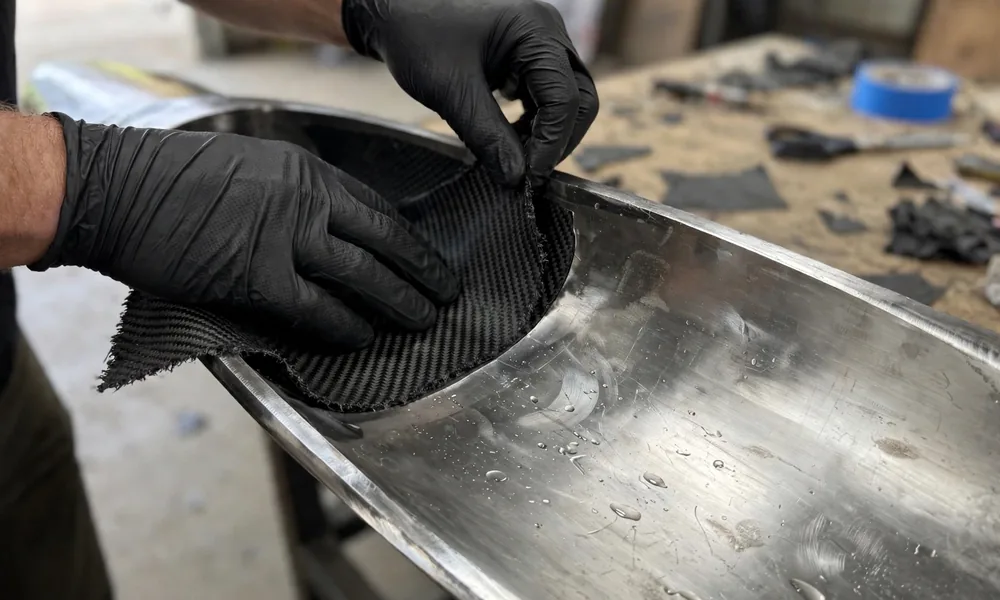
With the design frozen, technicians begin laying up the blade by hand. Sheets of carbon fibre cloth, pre-impregnated with epoxy resin, are cut to precise templates and laid into a polished steel mould in a carefully planned sequence. The direction of the fibres matters enormously: fibres running along the blade carry the bending loads of flight, while fibres angled across the skin resist twisting. A typical blade might contain forty or more layers, each one placed by hand and smoothed down with rollers to push out trapped air. A foam or honeycomb core is added in the thicker root section to give the blade stiffness without adding weight.
Step 3: Curing in the autoclave
Once the layup is complete, the mould is sealed inside a vacuum bag and placed in an autoclave, essentially a giant oven that is also a pressure vessel. The temperature climbs to around 120 degrees Celsius while the pressure squeezes the layers together, forcing the resin to flow into every gap and bond the fibres into a single solid structure. When the mould finally opens, the blade emerges as a single dark, glassy shape, already close to its finished form but still needing careful finishing work.
Step 4: Machining the hub and root
While the blades cure, the hub is machined from a solid billet of aluminium alloy or titanium on a five-axis computer-controlled mill. The hub is the heart of the propeller: it holds the blades at exactly the right pitch angle, carries all the thrust into the motor shaft, and must survive the full torque of the electric motor from a standing start. The blade roots are machined to match the hub sockets to a fraction of a millimetre, and each blade is fitted with a metal cuff that spreads the load where carbon meets metal. Bolt holes are drilled and reamed by hand, because a drilled hole in carbon fibre is a place where cracks love to start.
Step 5: Balancing and finishing
Each blade is weighed, and the set is matched so that no blade is more than a few grams heavier than its partners. The blades are then mounted on a balancing rig and spun up, first slowly and then at full speed, while sensors measure vibration in three directions. Tiny amounts of material are sanded from the tips or small weights are added inside the root until the assembly spins true. Finally, the blades receive a coat of polyurethane paint and a metal leading-edge strip, usually nickel or stainless steel, to protect the carbon from rain erosion at the tips, where the blade can be moving at close to the speed of sound.

Step 6: Testing and first flight
Before any propeller is allowed near an aircraft, it is tested on a rig that can spin it to 150 percent of its maximum operating speed while measuring thrust, noise and vibration. The blades are flexed under load to prove they can survive a bird strike and a sudden throttle slam. Noise is measured carefully, because a quiet propeller is one of the main selling points of electric flight and a noisy one defeats the purpose. Only after the test data is signed off does the propeller get fitted to the aircraft, the spinner is torqued on, and the pilot runs the motor up for the first time. On the ground, the check is simple: full power, no vibration, and a thrust reading that matches the design. In the air, the proof is a climb that feels effortless and a cabin so quiet you can talk in a normal voice.
Key Specifications
| Specification | Typical Value |
|---|---|
| Diameter | 1.8 to 2.0 metres |
| Number of blades | 2 or 3 |
| Blade material | Carbon fibre composite |
| Hub material | Aluminium alloy or titanium |
| Weight, complete assembly | 8 to 12 kilograms |
| Maximum speed | Around 2,200 rpm |
| Typical thrust | Up to 400 kilograms |
| Noise at 100 metres | About 60 decibels |
How Much Does One Cost?
A certified carbon fibre propeller for a light electric aircraft is not a cheap part. As an estimate, a two-blade fixed-pitch propeller for a small trainer costs roughly $8,000 to $15,000, while a three-blade variable-pitch unit for a larger aircraft can cost $20,000 to $30,000 as an estimate, with the hub and spinner included. The price reflects the hand layup, the autoclave time, the precision machining and the testing, all of which are done in small batches rather than on a production line. It is also one of the reasons electric aircraft remain so expensive today, because almost every part is still built almost by hand. Prices should fall as volumes rise, but for now a propeller can cost as much as a good used car.
The same craftsmanship shows up in very different places. The team that builds a yacht propeller works to similar tolerances, and the engineers behind a ship propeller face the same battle against vibration, even though their blades turn in water rather than air. The physics changes; the obsession with balance does not.
A Rare Fact
Some electric aircraft propellers can fold themselves away. On motor gliders, the blades are designed to fold flat against the nose the moment the pilot cuts the power, turning the aircraft back into a clean glider with almost no drag. The mechanism is entirely passive: centrifugal force holds the blades out while the motor spins, and air pressure folds them back when it stops. It is a trick a petrol engine could never pull off, because a piston engine cannot stop and restart in flight, and it is one of the quiet pleasures of electric flight that the noisiest part of the aircraft can simply disappear.


