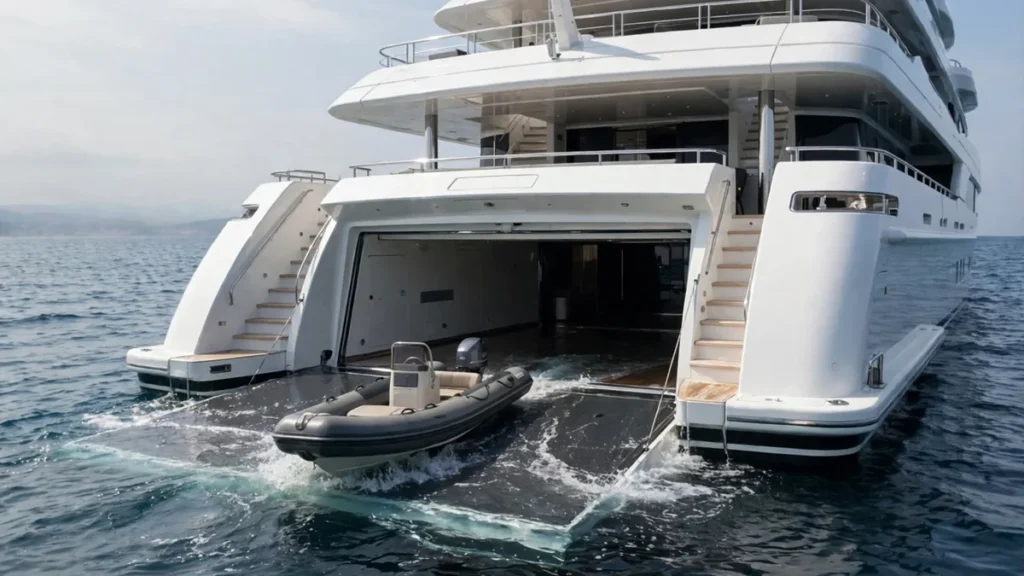
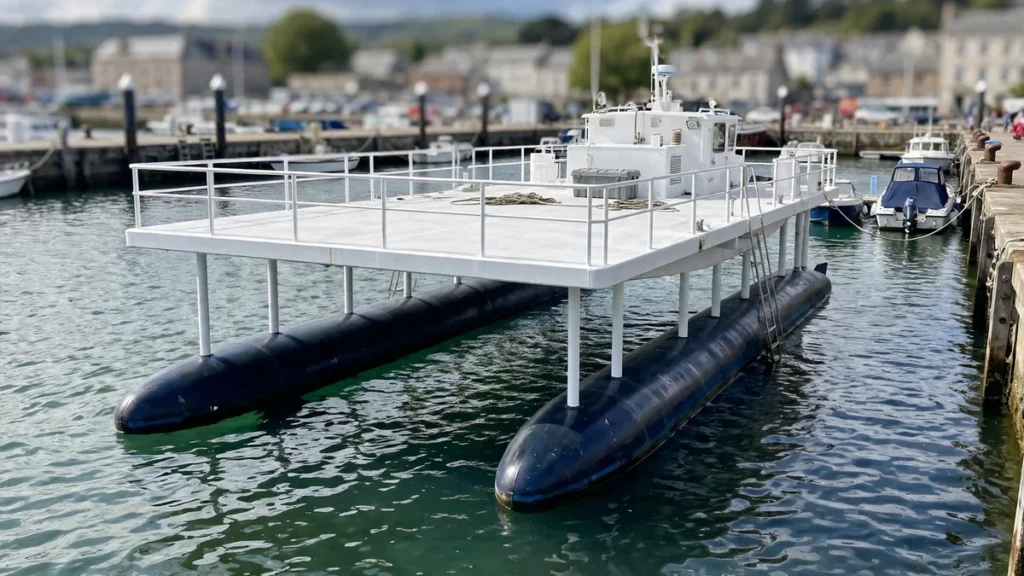
A luxury expedition submarine is not a warship, and it is not a toy. It is a small, crewed submersible built to take paying guests somewhere no ordinary boat can go: down to a reef, a wreck, or a deep wall, in comfort, with big windows and a pilot who knows the water. The newest ones are carried aboard superyachts, launched from a tender garage or a stern platform, and they turn a yacht holiday into something closer to an expedition, with dives planned like shore excursions.
The idea is older than it looks. Tourist submersibles have carried sightseers down to reefs since the nineteen eighties, and research submersibles have worked far deeper for even longer. What is new is the luxury version: a vessel designed from the start for guests who expect good visibility, quiet running, air conditioning, and a view worth the price, with the engineering of a research boat and the finish of a yacht tender.
What counts as an expedition submarine
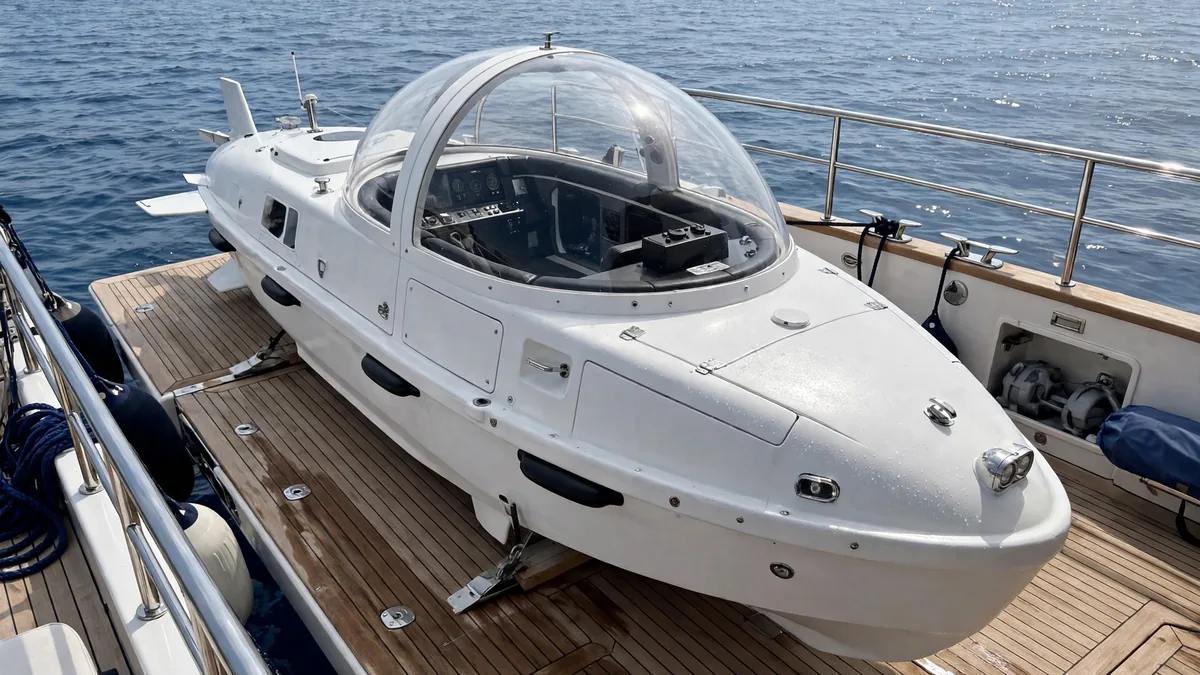
The name is used loosely, so it helps to be precise. A luxury expedition submarine is a crewed submersible, usually carrying a pilot and between two and seven guests, rated to dive to somewhere between one hundred and one thousand metres, and operated from a yacht or a dedicated expedition ship. It is not a submarine in the naval sense: it cannot stay down for days, it has no torpedoes, and it must be launched and recovered by its mothership.
What makes it an expedition vessel, rather than a simple tourist sub, is range and capability. It carries sonar to find its way in dark water, lights powerful enough to work at depth, manipulators or sample baskets for scientific work, and enough battery for several hours underwater. Some are built to a classification society’s rules and certified like a small ship, which is what allows them to carry paying guests at all. A vessel without that certification is a private toy, not a commercial expedition boat.
The pressure hull, and the view out of it
The heart of the vessel is the pressure hull, the strong shell that keeps the sea out. On most luxury expedition submarines the hull is a steel or titanium sphere, because a sphere spreads pressure evenly and needs no stiffening, and the guests sit inside it. The newest designs replace part of the sphere with a single huge acrylic dome, a transparent bubble several metres across, which gives the guests a view that a row of small portholes never could.
Power, propulsion and staying down
Expedition submarines are battery electric, with no engine of any kind. A bank of lithium batteries powers electric thrusters, usually four or more, arranged so the vessel can move forward, turn, rise, and hold station against a current. The thrusters are quiet, which matters for guests and for wildlife, and they are efficient enough to give the boat several hours of diving on one charge.
Buoyancy is controlled with ballast tanks and a variable ballast system, the same principle as a larger submarine: pump water in to sink, pump it out to rise, and trim the boat level with small adjustments. Some luxury boats also carry drop weights, heavy blocks that can be released in an emergency to make the vessel rise on its own, even if every other system has failed. That emergency ascent, and the rescue systems that back it up, are part of the certification, and they are rehearsed by the crew on every cruise. How a research submarine works explains the same buoyancy and propulsion principles in a working scientific boat, which shares most of its systems with the luxury version.

How a dive actually runs
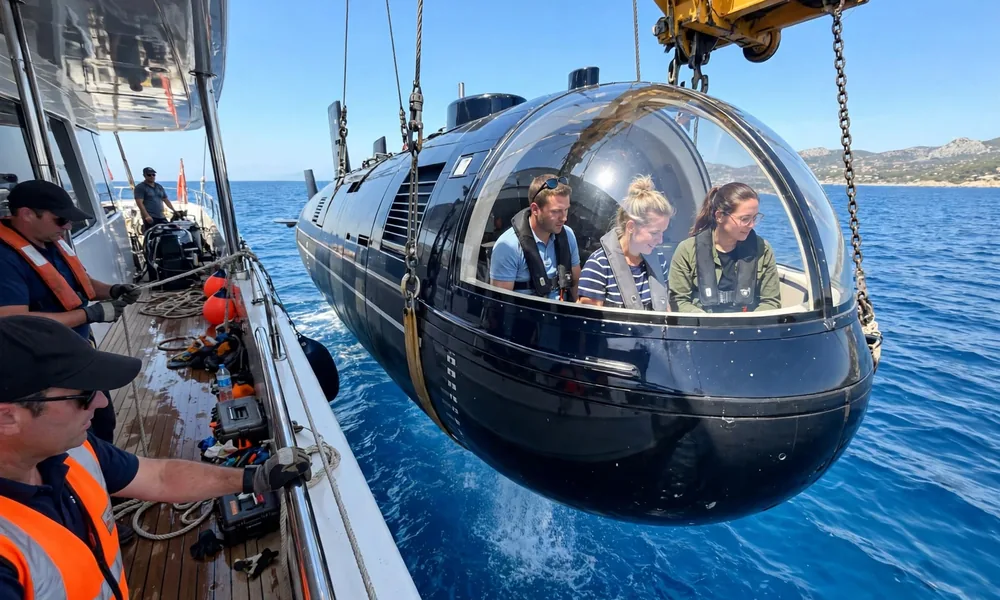
A dive begins on the mothership. The submarine is moved out on its cradle, the guests climb in through the top hatch, and the crew runs through the safety briefing: where the emergency breathing masks are, how the drop weights work, and what to do if the pilot says the word. The hatch is closed and dogged, the vessel is lowered into the water by crane or rolled off the stern platform, and the pilot takes it down.
What you see, and what it costs to see it
The experience is the product, and it is what separates an expedition submarine from a glass-bottomed boat. At a hundred metres the light is gone and the lamps pick out colours no surface visitor ever sees, from the white of a deep coral to the orange of a fish that lives its whole life in the dark. At three hundred metres the water is cold, the pressure is thirty times what it is at the surface, and the world outside the dome is entirely alien.
That experience is expensive, and the price reflects the engineering. A luxury expedition submarine costs several million pounds to build, needs a trained pilot and a support crew, and must be certified, maintained and insured like a small ship. A single guest dive can cost thousands of pounds, and a submarine carried aboard a superyacht adds millions to the yacht’s price before it ever touches the water. The market is small, but it is real, and it is growing as more yachts are built with the tender garage space to carry one. How a deep-sea submersible works goes deeper, literally, into the vehicles built for the very deepest water, where the pressures are far beyond what a luxury boat is rated for.
Expedition work, not just sightseeing
The better expedition submarines earn their keep with real work as well as sightseeing. Scientists use them to survey reefs, count species, and collect samples with manipulator arms, and film crews use them to shoot in places no diver can reach. Some yachts lend their submarine to research teams between guest cruises, and some expedition ships carry one as their main scientific tool, with a laboratory aboard the mothership to process what the submarine brings up. The best luxury submarine experiences, ranked lists the trips and operators that put these vessels to work, from reef dives to wreck visits.
Why the expedition submarine is here to stay
The luxury expedition submarine sits at the meeting point of two trends: yachts getting bigger and more capable, and guests wanting experiences that cannot be bought ashore. A bigger yacht can carry a submarine, a submarine can reach places a yacht cannot, and the combination turns a holiday into an expedition with a story to tell afterwards.
It will never be common, because the engineering is too demanding and the price too high for most owners. But it is no longer a fantasy either. The vessels are certified, the pilots are trained, the domes are proven, and the dives run every week in the places where the water is clear and the reefs are worth seeing. For a guest who has already sailed everywhere, the view through that dome is the one thing they have not seen before.