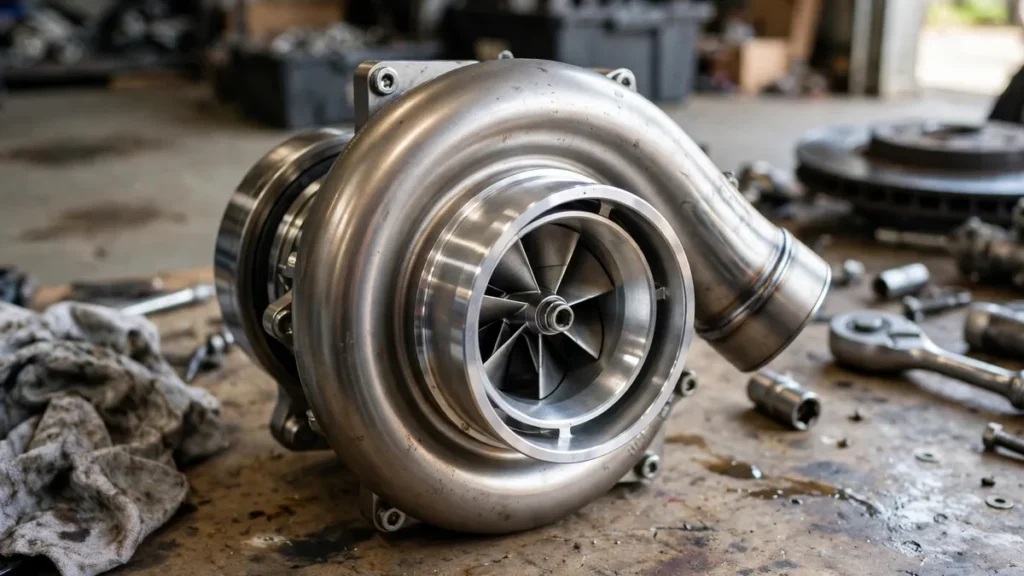
Floor the throttle of a modern luxury car and something extraordinary happens in the half second before the surge. Deep in the engine bay, a small wheel no bigger than a coin begins to spin, faster and faster, until it is turning at 200,000 revolutions a minute, quicker than a dentist’s drill and faster than any other moving part in the car. Exhaust gas rushes over its blades, and on the other end of the same shaft a second wheel scoops fresh air into the engine, packing it in so tightly that a small engine can make the power of a much bigger one. That spinning wheel is the heart of the turbocharger, and in the most extreme cars it is made from titanium.
Titanium is the metal engineers reach for when steel is too heavy and aluminium is too weak for the heat. It is light, it keeps its strength when it glows hot, and it resists the corrosive bite of exhaust gas. But it is also stubborn stuff, hard to cut, hard to join, and unforgiving of mistakes. Building a titanium turbocharger is a slow, precise job, and every gram saved in that spinning wheel makes the car respond a fraction quicker.

How It’s Made
Step 1: The titanium alloy is chosen and cast into blanks
It starts with the alloy. Pure titanium is too soft for a turbine wheel, so engineers use a blend with aluminium and other elements, tuned to stay strong at temperatures where ordinary metals go soft. The alloy is melted in a vacuum furnace, because molten titanium grabs oxygen from the air and turns brittle, and poured into moulds to make rough blanks, one for the turbine wheel and one for the compressor wheel. Each blank is checked for hidden bubbles and cracks with X-rays, since a flaw inside a wheel spinning at 200,000 revolutions a minute would be catastrophic. Only blanks that pass perfectly move on to machining.
Step 2: The wheels are machined blade by blade
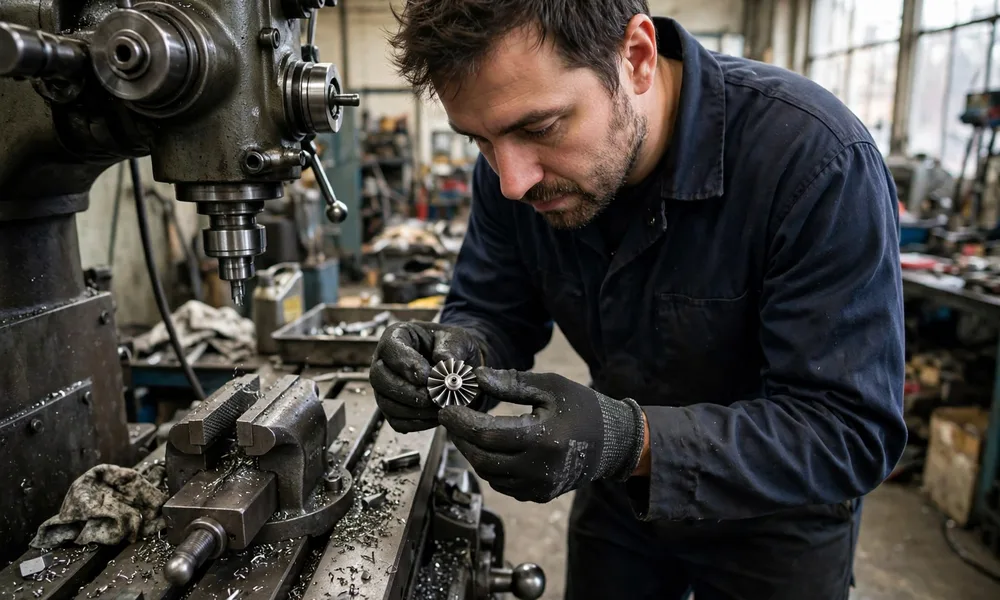
Next the blanks are carved into their final shapes. A five-axis milling machine, guided by a computer, cuts the curved blades of the turbine wheel one at a time from the solid metal, a process that can take many hours for a single wheel. The blades are thin, twisted and curved in three dimensions, shaped to catch the exhaust gas and turn its energy into spin with as little waste as possible. The compressor wheel on the other side gets the same treatment, its blades shaped to scoop air smoothly rather than chop at it. After machining, each wheel is polished by hand in places no machine can reach, because a rough surface slows the gas and steals power.
Step 3: The shaft and bearings are made to microscopic tolerances
The two wheels are joined by a steel shaft, and that shaft runs in bearings that must survive speed and heat no ordinary bearing could. The shaft is ground until it is round to within a few thousandths of a millimetre, then hardened, and the bearings are made from special bronze or ceramic, fed with a constant film of pressurised oil that keeps the metal parts from ever quite touching. The oil does two jobs at once, lubricating and carrying heat away, and the passages that feed it are drilled with great care. A turbocharger that must work in a hybrid supercar, like the one in the hybrid supercar build, needs this same precision, because its turbo must spin up instantly and then survive long periods of hard use without complaint.
Step 4: The housings are cast and machined
Around the wheels sit two housings, shaped like snail shells, that guide the gas in and the air out. They are cast from heat-resistant iron or stainless steel, then machined inside to a smooth spiral that matches the wheels with only a hair of clearance. The turbine housing must contain exhaust gas hot enough to glow, while the compressor housing stays cool enough to keep the intake air dense, and the two are separated by a centre housing that carries the oil and water cooling. Every housing is pressure-tested, because a crack would leak boost and rob the engine of power, and the mating faces are machined flat so the seals hold under pressure and heat.
Step 5: The wheels are balanced at extreme speed
This is the most delicate step of all. The turbine wheel, shaft and compressor wheel are joined into one spinning assembly and balanced on a machine that spins them up to speeds beyond anything they will see in the car, sometimes over 200,000 revolutions a minute. Sensors feel for the tiniest wobble, and a technician removes specks of metal, a fraction of a gram at a time, until the assembly spins perfectly true. An imbalance the size of a grain of sand would shake the turbo apart at full speed, so this step is repeated and checked, and the finished assembly is marked so it can only be reassembled in exactly the same position.
Step 6: The turbo is assembled, tested and run in
Finally the balanced assembly is fitted into its housings with fresh seals and bearings, the wastegate that controls boost is fitted and adjusted, and the whole turbocharger goes onto a test rig. Hot gas is blown through it, oil pressure and boost are measured, and the turbo is run through its full speed range while engineers listen for any whine or rattle that hints at trouble. The way a turbo must feed its engine, much like the breathing of the luxury diesel engine, decides how the car feels to drive, so the test results are compared against the design, and any turbo that falls short is stripped down and rebuilt. Only a unit that passes every test is packed for the engine line.

Titanium Turbocharger Specifications
The figures below describe a typical large titanium turbocharger on a current luxury performance car. Sizes vary by model, but the build and the testing are the same.
| Specification | Typical value |
|---|---|
| Maximum rotor speed | 150,000 to 220,000 rpm |
| Turbine wheel diameter | 50 to 70 millimetres |
| Peak exhaust temperature | Up to about 950 degrees Celsius |
| Maximum boost pressure | About 1.5 to 2.5 bar |
| Turbocharger weight | About 8 to 12 kilograms |
| Machining time per wheel | Several hours each |
What It Costs
A titanium turbocharger for a luxury performance car costs an estimated $4,000 to $9,000 as a replacement unit, depending on size and model, and a pair on a twin-turbo engine can cost considerably more, before labour. Those are estimates, not quotes, and they reflect the hours of five-axis machining, the high-speed balancing and the cost of the alloy itself. A turbo is also a wear item in the hardest-driven cars, and it needs clean oil and a gentle cool-down after hard driving to last. In a full performance car the turbo is only one part of a larger system, and the way the whole machine turns fuel and air into speed, as how a luxury hypercar works explains, depends on this small spinning wheel doing its job perfectly, thousands of times a minute, for years.
A Rare Fact
Here is a detail most drivers never guess. At full speed the tips of a turbocharger’s turbine blades move faster than the speed of sound, and the wheel goes from idle to 200,000 revolutions a minute in about a second, which is why the balance has to be perfect to a fraction of a gram.