Press the start button in a hypercar and the world changes. The engine wakes with a deep growl, the dashboard lights up like a cockpit, and the car seems to crouch, ready to leap. Drive it gently and it behaves like a civilised grand tourer, quiet and smooth. Press the accelerator properly and it becomes something else entirely: a machine that can outrun almost anything on the road, with a surge of power that feels like being launched.
A hypercar is the most extreme road car money can buy, with more than a thousand horsepower in some cases, a top speed beyond 400 km/h, and a price that rivals a mansion. Yet it is still a road car, with air conditioning, a stereo and a warranty. Here is how a hypercar works, from the engine in the middle to the wings that hold it to the road, and why it feels so different from every other car.
How It Works
Step 1: An engine in the middle
Most hypercars put the engine behind the driver, in the middle of the car, because that gives the best balance. The engine is usually a twin-turbo V8 or a V12, sometimes joined to electric motors, and it produces power that was once the preserve of racing cars. The engine is built by hand, with parts machined to exact tolerances and tested before fitting. Around it are radiators, intercoolers and a complex exhaust, all packed into a space that leaves no room for waste. The result is an engine that can rev past 8,000 rpm and still idle smoothly in traffic.
Step 2: Hybrid power that fills the gaps
Many modern hypercars add electric motors to the engine, and the combination is more than the sum of its parts. The electric motors deliver instant torque from a standstill, filling in the moment before the turbochargers wake up, so the car pulls hard from the very first centimetre. The driver can choose modes: silent electric driving for a quiet street, a balanced mode for the road, and a full attack mode that uses every horsepower for the track. The system is managed by computers that decide, hundreds of times a second, how to blend petrol and electric power. It is the same idea as a Formula 1 power unit, made civilised for the road.
Step 3: A chassis lighter than it looks
The chassis is a carbon fibre monocoque, the same technology used in racing cars, and it is the reason a hypercar can be both light and immensely strong. Carbon fibre weighs far less than steel yet is stiffer, so the car can carry a huge engine and still weigh less than a family saloon. The body panels are carbon too, shaped in wind tunnels and finished by hand. Lightness matters because a lighter car accelerates faster, brakes shorter and corners harder, and it also makes the huge power easier to control.

Step 4: Aerodynamics that change shape
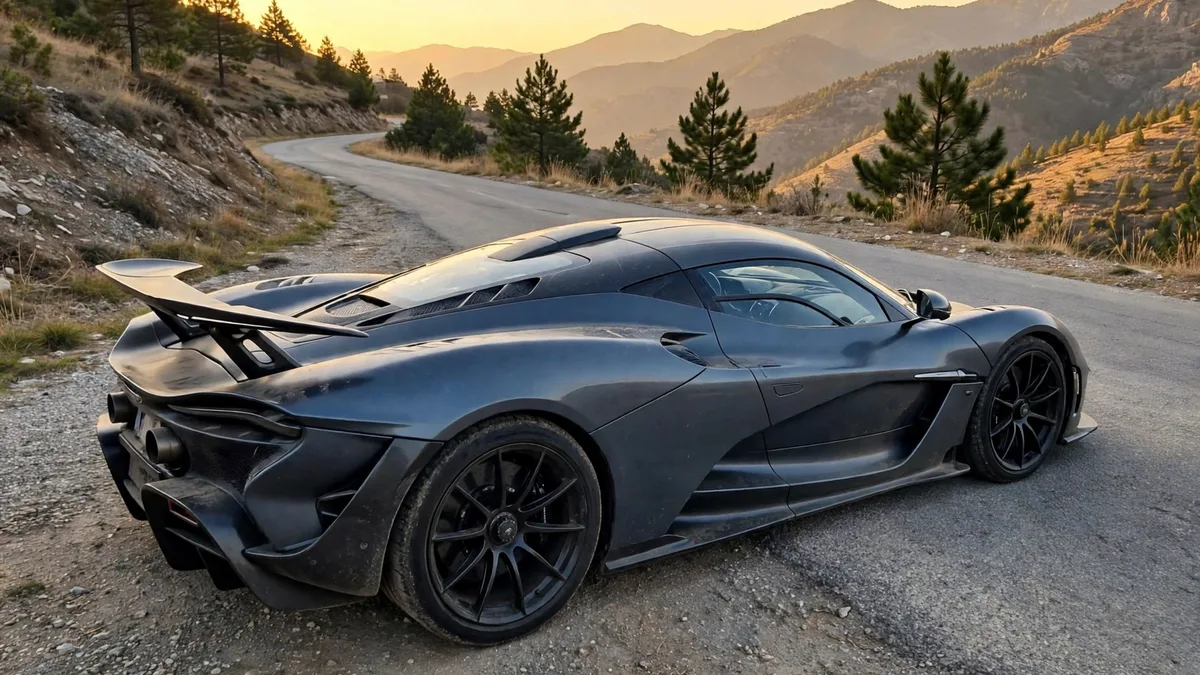
A hypercar’s body is not a fixed shape. It has active aerodynamics: wings that rise and tilt, flaps that open and close, and a rear spoiler that acts as an airbrake. At low speed the car is sleek and slippery, cutting through the air with little drag. At high speed the wings deploy, pressing the car into the road with tonnes of downforce so it stays stable and grips in corners. Under hard braking, the rear wing tilts up like a parachute, helping the brakes slow the car. All of this happens automatically, driven by sensors and computers, and the driver feels it only as confidence: the faster the car goes, the more planted it feels. The full story of the build behind this technology is told in how a luxury hypercar is made.
Step 5: Suspension and brakes from racing
The suspension is adaptive, with dampers that adjust in milliseconds to keep the tyres in contact with the road. In comfort mode the car rides smoothly over bumps; in track mode it stiffens until every ripple in the road is felt through the seat. The brakes are carbon ceramic, huge discs that can stop the car from motorway speed in a distance that seems impossible, and they never fade no matter how hard they are used. The tyres are bespoke, made for one model of car, with a compound that grips like glue when warm. The steering is precise and heavy with feedback, so the driver feels exactly what the front wheels are doing. Together, these systems make a thousand horsepower usable, rather than terrifying.
Step 6: A cockpit built for speed and comfort
Inside, a hypercar is a strange mix of racing car and luxury saloon. The seats are carbon shells trimmed in leather and Alcantara, the dashboard is a digital display, and the steering wheel carries buttons for driving modes and the launch control. Yet there is also air conditioning, a sound system, and soft materials everywhere the driver touches. The driving position is low and central, with the pedals and wheel exactly where they should be. It is a cockpit designed for a driver who wants both the thrill of a race car and the comfort of a car that can be driven home. The airflow that shapes all of this is explained in how hypercar active aerodynamics works.
Specifications
| Feature | Typical Hypercar |
|---|---|
| Engine | Twin-turbo V8 or V12, often hybrid |
| Power | 1,000 to 1,600 horsepower |
| 0 to 100 km/h | Around 2.5 seconds |
| Top speed | 350 to 440 km/h |
| Weight | Around 1,400 to 1,600 kg |
| Brakes | Carbon ceramic discs |
| Chassis | Carbon fibre monocoque |
The Price
A hypercar typically costs an estimated $2 million to $4 million, with the rarest models selling for far more at auction. The price reflects the hand-built engine, the carbon chassis, the tiny production numbers and the years of development behind each model. Servicing is expensive too: a set of tyres can cost thousands, and a routine service can run into five figures. Owners accept this because a hypercar is not just transport. It is a piece of engineering at the very edge of what is possible, and it is built in numbers so small that owning one puts you in a club of a few hundred people worldwide. The brakes that make this speed safe are ranked in the best hypercar brakes ranked guide.
A Rare Fact
Some hypercars are so fast that their tyres are the limiting factor, not the engine. The tyres must survive speeds over 400 km/h, where the forces trying to tear them apart are enormous, and they are tested by spinning them at high speed until they fail, just to find the safety margin. A single set can cost as much as a small car, and they are often glued to the rims as well as bolted, because at top speed the tyre can slip around the wheel. It is a reminder that in a hypercar, even the rubber is exotic.

A hypercar works by combining four things that rarely meet in one car: enormous power, very little weight, aerodynamics that change shape, and electronics that manage it all. Remove any one of them and the car falls apart, either too slow, too heavy, too unstable or too frightening to drive. Put them together and you get a machine that can cross a continent in comfort and then lap a circuit faster than a racing car from a generation ago. That is the trick of the hypercar, and it is why no other road car feels quite like one.