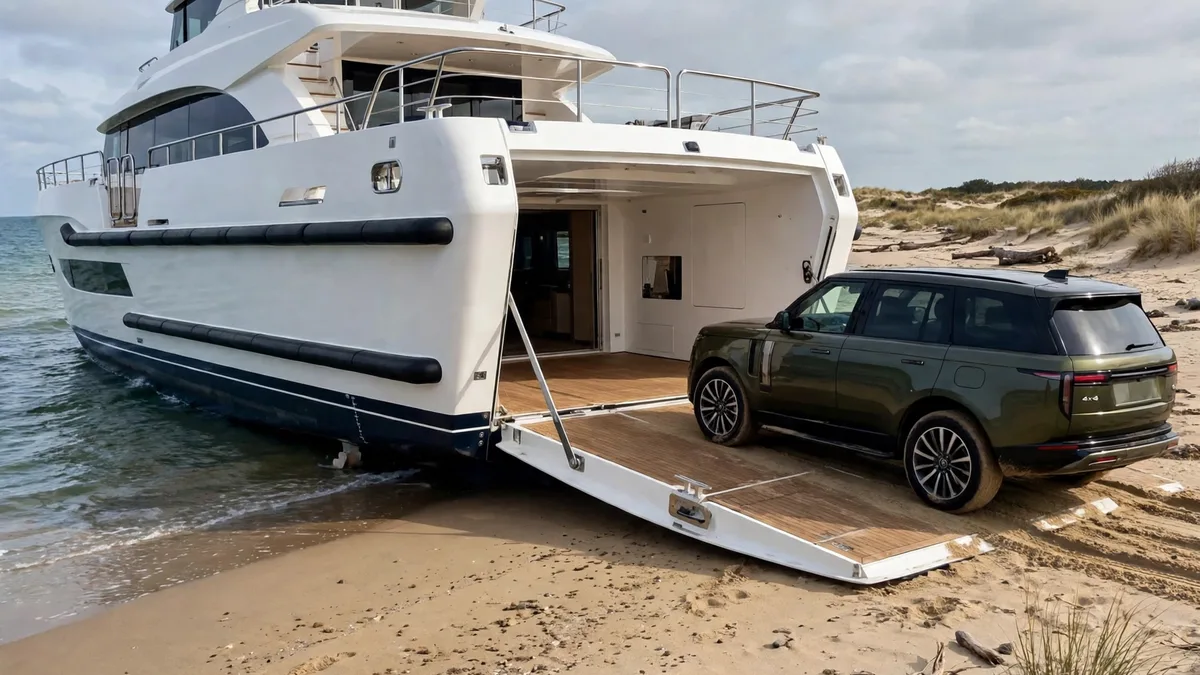
The beach is empty except for a family, a pile of luggage, and a car that has no road to follow. The tide is out, the sand is soft, and the nearest pier is an hour away by boat. Then the bow of a landing craft swings towards the shore, a great steel ramp drops onto the sand with a dull thud, and the car simply drives off the deck and onto the beach as if the sea had never been there. It looks effortless, and that is exactly why it is expensive. A luxury landing craft is a boat that is also a bridge, a garage and a beach house, and it has to do all of those jobs in salt water, under load, with people on board who expect a five-star stay.
Most boats are designed to stay in deep water and to be looked after in a marina. A landing craft is designed to do the opposite: to run itself aground on purpose, to sit on sand and gravel, and to come away undamaged. That single requirement changes everything about how it is built, from the thickness of the hull to the shape of the bow, and it is the first reason the price climbs. The second reason is the luxury part. A landing craft that carries an owner, their guests, their cars and their toys to a private island is not a military workhorse with a coat of paint; it is a superyacht tender on a grand scale, with cabins, air conditioning, a galley and a deck that has to look good in photographs. Put those two requirements together and you get a machine that is rare, hand-built, and priced accordingly.
What Makes It So Expensive
The hull is the first cost. A landing craft’s hull is built from thick marine-grade steel or aluminium, far heavier than the hull of a yacht of the same length, because it has to survive being driven onto a beach with tonnes of cargo on board. The bottom is flat, so the craft can sit upright on sand at low tide, and the flat bottom is reinforced with extra frames and plating where it touches the ground.
The bow ramp is the second cost, and it is the heart of the machine. The ramp is a huge steel door, hinged at the bottom, that must open and close smoothly, seal watertight when shut, and support the weight of a car or a truck driving over it. Designing a ramp that does all of that, year after year, without leaking or jamming, is a specialist job, and there are only a handful of yards in the world that do it well.
The engines and propulsion are the third cost. A landing craft needs enough power to push a heavy, flat-bottomed hull through the water at a useful speed, and it needs to do it in shallow water where a normal propeller would strike the bottom. Most luxury landing craft use waterjets or propellers set in tunnels under the hull, protected from the sand, and that protection costs efficiency, which means bigger engines to make up the difference. The machinery is packed into a shallow hull with little room to spare, which makes installation slow and expensive.
The luxury fit-out is the fourth cost. Once the steelwork is done, the craft is finished like a yacht: cabins with proper beds, a saloon with a galley, air conditioning, a sound system, and a deck laid in teak. The furniture is bolted down, the fittings are chosen to resist salt and vibration, and the whole interior is built to be hosed down after a beach landing. That combination of luxury and toughness is rare in boatyards, and the craftsmen who can do it charge accordingly.
Rarity is the fifth cost. Landing craft are not built in the hundreds like yachts or ferries; a yard might build one or two a year, and each one is designed for a specific owner, a specific island, and a specific set of vehicles. There is no production line to spread the design cost across, so the owner pays for the design, the engineering, the model testing and the sea trials almost in full.
The final cost is the equipment the craft carries. A luxury landing craft is expected to transport cars, tenders, jet skis and sometimes even a helicopter, and it carries the cranes, winches and tie-downs to do it safely. It needs navigation and communication equipment to operate far from help, generators to power the air conditioning and the ramp, and safety equipment for passengers who may be a long way from a hospital.
The Spec Table, in Plain Numbers
| Specification | Typical luxury landing craft | What it means |
|---|---|---|
| Length | 20 to 40 metres | Big enough for cars and cabins. |
| Beam | 7 to 12 metres | Wide enough for two lanes of vehicles. |
| Draught | 1 to 2 metres | Shallow enough to beach safely. |
| Hull material | Marine steel or aluminium | Thick plating to survive grounding. |
| Payload | 30 to 100 tonnes | Cars, tenders and supplies combined. |
| Bow ramp | Hydraulic, watertight when shut | The door that becomes a bridge. |
| Propulsion | Twin diesels, waterjets or tunnel props | Protected from the seabed. |
| Service speed | 12 to 20 knots | Slower than a yacht, fast for a workboat. |
| Passengers | 12 to 40 people | Guests plus crew. |
| Build time | 12 to 24 months | Hand-built, one at a time. |

What a Luxury Landing Craft Costs
Prices are estimates, and they depend on size and fit-out, but a luxury landing craft of around 25 metres is generally estimated at roughly $3 million to $6 million, a 35-metre craft at roughly $8 million to $15 million, and a large, fully fitted 40-metre craft at $20 million or more. The steel hull and ramp account for a large share, the engines and waterjets for another large share, and the luxury interior for the rest. Running costs are also high: the craft needs a professional crew, it burns a lot of fuel for its size because of the flat hull, and it needs regular inspections of the ramp seals and the bottom plating. An owner who buys one is not buying a toy; they are buying the ability to reach a place that no other luxury boat can reach.

A Rare Fact Worth Knowing
Here is the detail that catches people out: a luxury landing craft can sit on a beach at low tide, fully loaded, and float off again on the rising tide without any damage at all, something no yacht could ever do. The flat bottom spreads the weight across the sand, the hull is built to take the load, and the craft is designed to dry out upright, like a boat in a tidal harbour. It is a strange, wonderful trick for a luxury vessel, and it is the reason the craft exists in the first place.
For anyone wondering whether the price is justified, the honest answer is that it depends on the island. If there is a good pier and a road, a yacht and a tender will do the job for far less. If there is only sand, a landing craft is not a luxury at all; it is the only option, and the price is the price of getting there. The story of how a luxury landing craft is built shows the steelwork and the ramp in detail, inside a luxury landing craft explains how the ramp and the engines work together, and how a luxury ferry is built gives the closest comparison, a big steel vessel built to carry cars across the water.