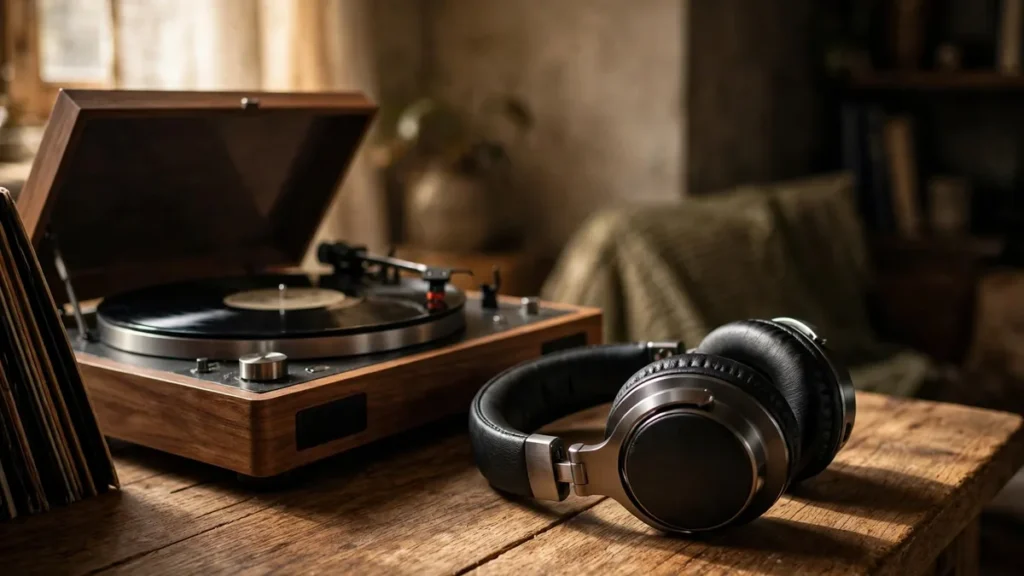
The box arrived on a Tuesday, heavy in a way that felt wrong for something that sits on your head. Inside, under a layer of soft foam, lay a pair of black over-ear headphones with leather cushions, metal yokes and a cable as thick as a bootlace. The little card tucked beside them did not talk about sound at all. It talked about numbers: forty millimetres, thirty-two ohms, eight hertz to forty kilohertz, minus thirty-five decibels. The owner stared at the card, then at the headphones, and realised he had bought a small piece of engineering and had no idea what any of it meant.
That card is the spec sheet, and on a luxury pair of headphones it is not decoration. Every number on it describes a real choice the maker made, and each choice costs money. This guide explains the numbers in plain words, so the next spec sheet you read actually tells you something.

The spec sheet at a glance
| Specification | Typical luxury figure | What it tells you |
|---|---|---|
| Driver size | 40–50 mm dynamic | How much air the speaker can move |
| Impedance | 16–300 ohms | How much power the headphones need |
| Frequency response | 8 Hz – 40 kHz | The range of sounds it can reproduce |
| Sensitivity | 98–110 dB/mW | How loud it gets from a little power |
| Noise cancellation | –30 to –45 dB | How much outside noise is removed |
| Wireless codec | LDAC, aptX HD, AAC | How much detail survives Bluetooth |
| Battery life | 30–60 hours | How long it plays between charges |
| Weight | 250–380 grams | How heavy it feels after an hour |
| Materials | Aluminium, leather, steel | What the earcups and band are made of |
| Connector | 3.5 mm, USB-C, balanced | How it plugs into your music |
Driver size: the engine of the sound
The driver is the small loudspeaker inside each earcup, and its size is usually the first number on the sheet. Most luxury over-ear headphones use a dynamic driver between forty and fifty millimetres across, which is roughly the width of a bottle cap. A larger driver can move more air, which is why big headphones tend to produce deeper, fuller bass without straining. Some makers use a coated paper diaphragm, others use a synthetic film or a metal alloy, and each material colours the sound in its own way. The driver is wound, glued and tuned by hand in the best workshops, a process described in how luxury headphones are made, where the coil, magnet and diaphragm are matched in pairs before they ever reach an earcup.
Impedance and sensitivity: how hard they are to drive
Impedance, measured in ohms, tells you how much electrical resistance the headphones present to whatever is playing the music. A low impedance of sixteen or thirty-two ohms means a phone or laptop can drive them easily, while a high impedance of two hundred and fifty or three hundred ohms means they need a dedicated headphone amplifier to sound their best. Sensitivity, measured in decibels per milliwatt, tells you how loud the headphones get from a given amount of power. A sensitivity of around one hundred decibels per milliwatt is efficient and will play loudly from a phone, while a lower figure needs more power to reach the same volume. Read the two numbers together: low impedance with high sensitivity is the easy, portable combination, while high impedance with lower sensitivity is the demanding, audiophile one. Buying the second kind without an amplifier is like buying a fast car and never leaving first gear.

Frequency response: the range you can hear, and beyond
Frequency response is written as a range, for example eight hertz to forty kilohertz, and it describes the lowest and highest sounds the headphones can reproduce. Human hearing runs roughly from twenty hertz to twenty thousand hertz, so a pair that reaches eight hertz at the bottom and forty kilohertz at the top is covering far more than your ears can use. At the bottom end, a driver that reaches eight hertz can reproduce the deep rumble of an organ or the thump of a kick drum without losing control.
Noise cancellation and wireless codes
Noise cancellation is measured in decibels, and a figure of minus thirty to minus forty-five decibels means the headphones can remove that much steady background noise, like the drone of an aeroplane engine or the hum of a train. The minus sign matters: it is a reduction, not an addition. The clever part is explained in how noise-cancelling headphones work, where tiny microphones sample the noise hundreds of times a second and the processor builds a mirror-image wave to cancel it. Wireless sound quality depends on the codec, the method used to squeeze music through Bluetooth. Standard SBC is the basic option, AAC works well with Apple devices, and LDAC and aptX HD carry far more detail, close to the quality of a wired connection. A luxury pair that supports LDAC but is paired with a phone that does not will quietly fall back to a lesser codec, so the codec number only matters if the rest of your equipment matches it.
Battery, weight and materials
Battery life on a luxury pair usually runs from thirty to sixty hours with noise cancellation switched on, and the difference is mostly down to the size of the battery and the efficiency of the electronics. A bigger battery adds weight, and weight is the number that decides whether you still enjoy the headphones after two hours. Most luxury over-ears sit between two hundred and fifty and three hundred and eighty grams, and the makers spend a surprising amount of effort on how that weight is distributed. A spring-steel headband spreads the load across the top of the head, and memory-foam cushions mould themselves to the shape of the ears, so a heavier pair can feel lighter than a cheap light one. Materials show up on the spec sheet as a short list, usually aluminium, stainless steel and leather, and they are there for a reason. The same idea, applied to a different kind of headphone, is set out in the noise-cancelling headphones spec guide, where the numbers are read in the same way but the priorities are different.

What a luxury pair costs, and a rare fact
A luxury pair of over-ear headphones typically costs an estimated $800 to $3,500, depending on the driver, the materials and whether the noise cancellation is built in. The rare fact is that some of the finest headphone drivers ever made were wound by hand, one at a time, and then matched in pairs by listening, not by measurement. Two drivers from the same production run can measure identically and still sound slightly different, so a technician listens to each one and pairs the two that sound closest. That human step is invisible on the spec sheet, yet it is often the reason one pair costs twice as much as another with the same numbers. Read the sheet, then trust your ears, because the numbers will tell you what the headphones can do, and only listening will tell you whether they do it beautifully.