Watch a wave-piercing yacht meet a swell and something looks wrong, in the best possible way. Instead of climbing the wave and crashing down the other side, the long, sharp bow slides straight through it. The deck stays level, the glasses stay on the table, and the boat seems to ignore the sea altogether while other yachts around it pitch and roll.
That calm is not luck. It comes from a hull shape borrowed from racing boats and warships, a deep, narrow bow that cuts water instead of riding over it, and a set of systems that keep the boat steady, dry and fast even when the weather turns. The yacht is built around that idea, from the sealed foredeck to the stabilisers under the hull.
This is how a luxury wave-piercing yacht works, from the bow that slices the sea to the bridge that keeps it all under control.
How It Works
Step 1: The inverted bow that pierces the wave
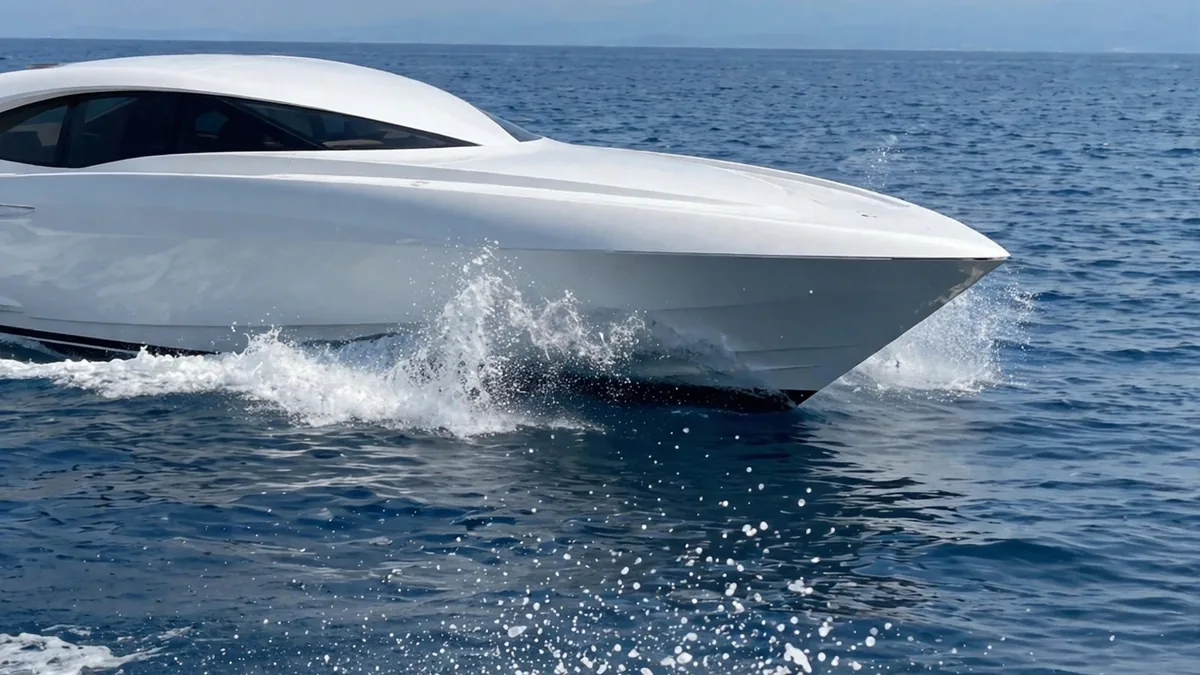
The heart of the yacht is its inverted bow, sometimes called an axe bow. On a normal yacht the bow flares outwards, so it lifts over a wave. On a wave-piercing yacht the bow leans the other way, narrowing towards the waterline, so it slices through the wave instead. The water flows up and around the bow rather than lifting the whole boat.
That single change transforms the ride. Pitching, the fore-and-aft rocking that makes guests seasick, drops sharply, and the boat keeps more of its speed in a head sea because it is not spending energy climbing every swell. The trade-off is a wetter foredeck, which is why the front of the boat is sealed, cambered and fitted with drains, so green water runs off instead of pooling. The luxury wave-piercing yacht build explains how that bow is shaped in carbon, while this guide looks at what it does at sea.
Step 2: The long, narrow hull and its speed
Below the bow, the hull is long and narrow for its length, with fine, sharp sections forward that open out into a fuller stern. The narrow entry keeps resistance low, and the fuller stern gives the boat the volume it needs for cabins, tanks and engines. It is a shape that rewards steady speed rather than short bursts.
At cruising speed the hull runs with very little bow wave, which is why the yacht looks so calm from the shore. The engines do not have to fight the wave the boat itself is making, so fuel burn stays lower than on a conventional yacht of the same size, and the range stretches further on the same tanks.
Step 3: Engines, shafts and propellers
Power comes from two large diesel engines, usually mounted low and amidships to keep the centre of gravity down. They drive the propellers through shafts or, on newer boats, through pods that can swivel, which gives the captain far finer control at low speed in a marina.
The propellers are large, slow-turning and carefully matched to the hull, because a propeller that cavitates, or boils the water around its blades, wastes power and shakes the boat. Engineers test the propeller in a tank before it is fitted, checking that it stays quiet and efficient across the whole speed range, from a slow harbour crawl to full cruising speed.
Step 4: Stabilisers that keep the deck level
Even a hull that pierces waves will roll in a beam sea, so the yacht carries stabilisers: fins under the hull that move constantly, driven by hydraulic rams, to counter each roll as it starts. Sensors measure the roll many times a second, and a computer decides how far each fin should move.
At anchor, a different system takes over. Gyroscopic stabilisers, heavy spinning wheels mounted deep in the hull, resist rolling without needing forward speed, so guests can sleep soundly on a still night in a rolling anchorage. Together, the fins and the gyro make the deck feel more like a hotel terrace than a boat. The luxury expedition yacht uses a similar pair of systems, though its heavier hull needs larger fins to get the same calm.
Step 5: The bridge, navigation and control
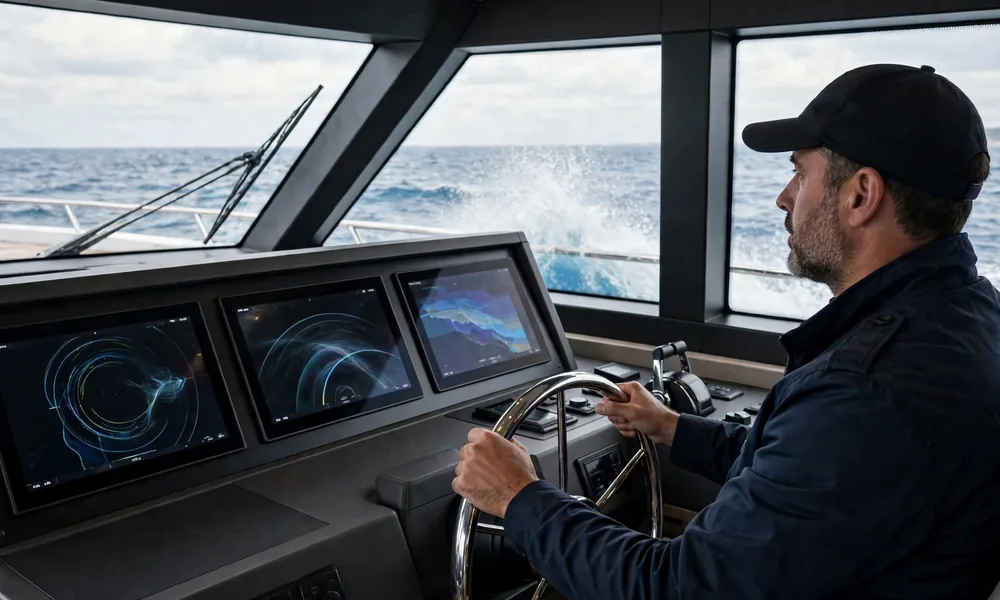
From the bridge, the captain sees the whole boat at a glance. Radar, charts, engine data and stabiliser status sit on a row of screens, and the steering can be done by wheel, by joystick, or by a dynamic positioning system that holds the yacht over one spot using its thrusters, even in wind and current.
The bridge is also where the wave-piercing shape is used best. Because the bow does not lift, the captain can hold a steady course and speed through a swell without constantly adjusting the throttles, which makes long passages less tiring for the crew and far more comfortable for the guests below.
Step 6: Living aboard in heavy weather
Below decks, the yacht is designed around the same calm. Cabins sit near the centre of the boat, where motion is smallest, and heavy furniture is bolted down so nothing shifts when the sea builds. The galley is fitted with rails and fiddles, the small raised edges that stop plates sliding off the counter.
Water and fuel are carried in tanks low in the hull, and their baffles stop the liquid sloshing from side to side, which would otherwise make the boat roll more. Even the air conditioning is part of the system, keeping the cabins dry and cool when the hatches are sealed against spray. A luxury catamaran yacht solves the same comfort problem a different way, with two hulls for stability, but the wave-piercing yacht does it with a single sharp hull and clever systems.
What it is made of
The table below sums up the systems that matter most in a luxury wave-piercing yacht, from the bow to the bridge.
| System | How it works |
|---|---|
| Bow | Inverted axe bow, slices through waves |
| Hull | Long, narrow, carbon or aluminium |
| Engines | Twin diesels, 2,000 to 4,000 horsepower |
| Propulsion | Shafts or pods, large slow propellers |
| Stabilisers | Fins under way, gyro at anchor |
| Bridge | Radar, charts, joystick and positioning |
| Cruising speed | 18 to 24 knots, 3,000 nautical miles range |
How much does one cost?
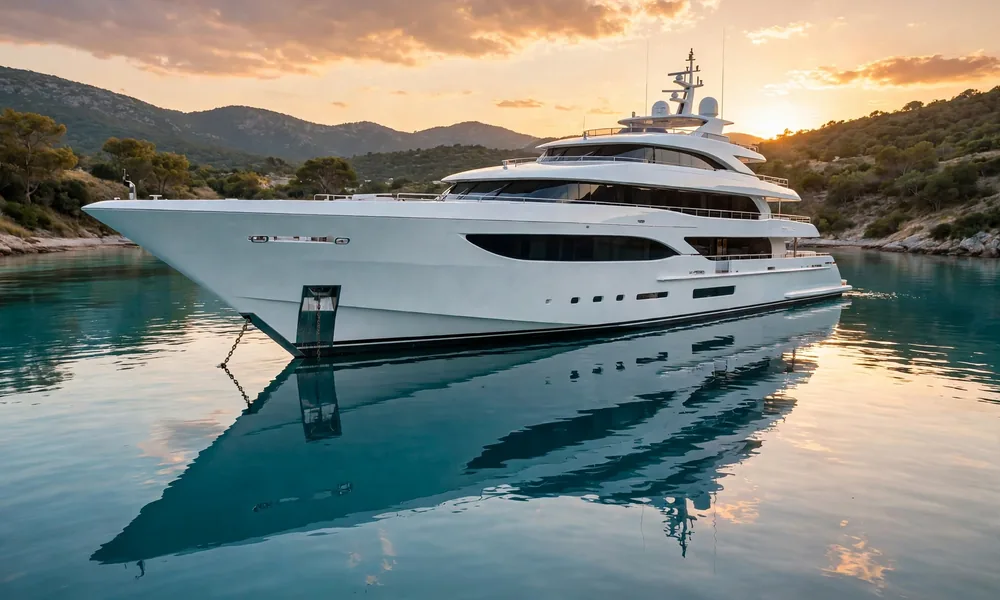
A luxury wave-piercing yacht is priced like a small superyacht, and the bow is a large part of why: the carbon structure, the tank testing and the sealed foredeck all cost far more than a conventional hull. As an estimate, a new 30-metre example costs roughly 15 to 30 million dollars, with the hull, engines and bespoke interior accounting for much of that figure.
Running costs are steep too. The carbon hull needs regular inspection, the foredeck seals must be maintained on a strict schedule, and a specialist crew is needed to drive the boat well in heavy weather. Owners accept that because nothing else crosses an ocean swell with the deck so level and the guests so calm.
A rare fact
Here is something few people know: the inverted bow was first drawn for warships, not yachts, and early naval architects called it the axe bow because it chops through a wave the way an axe splits wood. The first yachts to borrow it were racing boats, whose crews discovered that a bow that pierces a wave is faster than one that climbs it, because climbing wastes energy lifting the whole boat with every swell.
The result is a yacht that seems to break the rules of the sea. Sailing one takes a crew that understands the shape, but the payoff is a boat that arrives calmer, drier and faster than anything with a conventional nose.


