A yacht bar looks like a quiet corner for a drink at sunset, a curved counter, a row of bottles catching the light, and glasses that never seem to slide. On a boat that rolls with every wave, that calm is engineered, not luck, and every part of the bar is built to hold its place while the sea moves underneath it.
Making one is a joiner’s puzzle as much as a bartender’s. The counter must curve around the room without wasting space, the bottles must be reachable but never free to fall, and the whole room must survive salt air, spilled drinks and a deck that is never quite level. This is how a luxury yacht bar is made, from the curved counter to the last polished glass.

How It’s Made
Step 1: The counter is curved and braced
The bar starts with its counter, a long curve of timber or stone that is shaped in the workshop before it ever reaches the boat. The curve is drawn to fit the room exactly, so guests can stand along it without crowding, and the bartender can reach every bottle from one spot behind it.
Under the counter sits a steel frame bolted to the deck, because a heavy stone top on a rolling yacht needs more than glue and screws. The frame is levelled with shims and checked against the hull, so the counter stays true even when the yacht heels, and a small raised lip runs along the front edge to stop a glass sliding off.
Step 2: The bottle racks are built to grip
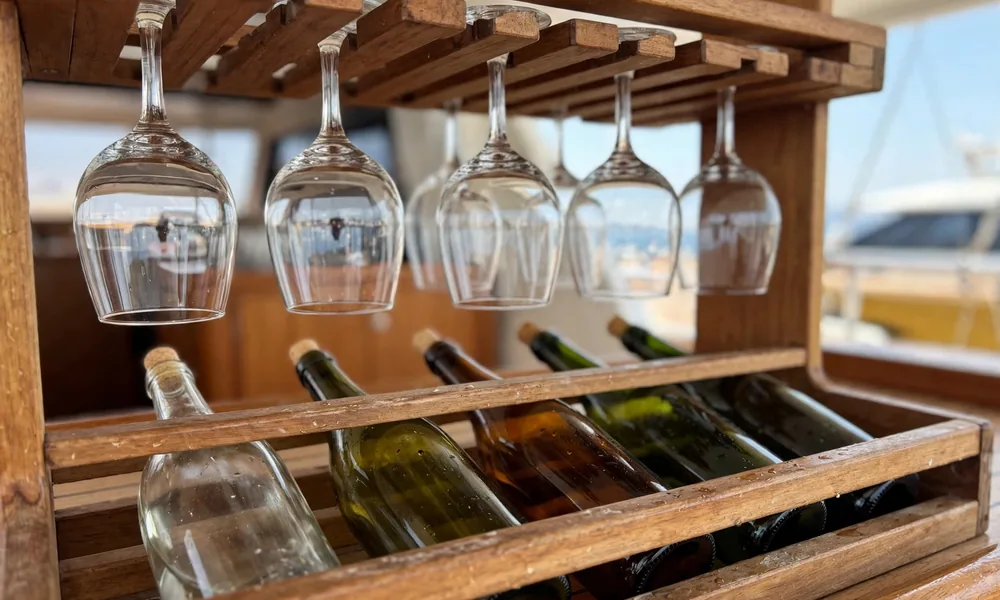
Behind the counter, the bottles live in racks that grip them like hands. Each shelf is lined with a soft, non-slip material, and a low rail runs across the front of every row, tall enough to catch a bottle that tips, but low enough for the bartender to lift one out in a single motion.
The racks are built in sections that can be lifted out for cleaning, and the shelves are tilted very slightly towards the back, so a bottle always settles against the wall rather than drifting towards the edge.
Step 3: The glass racks hang above
Above the counter, the glasses hang upside down from slotted wooden racks, their stems slid into narrow grooves that hold them firmly. Hanging the glasses keeps the counter clear, and it keeps them safe, because a glass in a rack cannot slide, tip or clink against its neighbour when the yacht rolls.
Each rack is cut for a different glass, tall stems for wine, short ones for tumblers, and the wood is sanded smooth so no stem catches or chips. The racks are fixed to a beam that is bolted through the ceiling into the deck above, and they are tested by rocking the yacht at the dock, with every glass in place, before the bar is signed off.
Step 4: The chillers and ice are fitted
The cold side of the bar hides below the counter, where small chillers keep wine and mixers at the right temperature without humming through the room. The chillers are marine units, built to run at an angle, with compressors mounted on rubber feet so their vibration never reaches the counter above.
Ice is made in a small machine tucked beside the chillers, and it drops into an insulated bin lined with stainless steel, where it stays cold for hours. The bin drains to the yacht’s grey water system, and a scoop hangs on a hook beside it, because a bartender who has to hunt for a scoop is a bartender who spills.
Step 5: The sinks and drains are plumbed
Every yacht bar needs a small sink, and plumbing one on a moving boat takes care. The sink is shallow and set into the counter, with a tap that folds flat when it is not in use, so nothing sticks up to catch an elbow or a sleeve as the bartender works.
The drain runs downhill to a holding tank, with a trap that stops smells coming back up, and the pipes are clipped firmly to the frame, because a loose pipe on a rolling yacht will rattle, leak and eventually crack.
Step 6: The bar is dressed and tested
The last step is dressing the bar, and it is done with the yacht at the dock, rocking gently in its berth. The counter is polished, the bottles are set in their racks, the glasses are hung, and a bartender pours a round of drinks while the boat moves, checking that nothing slides, rattles or tips.
Any glass that chatters in its rack gets a thicker groove, any bottle that creeps forward gets a taller rail, and any counter that hums with the chillers gets another rubber mount. Only when a full round can be poured and served without a single spill does the bar pass, ready for a sunset, a celebration and a sea that never sits still.
| Spec | Detail |
|---|---|
| Counter | Curved timber or stone top on a steel frame bolted to the deck |
| Bottle racks | Non-slip shelves with low rails, tilted slightly to the back |
| Glass racks | Slotted wooden racks holding glasses upside down by the stem |
| Chillers | Marine units on rubber feet, quiet and built to run at an angle |
| Ice | Small ice maker dropping into an insulated stainless steel bin |
| Sink | Shallow sink with a folding tap, drained to a holding tank |
The hardest part of a luxury yacht bar is the balance between grip and grace. The racks and rails must hold everything firmly, yet the bar must still look open and welcoming, and a rail that is too tall or a rack that is too tight makes the whole room feel like a cupboard.
What One Costs
A luxury yacht bar typically costs an estimated $40,000 to $150,000, set mostly by the stone or timber of the counter, the quality of the joinery and the chillers hidden below. A simple bar with a timber top and modest racks sits near the bottom, while a long curved bar in rare stone, with custom racks and silent marine chillers, costs far more. The price of the room itself is a different question, and why a luxury yacht bar costs so much explains how the joinery and the fittings push the bill up, while how a luxury yacht wine cellar works covers the chilled room where the best bottles are kept before they reach the bar.
A Rare Fact
Some luxury yacht bars are fitted with a hidden drawer under the counter that holds a bartender’s notebook, a small book in which the crew record each guest’s favourite drink, so that on the next voyage the first glass is poured exactly as they like it, before they even ask.

A luxury yacht bar is built to stand still while the sea moves: a curved counter on a steel frame, bottle racks that grip, glasses hung safely above, quiet chillers and ice below, and a sink that drains without a fuss. It is a small room with a large job, keeping every drink steady. The same careful joinery runs through the rest of the yacht, and how a luxury yacht galley is made shows how the kitchen beside it is built to the same unforgiving standard.