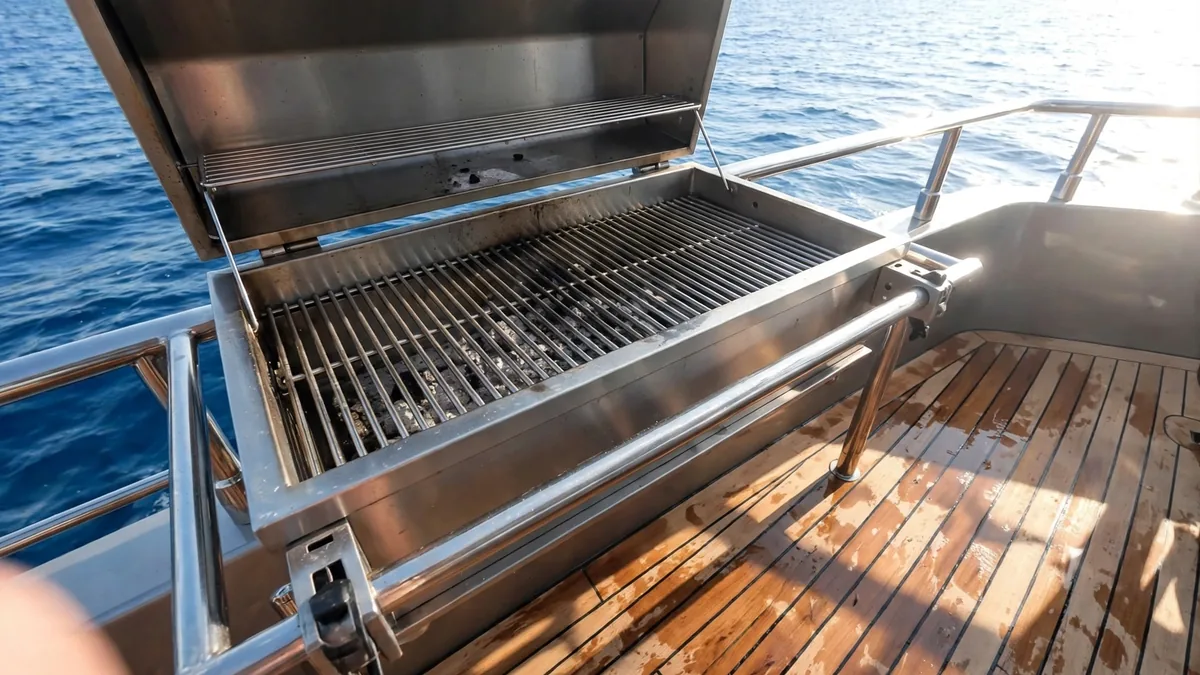
At dusk on a calm anchorage, the smell of charcoal drifts across the water, and a small crowd gathers on the aft deck around a stainless steel grill glowing gently in the last of the light. The chef lifts the lid, turns the skewers once, and the whole evening settles into place. It is the simplest kind of cooking, fire and food, but the grill doing the work was built to survive a place where most grills would rust away in a single season.
A luxury yacht BBQ grill is an outdoor grill built for the deck of a yacht, usually running on gas or charcoal, made from marine-grade stainless steel, and mounted so it stays put when the boat rolls. It is made by shaping a firebox that takes fierce heat, fitting burners and grates that spread it evenly, and mounting the unit so the crew can swing it inboard for cleaning. Every part has to resist salt spray, drain properly, and never drop a hot coal onto a teak deck.
How It’s Made
Step 1: Choosing the marine-grade steel
The grill starts as a sheet of 316 marine-grade stainless steel, the alloy that boatbuilders reach for whenever metal has to live in salt air. Ordinary stainless steel pits and stains at sea, but 316 contains molybdenum, which helps it resist the chlorides in salt spray. The maker orders the sheet thick enough to hold heat without warping, around two to three millimetres for the firebox, and checks every sheet for scratches before cutting, since a scratch is where corrosion starts.
Step 2: Cutting and shaping the firebox
The firebox is the heart of the grill, a shallow steel box that holds the fire and shapes the heat. The maker cuts the panels on a press brake, folding the edges so there are no sharp corners for a cook to catch a hand on, and welds the seams with the same filler metal as the sheet, so the welds corrode at the same slow rate as the rest. A drain hole in the lowest corner and a small channel guide grease and rainwater away from the fire into a drip tray. The yacht teppanyaki grill nearby works on a flat hot plate instead of an open fire, and the difference starts here: a BBQ firebox is built to breathe, with air vents that feed the flames from below.
Step 3: Fitting the burners and the gas system
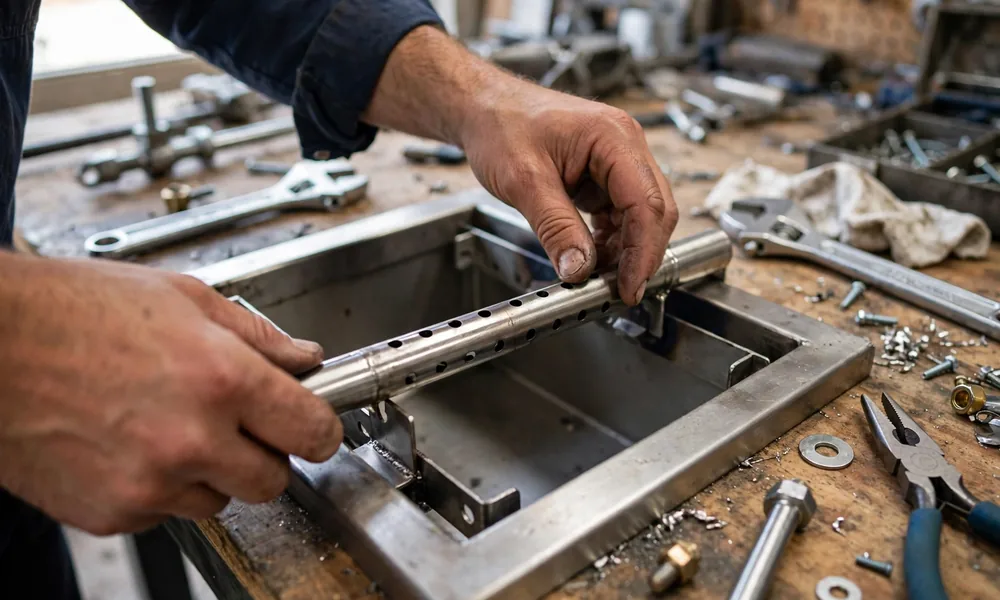
On a gas model, the burners are the next part in, usually two or three U-shaped stainless steel tubes drilled with a row of small flame holes. Each burner sits above a heat shield, a shaped plate that stops dripping fat from hitting the flame and flaring up, and the burners are spaced so heat covers the whole grate without hot spots. The gas valve, igniter, and hose sit in a sealed compartment behind the firebox, away from the heat, and the hose is a marine-rated line with brass fittings that swap without tools. Every joint is soapy-water tested before the grill leaves the workshop.
Step 4: Making the grates and the heat spreaders
The cooking grate is where the food meets the fire, and it is made from thick stainless steel rods, welded into a frame that lifts out in one piece for cleaning. The rods are spaced so a prawn cannot slip through, yet far enough apart for heat to rise between them and mark the food with the dark lines guests expect. Under the grate, angled heat spreaders, sometimes called flavour bars, catch drips, turn them into a little smoke, and even out the temperature across the cooking surface. The maker tests the grate at full heat, probing a dozen places for cold corners.
Step 5: Building the lid and the temperature gauge
The lid turns the grill into an oven, trapping heat and smoke so a thick steak cooks through instead of burning outside and staying raw inside. It is rolled from the same 316 steel, double-skinned so the outside stays cool to the touch, and hinged with a counterbalance spring that holds it open at any angle, even when the boat rolls. A dial thermometer in the front reads the firebox temperature, and a heat-resistant handle stays cool enough to lift bare-handed. The lid is also the grill’s weather cover when the boat is under way, clamping shut so rain and spray stay out.
Step 6: Mounting it on the rail and the first cook
A yacht grill is rarely free-standing, because a free-standing grill would walk across the deck in a swell. Instead it is mounted on a rail bracket or a pedestal, clamped to the pushpit rail at the stern, where the smoke blows away from the guests and the cook can work facing the sea. The bracket swings: the crew pulls a pin and turns the grill inboard for loading and cleaning, then swings it back out over the water to cook. The yacht pizza oven on the same deck is fixed in place by comparison, and the grill’s swing mount is what lets a small yacht have a big barbecue without giving up deck space. Then comes the test: the grill is lit, run to full heat, and cooked on for an afternoon while the maker checks the mount, the lid hinge, and the drain.
A yacht BBQ grill earns its place by being ready in minutes and forgotten the rest of the time. It lives outside in salt and sun, lights on the first click, and turns a quiet evening at anchor into the meal everyone remembers. The yacht galley below decks does the careful cooking, and the grill does the joyful kind: smoke, fire, and dinner with the sea all around.
Yacht BBQ Grill Specifications
| Feature | Typical Detail |
|---|---|
| Firebox | 316 marine-grade stainless steel, around 2 to 3 millimetres thick |
| Burners | Two or three U-shaped stainless steel tube burners |
| Cooking grate | Thick stainless steel rods, lifts out in one piece for cleaning |
| Heat spreaders | Angled steel bars that catch drips and even out the heat |
| Lid | Double-skinned steel, counterbalanced hinge, dial thermometer |
| Mount | Rail bracket or pedestal, swings inboard for cleaning |
| Drainage | Drip tray and drain channel guiding grease away |
How Much Does a Yacht BBQ Grill Cost?
Prices are estimates and vary with size, fuel type and maker. A luxury yacht BBQ grill typically costs an estimated $3,500 to $18,000, with large gas models with a rotisserie and side burner at the top and compact charcoal models lower. A rail mount, cover, and marine tools can add an estimated $500 to $2,000. It sounds like a lot for a grill, but a cheap one rusts, warps, and drops grease on the deck within a season.
A Rare Fact About Yacht BBQ Grills
Here is a detail most guests never notice: the grease from a yacht BBQ grill never goes overboard. The drip tray drains into the yacht’s grey-water tank, because dumping fat and ash into the sea is banned under international pollution rules, and one barbecue can produce enough grease to leave a slick across an anchorage. The grill is built for that rule, with a sealed tray the crew empties into the tank after every cook, so the sea stays clean for the next swim. It is the least glamorous part of the grill, and one of the most important.

The best yacht barbecues are the ones where nobody talks about the grill at all. The food is hot, the smoke smells wonderful, and the only sound is the sizzle of the grate. Dinner is on the deck, and the grill has done its job before dark.


