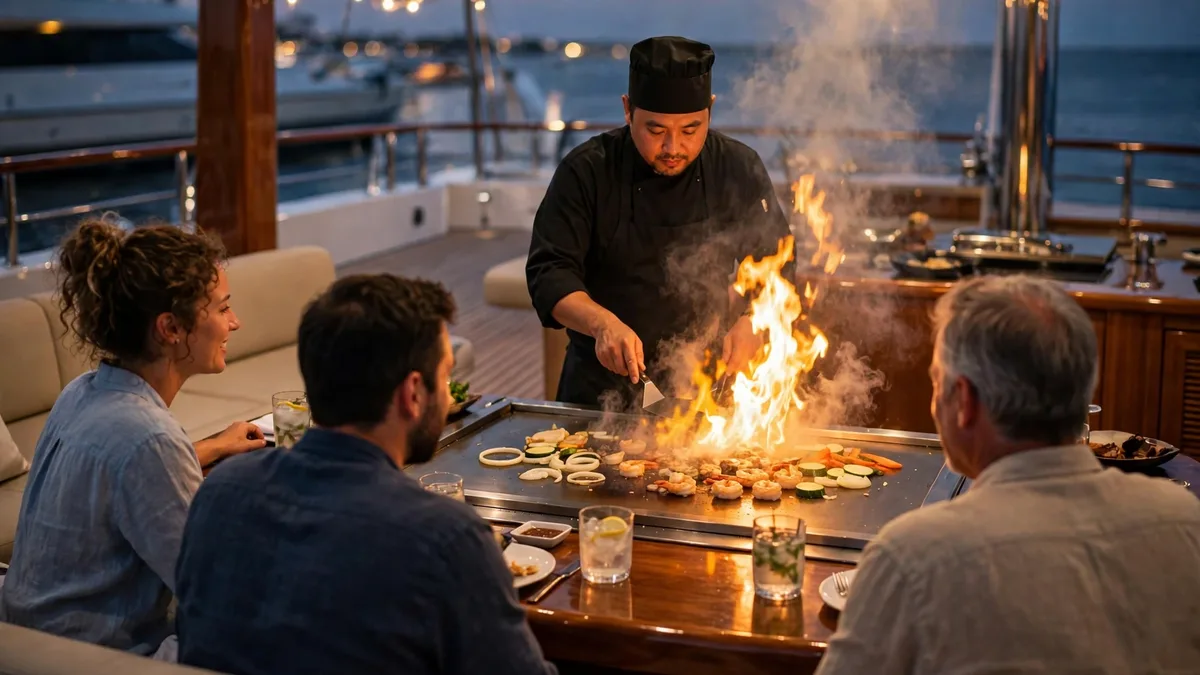
On the aft deck of a yacht at dusk, a chef stands behind a flat steel plate that glows with heat, a spatula in each hand and a row of guests watching from their seats. He tosses a piece of prawn into the air, catches it on the plate, and it sizzles as it lands, while a plume of steam rises into the evening air and the smell of garlic and soy drifts across the deck. The guests lean in, glasses in hand, as the chef cooks their dinner in front of them, one piece at a time.
A yacht teppanyaki grill is a flat steel hotplate, heated from below, on which a chef cooks meat, fish and vegetables in front of seated guests, and it has to work outdoors, on a moving boat, in the wind, while keeping its plate at a steady, searing heat. This is how it works, from the lighting of the plate to the last piece of the evening.
How It Works
The steel plate stores the heat
The heart of the grill is its plate, a thick slab of steel, often more than a centimetre thick, that sits on a frame and is heated from below until its surface is hot enough to sear meat in seconds. The plate stores heat the way a stone stores heat in a pizza oven, so that when a cold piece of fish lands on it, the plate does not cool down, and the fish sears instead of steaming. A teppanyaki plate that is too thin cools when the food lands on it, and one that is too thick takes an hour to heat, so the thickness is chosen with care, and the chef learns his own plate’s temper the way a sailor learns his boat.
The burners: gas or electric heat below the plate
The heat comes from below the plate, from gas burners or electric elements, and each has its own character aboard a yacht. Electric elements are simpler and safer, with no flame and no fumes, and they are the ones most yachts choose for a deck grill, because a flame on an open deck in the wind is a risk that needs watching. Whichever heat the grill uses, it is divided into zones, so one end of the plate can be kept fiercely hot for searing while the other end is kept cooler for keeping food warm, and the chef moves the food between the zones as it cooks. The galley that prepares all the food for the grill is a small, hard-working room, and the way a yacht galley really runs is what a luxury yacht galley at work shows.
Ventilation carries the smoke and steam away
A teppanyaki grill makes a great deal of smoke and steam, and on a yacht deck that smoke has to go somewhere, or the guests will be sitting in it. Above the plate, a hood or an open-air canopy draws the smoke up and away, and on a deck grill the wind itself does much of the work, carrying the steam out to sea. The hood is fitted with a fan and a grease filter, which is cleaned after every service, because a filter clogged with grease is a fire risk, and the fan is checked before every evening, because a fan that fails mid-service leaves the guests in a cloud. Ventilation is the part of a teppanyaki grill that guests never notice when it works and always notice when it does not, and the best deck grills are the ones where the smoke rises and disappears, and the guests smell the food, not the fire.
The show: spatulas, tossing and timing
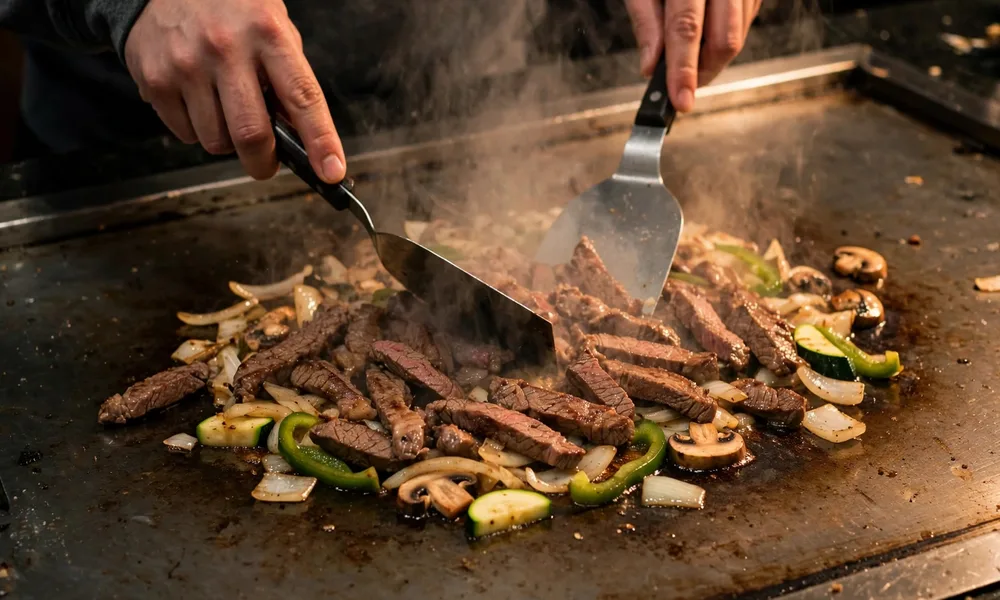
The cooking itself is a performance, and the chef’s tools are few: two spatulas, a knife, a small fork, and a squeeze bottle of oil. He cooks in front of the guests, slicing meat and vegetables on the plate, tossing pieces into the air and catching them, and building a small onion volcano that flames for a moment before he flattens it and serves it. The guests sit close, close enough to feel the heat and to talk to the chef, and the chef watches them as he cooks, judging how hungry they are and how fast to go. The great kitchens of a cruise ship run their grills on the same rhythm, on a far larger scale, and the way one of those kitchens works is what a cruise ship galley at work shows.
Cleaning, cooling and the end of the evening
When the last course is served, the grill is left to cool with its burners off, and the crew scrape the plate clean with a spatula, wiping it with oil and a cloth until it shines. The grease filter is removed and cleaned, the gas is shut off at its valve, and the grill is covered against the night air, so the salt does not settle on the steel. The next morning, the plate is wiped again, the burners are checked, and the food for the evening is prepared in the galley, because a teppanyaki grill aboard a yacht is only as good as its last cleaning. The wine that guests drink with their meal is kept in its own cold store nearby, and the way a yacht keeps its bottles is what a yacht wine cellar at work describes.
| Specification | Typical machine |
|---|---|
| Role aboard | Flat steel hotplate on which a chef cooks meat, fish and vegetables in front of seated guests |
| Steel plate | Thick steel slab, often more than a centimetre thick, that stores heat and sears in seconds |
| Heat source | Gas burners or electric elements below the plate, with most yachts choosing electric on deck |
| Heat zones | Plate divided into zones, fiercely hot for searing at one end, cooler for keeping food warm |
| Ventilation | Hood with fan and grease filter, plus the open air, carrying smoke and steam away |
| Tools | Two spatulas, a knife, a small fork and a squeeze bottle of oil |
| Safety | Gas shut-off valve beside the chef’s station, grease filter cleaned after every service |
| Cleaning | Plate scraped and wiped with oil, never washed hot with water or scrubbed with soap |
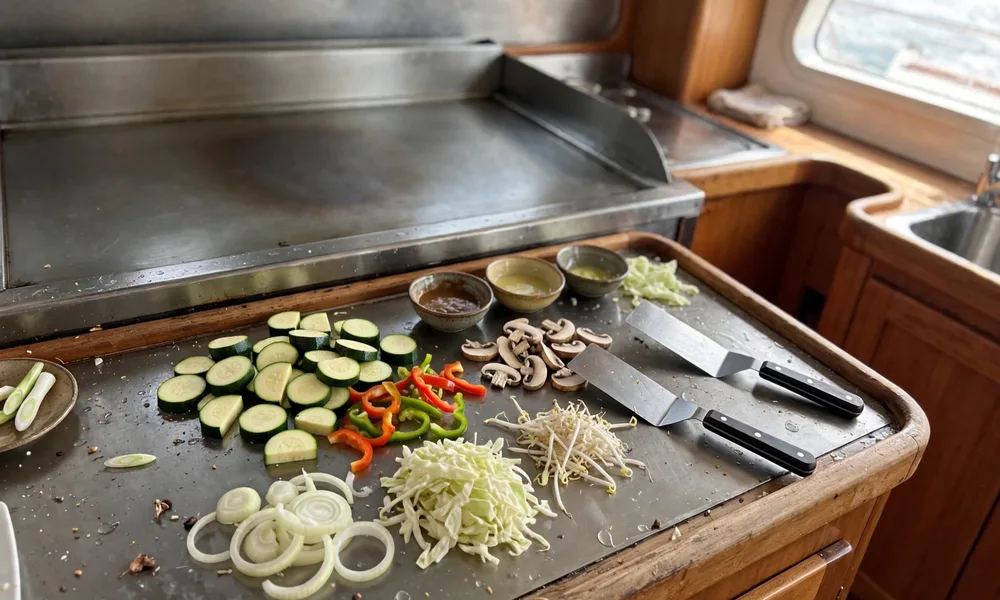
A luxury yacht teppanyaki grill costs an estimate of $25,000 to $90,000, depending on the size of the plate, whether it is gas or electric, and how much of the work is bespoke. The price covers the plate and its frame, the burners or elements, the hood and ventilation, and the seating around it, but not the food itself, which is bought fresh for every trip and is often the most expensive meal aboard. A spare set of spatulas and a spare grease filter travel with the grill, because a deck service cannot wait for a part to arrive by tender.
Here is a rare fact worth knowing. Teppanyaki was invented in Japan after the Second World War, when a restaurant owner in Kobe noticed that foreign visitors were fascinated by watching their food cooked in front of them, and he built a restaurant around a flat steel plate so they could watch. The word itself means grilled on an iron plate, and the show that grew up around it, the tossing, the onion volcano, the flaming shrimp, was invented for those visitors, not for Japanese diners at home.


