Nothing smells better on a yacht at sunset than a pizza coming out of a wood-fired oven. The dome glows, the cheese bubbles, and the whole deck gathers round. It looks like a simple clay dome on a steel table, but inside that dome is a stack of firebrick, insulation, and steel that has to hold hundreds of degrees without scorching the deck or tipping over in a swell.
A luxury yacht pizza oven is a compact wood-fired or gas-fired dome oven fitted into a yacht’s outdoor kitchen, built from a firebrick floor, an insulated dome, and a stainless steel shell. It is made by laying the firebrick base, shaping the dome so heat circles back down onto the pizza, and venting the smoke safely above the deck. The oven has to be light enough for a yacht, hot enough to cook a pizza in ninety seconds, and safe enough to run while guests stand a metre away.

How It’s Made
Step 1: Finding a safe spot on deck
The oven always starts with the deck plan. A pizza oven is heavy, hot, and smoky, so it needs a spot downwind of the seating area, close to the outdoor kitchen, and above a part of the deck that can carry the weight. The designers check the structure below, plan a route for the flue, and make sure the oven sits where a gust cannot blow smoke into the saloon. On most yachts the oven lives in a corner of the aft deck or the flybridge kitchen, where the cook can work and the guests can watch without standing in the heat.
Step 2: Building the base and firebrick floor
The base is a stainless steel table or a masonry plinth, bolted to the deck, with a layer of insulation board on top. On the insulation goes the firebrick floor, laid piece by piece in a bed of heat-proof mortar, with the joints kept tight so the floor is smooth enough for a peel to slide across it. The floor is the heart of the oven: it stores heat from the fire and cooks the pizza from below, so it has to be thick, flat, and free of cracks. A floor laid badly will crack in the first season, and a cracked floor tears every pizza that slides over it.
Step 3: Shaping the dome
The dome is what makes a pizza oven different from a barbecue. It is built from firebrick or cast refractory concrete, shaped in a low curve so the heat from the fire rolls up the dome and back down onto the top of the pizza. The mouth of the oven is kept small, just wide enough for a peel, so the heat stays inside. The yacht galley below deck does the heavy cooking, but the dome oven is the showpiece, and its shape is the reason a pizza cooks in ninety seconds instead of ten minutes. A dome built too tall loses its heat; one built too low burns the topping.

Step 4: Insulating and cladding the shell
Outside the dome goes a thick blanket of ceramic insulation, then a shell of stainless steel or a rendered finish that matches the yacht. The insulation is the safety layer: it keeps the outside of the oven cool enough to touch while the inside runs at over 400 degrees Celsius. The shell is sealed against rain and salt spray, and the whole oven is bolted down so it cannot shift in a swell. A well-insulated oven also uses less wood, because the heat stays inside the dome instead of leaking out through the walls.
Step 5: Fitting the flue and the fuel
Smoke has to go somewhere, and on a yacht it has to go up and away. A stainless steel flue runs from the top of the dome to above the deckhead, fitted with a rain cap and a spark arrestor so embers cannot escape onto the teak. Wood-fired ovens burn small, dry hardwood, stored in a locker beside the oven, while gas-fired ovens use a burner under the floor fed from the yacht’s gas system, with a flame-failure cut-off for safety. The flue is tested with a smoke pellet before the oven is ever lit, to prove the smoke rises instead of drifting back over the guests.
Step 6: Firing, curing and the first pizza
A new oven is never lit at full heat on day one. The yard cures it with a series of small fires over several days, letting the mortar dry slowly so it does not crack. Then the chef builds a full fire, watches the floor temperature climb, and slides in the first pizza. The base should crisp in under two minutes, the cheese should bubble, and the crust should puff at the edges. The yacht bar nearby keeps the drinks cold while the oven runs hot, and by the second pizza the crew knows exactly how much wood the oven wants and how long each pizza takes.
A yacht pizza oven turns a quiet evening into a small event. Guests choose their toppings, the chef slides the pizzas in one by one, and the deck smells of wood smoke and baking dough. Brushed out after every use and covered when the yacht is under way, the oven is ready for the next anchorage and the next hungry crew.
Yacht Pizza Oven Specifications
| Feature | Typical Detail |
|---|---|
| Oven type | Wood-fired dome or gas-fired dome, deck-mounted |
| Floor | Firebrick on insulation board, heat-proof mortar joints |
| Dome | Firebrick or cast refractory concrete, low curved profile |
| Cooking temperature | Around 400 to 450 degrees Celsius at the floor |
| Cooking time | About 60 to 90 seconds per pizza |
| Shell | Stainless steel or rendered finish, ceramic insulation inside |
| Flue | Stainless steel with rain cap and spark arrestor |
How Much Does a Yacht Pizza Oven Cost?
Prices are estimates and vary with yacht size, materials and yard. A compact deck pizza oven fitted into a yacht outdoor kitchen typically costs an estimated $15,000 to $45,000, including the oven, insulation, flue and installation. A large hand-built dome oven with a stone surround and a dedicated prep counter can run an estimated $50,000 to $80,000 or more. Wood is cheap and the oven lasts for years, so the real cost is the space on deck, which on a yacht is always the dearest thing of all.
A Rare Fact About Yacht Pizza Ovens
Here is a detail most guests never notice: the pizza is cooked mostly by the floor, not the fire. The firebrick floor stores heat from the fire and passes it straight into the base of the pizza, which is why the base goes crisp while the topping stays soft. The smart oven specs measures heat from above, but a dome oven works the other way round, and a chef who slides a pizza onto a cold floor will serve a soggy base no matter how hot the flames look. That is why the first pizza of the night is always a test: it tells the chef whether the floor is ready, and the floor is never rushed.
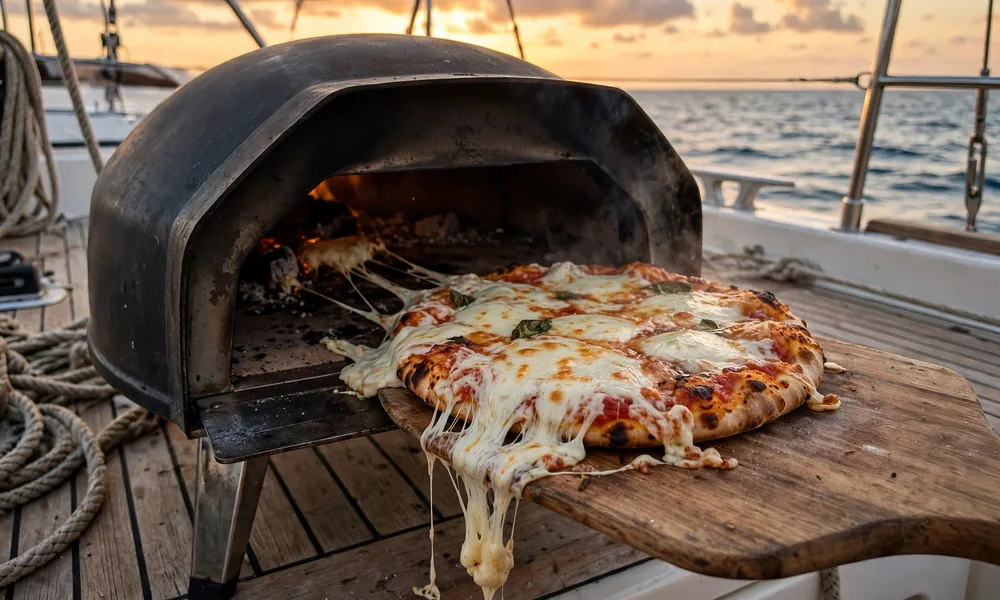
The best yacht pizza ovens are the ones that earn their deck space. They cook fast, they clean up with a brush, and they give the crew a reason to gather on deck instead of eating below. A dome that glows at sunset is not just an oven; it is the evening’s entertainment, with dinner attached.


