The bridge of a superyacht is the one room where luxury gives way to work. Everywhere else on the yacht is built for comfort, but the bridge is built for seeing, deciding and steering, and it shows. The room is mostly glass, the console is covered in screens, and the captain sits in the middle of it all with a wheel that looks old-fashioned and instruments that are anything but.
Building that room takes a different kind of craftsman from the rest of the yacht. The glass has to be thick enough to take a wave, the consoles have to hold their screens steady in a swell, This is how a luxury yacht bridge is made, from a bare steel deckhouse to the room that steers the ship.

How It’s Made
Step 1: The glasshouse is framed
Every bridge starts as a steel deckhouse, a box on top of the yacht with its front and sides left open for the glass. The builders weld the frame from steel plate, then check it for square, because a frame that is even slightly twisted will make the glass bind in its seals and leak in the first storm.
Inside the frame they build the floor, raised on a platform so the captain sits high enough to see over the bow. Cable trays are laid under the floor before anything else goes in, wide steel channels that will carry hundreds of wires from the consoles to the rest of the ship,
Step 2: The glass is cut and laminated
The glass is the most expensive part of the room, and it is cut to order. Each pane is fifteen to twenty-five millimetres thick, made of layers of glass bonded together with a clear plastic sheet, so a wave strike or a flying object cracks the outer layer without shattering the pane into the room.
Setting the glass is a slow job. The panes are lifted by suction cups, eased into rubber seals in the frame, and clamped in place with steel beads that are bolted down a little at a time, so the pressure is even all round.
Step 3: The consoles are built and fitted
With the glass in, the joiners build the consoles, long low desks that run across the front of the bridge and hold the screens, dials and switches. The consoles are built in the workshop from marine plywood and leather, then carried up in sections and bolted to the floor, because a finished console is too wide to fit through the bridge door.
The top of each console is cut with openings for the screens, and the screens are set into them on shock mounts, rubber feet that absorb the vibration of the engines and the slam of the hull in a chop.
Step 4: The instruments are wired in
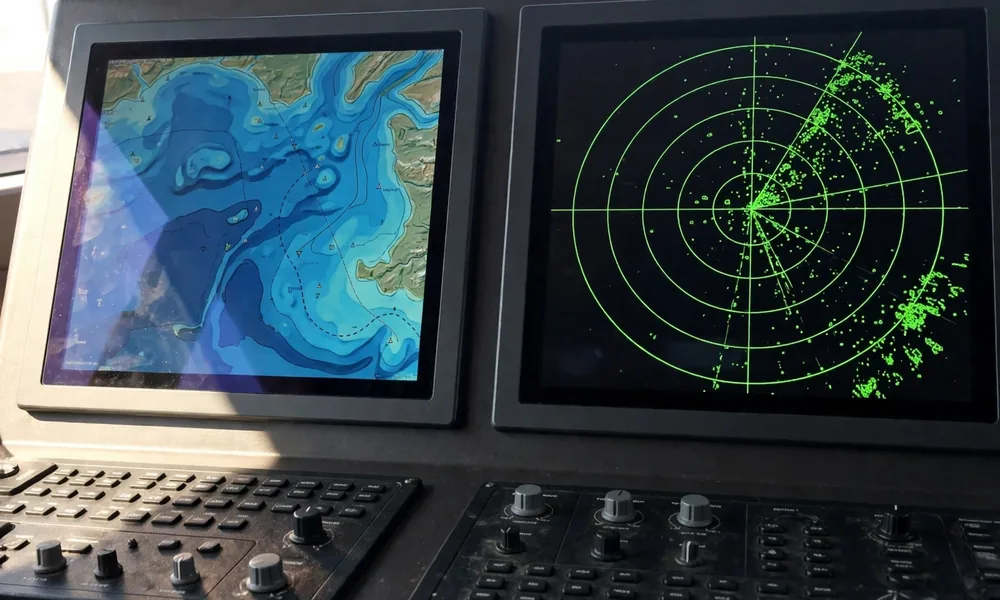
Behind the consoles, the electricians take over. Radar, chart plotters, engine displays, radios and the autopilot are wired into the cable trays under the floor, each system on its own circuit with its own breaker, so a fault in the radio cannot kill the radar.
Every instrument is powered twice, from the main generators and from a battery bank that takes over in seconds if the power fails. The builders test each circuit with the engines running and the radar turning, checking that no instrument interferes with its neighbour.
Step 5: The helm and wing stations go in
The helm is the heart of the bridge, and it is fitted last among the big pieces. A wooden wheel, often teak or mahogany, is mounted on a pedestal in the centre of the main console, connected to the steering gear below by hydraulic lines or by wire. The wheel is balanced so it turns smoothly with one hand, and a small display beside it shows the rudder angle, so the captain can see exactly where the rudder is pointing without looking down.
On either side of the bridge, wing stations are fitted, small duplicate controls set into the wings that stick out over the water. From a wing station the captain can see the side of the yacht while docking, steering with a small joystick instead of the wheel, and the builders test them by bringing the yacht alongside a dock, checking that the captain can see the quay from both sides.
Step 6: The bridge is tested at sea
The last step is a sea trial, and it is the longest test on the yacht. The captain takes the ship out and runs through every instrument, checking the radar against ships on the horizon, the charts against the coastline, and the autopilot against a compass course held for hours. The glass is watched in a head sea, the consoles are listened to for rattles, and the bridge is checked for leaks after a night of rain.
Then the bridge is handed over, with its manuals, its spare fuses and its charts, and the captain signs for a room that will be his office for years. A bridge that passes its sea trial is a quiet room, with clear glass, steady screens and a wheel that answers the hand, and it stays quiet even when the weather does not.
| Spec | Detail |
|---|---|
| Glass | Laminated panes, 15 to 25 millimetres thick, curved at the sides |
| Frame | Steel deckhouse, checked square, roof overhang keeps rain off glass |
| Consoles | Built in sections, bolted and levelled, screens on shock mounts |
| Instruments | Radar, charts, engine displays, each on its own circuit |
| Helm | Wooden wheel on a pedestal, rudder display, wing stations each side |
| Testing | Sea trial of every instrument, glass and seals checked in rain |
The hardest part of building a yacht bridge is the glass. A bridge window is one of the largest pieces of glass on any ship, and it has to be curved, laminated, sealed and clamped into a steel frame that flexes with the hull, without ever leaking, fogging or cracking under a wave.
What One Costs
A luxury yacht bridge typically costs an estimated $400,000 to $2,500,000, set mostly by the glass, the number of screens and whether the consoles are built for one helm or three. A simple bridge on a smaller yacht sits near the bottom, while a wide glasshouse with wing stations and a full instrument suite costs far more. The view from it stretches over the whole yacht, and how a yacht sun deck works shows the open deck the captain watches from above, while the salon specifications set the standard for the grand room just below.
A Rare Fact
Many yacht bridges still carry paper charts in a drawer under the console, even though the screens can plot a course to anywhere on earth. The paper is the backup, and the captain who has watched a screen go dark in a storm keeps the charts close, folded and ready, just as captains did a hundred years ago.

A luxury yacht bridge is a steel glasshouse, a set of laminated panes, consoles built in sections, instruments wired on separate circuits and a wooden wheel that answers the hand, all tested at sea until the room stays quiet and dry. It is the hardest working room on the ship, and the least decorated. The numbers behind it are just as exacting, and the bridge specifications explain what each figure means for safe steering.