From the deck of a superyacht at anchor, the helicopter looks almost too big for the boat beneath it. The rotors are still, the sea is moving gently under the hull, and the pilot is waiting for the word that the pad is clear.
A luxury yacht helicopter pad is far more than a painted circle. It is a strengthened deck, a fire-safe surface, a drainage system, a lighting grid and a set of tie-downs, all built to take the weight, the heat and the downwash of a helicopter landing on a ship that never stops moving. Building one means thinking like an engineer, a pilot and a firefighter at the same time, and getting every detail right before the first landing.

How It’s Made
Step 1: Designing the pad for the helicopter
Everything starts with the helicopter itself. The designers ask which models the owner will fly, how much each one weighs when it is fully loaded with fuel and passengers, and how hard it will press down when it lands on a moving deck. A light helicopter and a heavy twin-engine machine need very different decks, so the pad is sized and strengthened for the biggest aircraft it will ever carry, with a safety margin on top.
The pad also has to fit the yacht. The naval architects check where it can sit without blocking the view from the bridge, without weakening the superstructure and without making the yacht top-heavy. The shape is usually a circle, because a circle spreads the landing loads evenly and gives the pilot a clear target from any direction. The way a luxury yacht helicopter pad is specified shows how those choices are written down, from the diameter of the circle to the weight it must carry.
Step 2: Strengthening the deck underneath
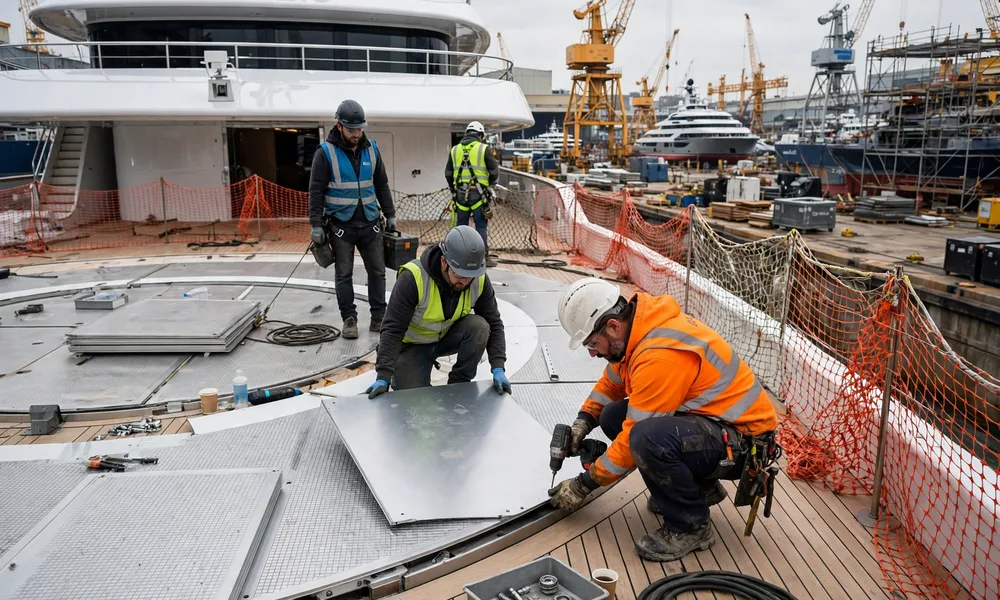
Under the visible deck, the builders fit a hidden skeleton of steel and aluminium. Thick beams run across the deckhead, spreading the force of a landing over a wide area instead of letting it punch through one small spot. The structure is welded and bolted to the yacht’s main frames, so the pad and the hull move as one piece when the sea rolls.
This is the most demanding part of the build, because a yacht deck is normally light and slim, while a helicopter pad must be rigid. The builders test the structure with heavy loads and check it for flex, then add stiffeners wherever the deck moves too much. The same care with a strong backbone appears elsewhere on a ship, and the way a luxury ship keel is made shows how a vessel’s strength starts with the structure underneath everything else.
Step 3: Laying the fire-safe landing surface
On top of the strengthened deck goes the landing surface itself, usually aluminium panels coated with a tough, non-slip material. The surface must grip the helicopter’s wheels or skids in rain and sea spray, resist the heat of the exhaust, and survive fuel spills without catching fire. The panels are fitted tightly together, with no gaps where a wheel could catch or water could sit.
Drainage is built into the same layer. Small channels and scuppers carry rain, sea water and spilled fuel away from the pad, so the surface stays dry and the helicopter never lands in a puddle.
Step 4: Fitting the tie-downs and lighting
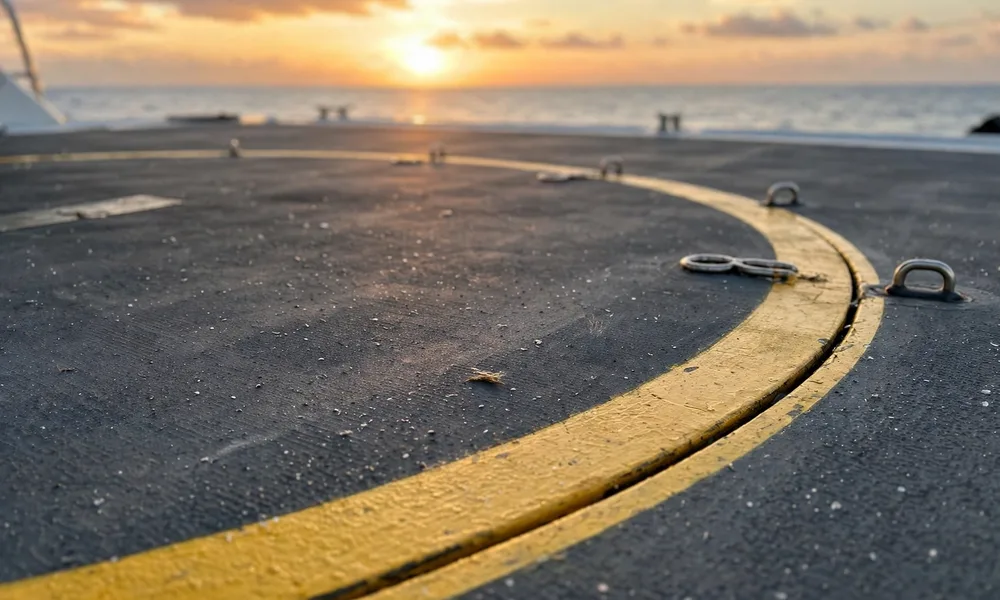
Once a helicopter lands, it must be tied down quickly, before a gust of wind or a roll of the ship moves it. Flush tie-down points are set into the deck in a ring around the landing circle, each one strong enough to hold the aircraft against the worst weather the yacht will meet at anchor. The tie-downs sit flat when they are not in use, so nobody trips over them and the deck stays smooth.
Lighting comes next. Low lights mark the edge of the circle, the centre and the approach path, and they are bright enough for a pilot to see at dusk but dim enough not to blind anyone on deck. The lights are wired through the deck in sealed conduits, protected from salt water, and tested at night so the crew can see exactly what the pilot will see.
Step 5: Adding firefighting and fuel systems
A helicopter pad needs its own fire protection, because a fuel fire on a yacht deck is a serious emergency. Foam monitors, extinguishers and a water supply are placed around the pad where the crew can reach them in seconds, and the deck is tested to make sure foam covers the whole circle evenly. The crew drills the routine again and again, until every person knows their job without thinking.
Some pads also have a fuel system, with a tank hidden below deck and a pump that fills the helicopter on the pad. The fuel lines are double-walled and fitted with shut-off valves, and the whole system is pressure-tested before it is used. The discipline is the same as in any part of a ship where safety depends on clear systems and trained people, and the way a luxury ship bridge is specified shows how a control space is planned around the same idea.
Step 6: Testing, certifying and landing
Before the pad is used, it is inspected and certified. Surveyors check the structure, the surface, the lighting, the tie-downs and the fire equipment, and they watch a test landing, often with a helicopter that is heavier than the one the owner normally flies. The pilot reports on the approach, the deck movement and the wind, and any problem found in that test is fixed before the pad is signed off.
Only then does the pad enter service, and even then the routine stays strict. The deck is checked before every flight, the wind and the sea state are measured, and the landing is called off if the conditions are wrong.
| Specification | Typical luxury yacht pad |
|---|---|
| Pad diameter | About 12 to 18 metres, depending on the helicopter |
| Maximum landing weight | Roughly 3 to 6 tonnes, with a safety margin |
| Deck material | Aluminium panels with a non-slip, fire-resistant coating |
| Tie-down points | Flush ring of points around the landing circle |
| Lighting | Edge, centre and approach lights, dimmable for night landings |
| Fire protection | Foam monitors, extinguishers and a deck water supply |
| Drainage | Channels and scuppers for rain, sea water and fuel |
| Certification | Inspected and signed off by a marine surveyor |
A luxury yacht helicopter pad is an estimate of $500,000 to $2,000,000 to build, depending on the size of the yacht, the weight of the helicopter and whether a fuel system is fitted. The price covers the strengthened structure, the deck surface, the lighting, the fire equipment and the certification, and it is a small part of the cost of a superyacht that can carry a helicopter at all.
Here is a rare fact worth knowing. Some yacht helicopter pads are built so the helicopter can be stored below deck. The pad slides or lifts away, the helicopter is lowered into a hangar under the deck, and the space above becomes a swimming pool or a sun deck again. Guests swimming where a helicopter landed an hour earlier is one of the cleverest tricks in superyacht design, and it only works because the pad was engineered as a moving machine, not just a painted circle.


