An office on a superyacht has to be two things at once: a serious place to work, with the screens, calls and documents of a shore office, and a room that can be cleared away in minutes when the working day ends. The owner may take a video call with a boardroom in the morning and host dinner in the same space that evening, and the room has to serve both without compromise.
That double life shapes every system inside it, from the internet connection to the desk itself. A yacht office is not a desk pushed into a spare cabin; it is a purpose-built workspace, engineered to stay connected and calm hundreds of miles from the nearest shore. This is how a luxury yacht office works.
How It Works
Step 1: The office connects through satellites and shore links
Everything in a yacht office depends on the connection, and the connection comes from above. A stabilised satellite antenna on the mast locks onto a satellite and holds it as the yacht rolls, feeding the office through the yacht’s network, while a second antenna provides a backup path so a single failure cannot cut the office off. The antenna tracks the satellite through rolls and turns, so the link holds even in a swell.
Close to shore, the system switches automatically to faster coastal links, using shore-based mobile networks and marina Wi-Fi where they are available, and the office network chooses the best path without the user ever noticing.
Step 2: A private network keeps the work secure
Once the connection reaches the yacht, it runs through a private network built for the office alone. The office has its own encrypted segment, separate from the guest network and the crew network, so a visitor streaming a film in the saloon cannot slow down a video call, and cannot see the office traffic at all.
Step 3: The desk and chair are built for a moving room
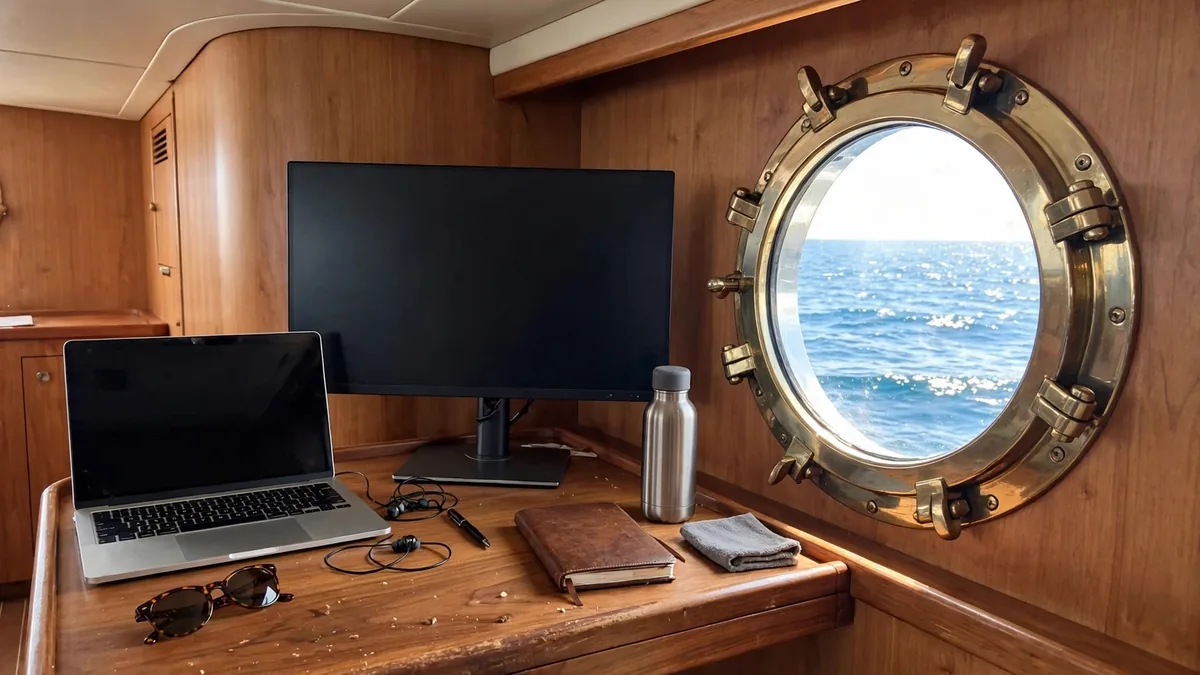
The furniture is where the office meets the sea. The desk is bolted to the deck and the bulkhead, built from the same marine joinery as the rest of the yacht, with cable runs hidden inside its legs and drawers that latch shut so nothing slides open when the yacht rolls. The chair is a different matter: it is a proper office chair, but mounted on a gimballed or locking base that keeps it steady under way.
Monitors are fixed to articulated arms that lock in place, and every cable is clipped and routed so it cannot snag or pull free. A laptop is held by a small lip and a strap, and the desk surface is finished in a material that grips rather than slides, so a phone or a pen stays where it is put even in a swell.
Step 4: Power stays clean and never drops
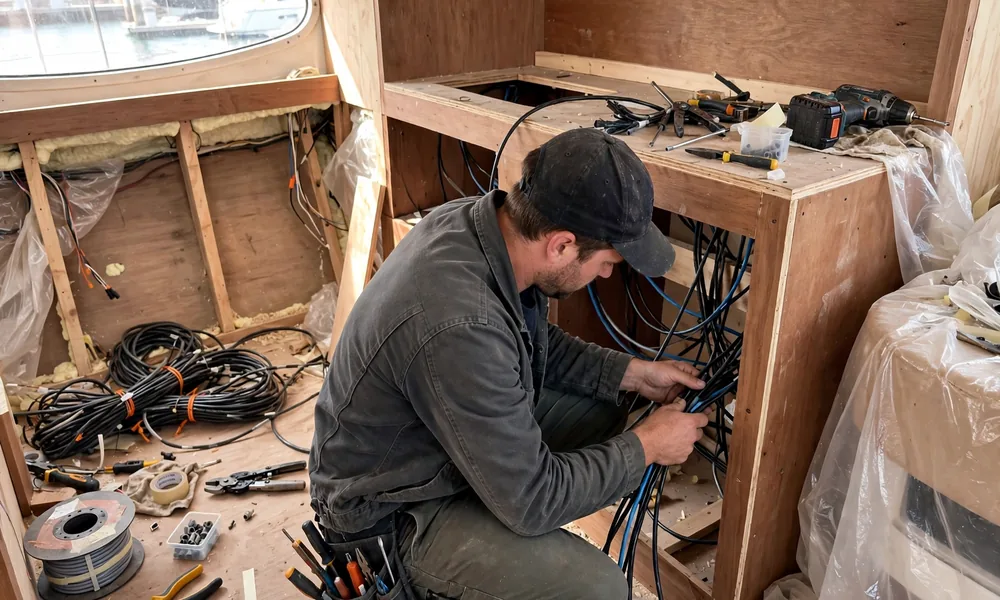
An office cannot tolerate a flicker in the power, so the yacht feeds it through its most protected circuit. The office runs from the yacht’s main generators, with an uninterruptible power supply that takes over in the fraction of a second it takes to switch sources, keeping screens, routers and calls alive through any changeover. A video call may notice nothing at all when the yacht changes power source mid-sentence.
Step 5: Sound, light and air are tuned for concentration
A yacht is a noisy place, with engines, waves and wind, so the office is built as a quiet box inside the hull. Acoustic panels line the walls and ceiling, the door is sealed against sound, and the air handling is designed to move air without the hum of a fan, so a microphone picks up the voice and nothing else.
Lighting is cool and even, bright enough for a full working day without eye strain, and it can be warmed in the evening when the room turns back into a sitting room. The temperature is held steady by its own climate control, so a long call in a warm climate feels no different from a call in a cool one, and the blinds can cut the glare of a low sun without darkening the room.
Step 6: The office hides itself when the working day ends
The last trick of a yacht office is the one the guests see. Monitors fold away into the desk or behind a panel, the keyboard slides into a drawer, and the desk itself can be dressed with a lamp and a vase so the room reads as a study rather than a workplace. In some offices the whole desk lowers into the floor, leaving a clear room for the evening.
Files are locked away in a safe built into the joinery, the screens go dark, and the network stays quietly on standby for the morning. The room that hosted a board meeting at noon can host a quiet drink at eight, and nobody who walks in afterwards would guess that it had ever been an office at all.
| Spec | Detail |
|---|---|
| Connection | Stabilised satellite antenna with coastal mobile and marina links as backup |
| Network | Encrypted private segment, separate from guest and crew networks |
| Furniture | Bolted desk with hidden cabling, locking monitor arms and steady chair |
| Power | Conditioned supply with uninterruptible backup through any changeover |
| Comfort | Acoustic panels, sealed door, own climate control and adjustable light |
| After hours | Screens and desk fold away, files lock into a built-in safe |
The hardest part of a yacht office is not the technology but the silence around it. Every system has to work without being seen or heard, because the moment a guest notices a router, a cable or a fan, the room stops feeling like part of a yacht and starts feeling like a server room. The engineers hide their work so well that the office looks like nothing more than a desk, a chair and a view of the sea, which is exactly the point.
What One Costs
A luxury yacht office typically costs an estimated $200,000 to $800,000 to build and fit out, and the price is set mostly by the satellite system, the network and the custom joinery rather than the size of the room. A compact office with a single satellite link sits near the bottom of the range, while a full executive suite with dual satellite antennas, a private network and a folding desk costs far more. The satellite hardware alone can cost as much as the furniture, and how a luxury yacht bridge works shows the other room where the yacht’s electronics are concentrated, while how a yacht tender works explains the small boat that carries the owner ashore for meetings.
A Rare Fact
Some yacht offices have a second, hidden desk built into the owner’s cabin, wired to the same network, so a call can be taken in private at midnight without ever walking through the yacht, and the main office can be shown to guests as nothing more than a quiet study.

A luxury yacht office is a satellite link, a private network and a desk bolted to a moving floor, finished so cleanly that it disappears when the working day ends. It lets an owner run a business from the middle of the ocean, and then forget about the business entirely by dinner. For the power that keeps it all running, how a luxury ship engine works explains the machinery below decks that feeds every system on board.


