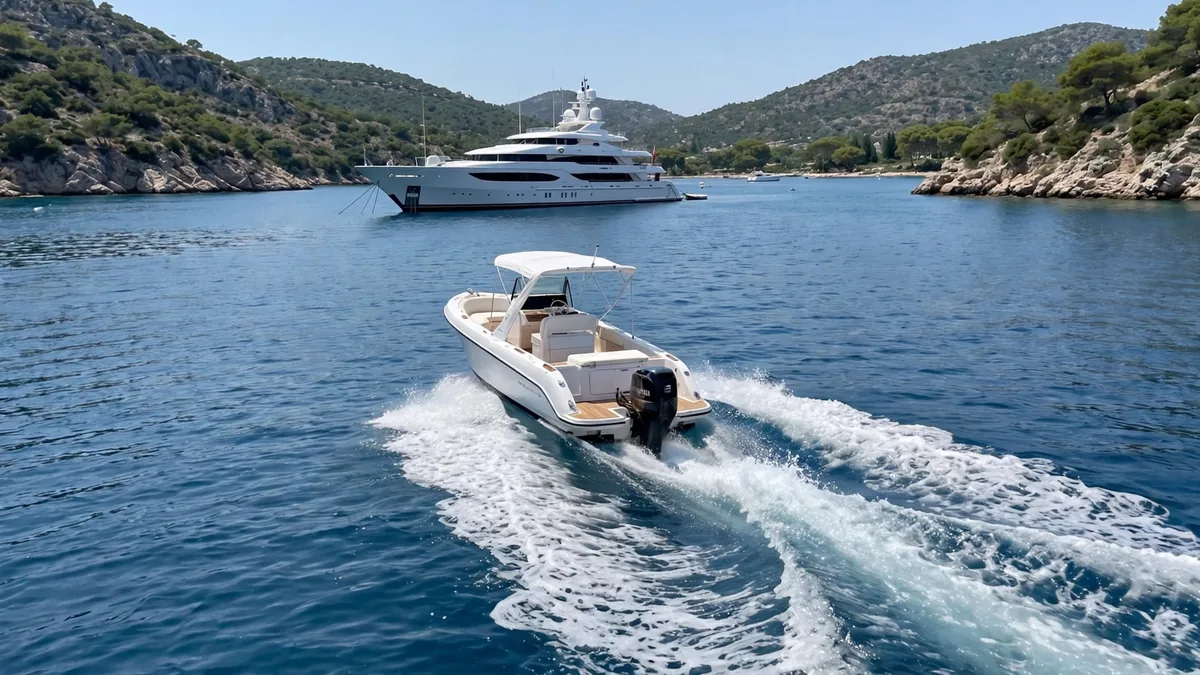
The big yacht is anchored in a bay so calm you can see the anchor chain on the sand below, and the guests want to go ashore. Nobody lowers a rope ladder and climbs down the side. Instead, a door opens in the stern, a small white boat slides out on rails, and a crane lowers it gently into the water. Two minutes later it is speeding towards the beach with six people aboard, and the yacht is alone again.
This is how a luxury yacht tender works, from its garage inside the yacht to the launch, the drive, the steering and the lift back aboard at the end of the day.
Step 1: The tender lives in the garage
When it is not working, the tender lives inside the yacht, in a garage built into the stern or lowered into the hull. The garage is a tight space, and the tender is built to fit it exactly, which is why tenders are measured in centimetres rather than metres: the boat must slide in on rails, with room for the crew to walk around it and tie it down. The tender’s build is a story of its own, and the story of how a luxury yacht tender is made follows it from a moulded hull to a hand-finished deck.
Step 2: Launching, by crane, davit or platform
Getting the tender into the water is a careful operation, and there are three ways to do it. On the largest yachts, a crane in the garage lifts the tender on straps and swings it over the side, lowering it until it floats, and a crew member unhooks the straps from the boat. On smaller yachts, a davit, a small crane arm mounted on the deck, does the same job from above. And on yachts with a tender garage at the waterline, the tender simply slides out on rails and floats off the platform.

Step 3: The engine and the drive
Most luxury tenders are driven by an outboard engine mounted on the transom, hidden under a cover so the stern looks clean, or by a small inboard engine with a jet drive that has no exposed propeller at all. The outboard is the simpler choice: it tilts up out of the water when the tender is lifted, it is easy to service, and it gives the tender real speed, often more than 30 knots. The jet drive is the safer choice for swimming areas, since there is no spinning blade under the boat, and it lets the tender run in very shallow water.
Step 4: Steering, trim and handling
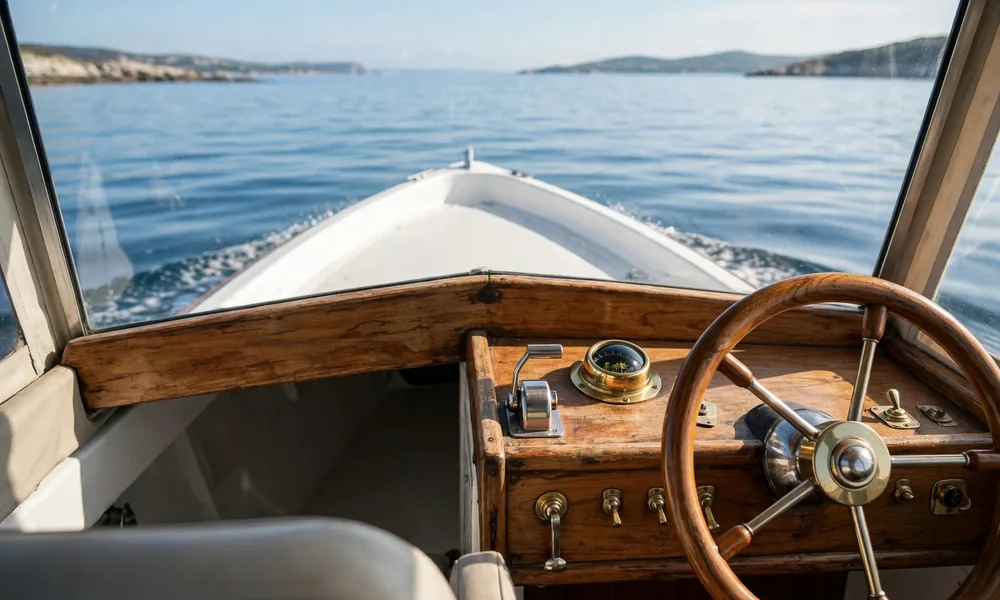
A tender steers like a small speedboat, with a wheel that turns the engine or the jet nozzle, but it handles differently from an ordinary boat because it is light and short. At low speed it is steered gently, with small movements of the wheel, since a sharp turn at speed can throw standing passengers off balance. Luxury tenders have trim tabs, small flaps on the transom that the driver adjusts with buttons, to level the boat as guests move around. The numbers behind the hull and the engine are a subject of their own, and the guide to a superyacht tender’s specs, explained simply sets out what the figures mean in practice.
Step 5: Loading guests and gear
A tender’s real work is carrying people, and it does it in a careful order. Guests step aboard from the yacht’s swim platform or the tender garage, one at a time, holding a rail, and they sit down before the engine starts. The driver counts heads, checks that everyone is seated, and then casts off, and the tender pulls away from the yacht at idle speed until it is clear of the anchor chain and any swimmers. At the beach, the tender noses up to the sand or a small jetty, the driver holds it steady against the current, and guests step off onto dry land.
Step 6: Recovery and stowing
At the end of the day, the tender comes home. The driver brings it alongside the yacht at idle speed, the crew takes the lines, and the tender is positioned under the crane or over the rails of the garage. The engine is switched off and tilted up, the fenders are hung out to protect the hull, and the crane lifts the tender clear of the water, swinging it back into the garage as gently as it came out. Inside, the tender is washed down with fresh water to stop salt corroding the fittings, the fuel is checked, and the cover goes on. For a sense of the machine it serves, the guide to how a luxury yacht works shows the yacht itself, from its engines to its stabilisers.
The spec sheet at a glance
| Specification | Typical luxury figure | What it tells you |
|---|---|---|
| Length | 3.5–6 metres | How many guests it carries |
| Engine | Outboard 40–200 hp, or jet drive | How fast it runs and how it is driven |
| Top speed | 25–40 knots | How quickly it reaches the shore |
| Capacity | 4–8 guests plus crew | How many people it takes per trip |
| Hull | Fibreglass or carbon fibre | How light and tough the boat is |
| Fuel | 40–100 litres | How long a day of shuttling lasts |
| Launch | Crane, davit or garage rails | How it gets into the water |
| Draft | 0.3–0.5 metres | How shallow it can run |
| Weight | 300–900 kilograms | How heavy the crane must lift |
Keeping it in good shape
A tender that works well is a tender that is looked after daily. The engine is flushed with fresh water after every use, the hull is washed down to stop salt eating the fittings, and the fuel filter is checked before the first launch of the day. The crane straps and the davit cables are inspected for wear, since they carry the whole weight of the boat, and the fenders are kept clean so they do not mark the yacht’s paint. A well-kept tender starts first time, every time, and that reliability is worth more than speed.
What it costs
A luxury yacht tender typically costs an estimated $40,000 to $250,000, depending on its length, its engine and whether the hull is fibreglass or carbon fibre. The estimate covers the tender alone, not the crane, the garage or the yacht it serves.
A rare fact
One detail few guests ever learn is that the word tender comes from the old verb to attend, meaning to wait on or serve. The little boat is literally the yacht’s attendant, waiting in its garage until it is needed and then serving the big boat all day. It is the only boat in the fleet whose name is a job description, and it is a fitting one: the tender attends the yacht from the first launch of the morning to the last recovery of the evening.
From the garage to the shore and back again, a luxury yacht tender works as the yacht’s hands and feet, launched by crane, driven by a hidden engine and steered with a light touch.


