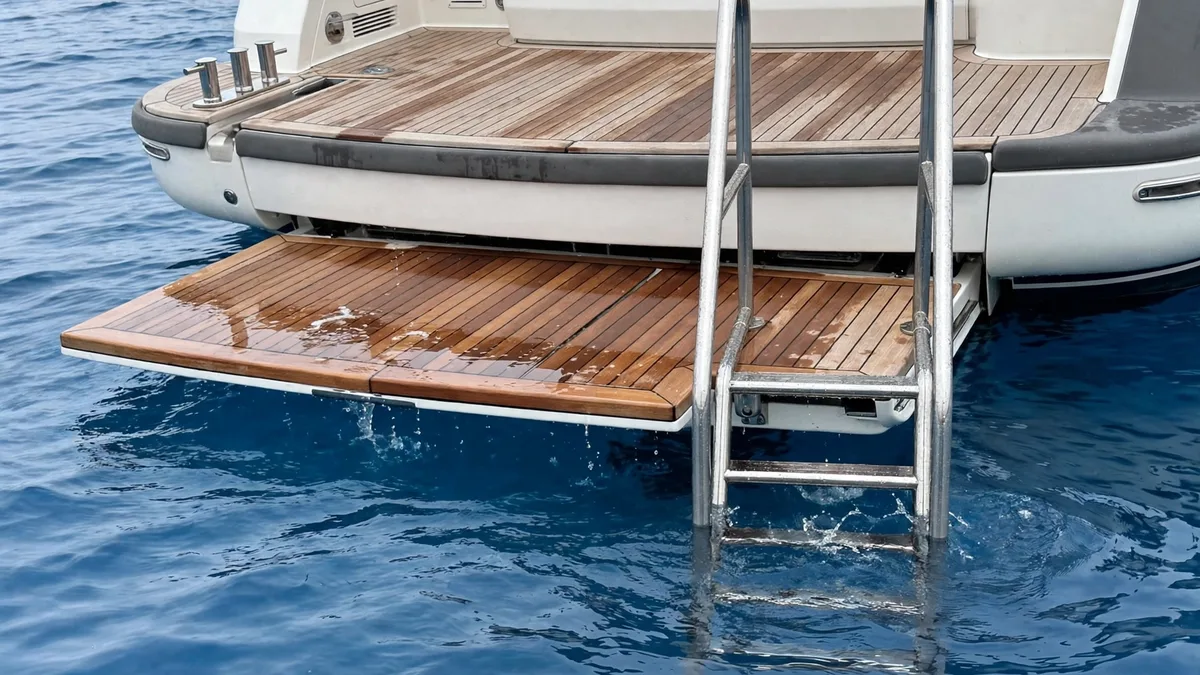
At the back of a luxury yacht, just above the water, sits a flat teak deck that looks like part of the boat until it moves. At the touch of a button it lowers itself to the surface of the sea, turning the stern into a private beach where guests can swim, climb aboard and launch a tender without ever touching a ladder on the side of the hull.
It is called a swim platform, and it is one of the cleverest machines on a yacht. It must hold the weight of a dozen people, lift a small boat out of the water, and fold away flush with the transom when the yacht is under way. This is how a yacht swim platform works, from the button on the deck to the rams underneath it.
How It Works
Step 1: The platform lowers on hydraulic rams
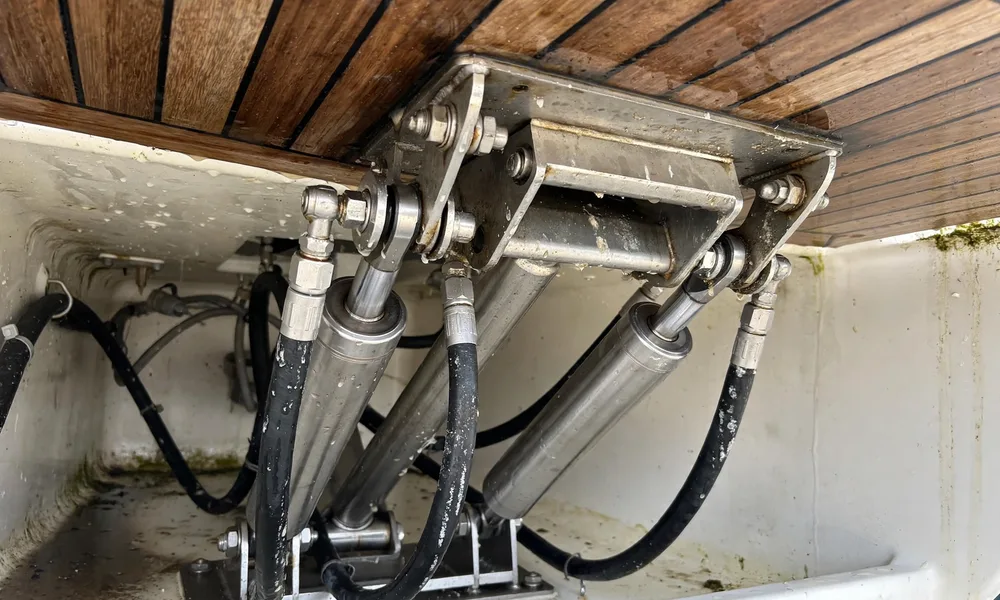
The platform is a flat panel, usually teak over a fibreglass or aluminium core, hinged to the bottom of the transom. When it is time to swim, the crew press a button on a small control panel on the aft deck, and a hydraulic pump in the engine room pushes oil through hoses to two or more rams mounted under the stern.
The rams extend slowly, swinging the platform down and out until it sits flat on the water. The movement takes about half a minute, and the platform stops at whatever height the crew choose, level with the sea when guests are swimming, or raised a little when the tender is being loaded.
Step 2: The platform locks flat at the water
Once the platform reaches the water it has to stay there, steady, while people walk on it. The rams hold it in place under hydraulic pressure, and a mechanical lock drops in as a backup, so the platform cannot fall even if a hose fails. The lock is tested every time the platform is used, and the crew listen for its click before anyone steps aboard. The edge of the platform is fitted with a rubber bumper that cushions it against the hull.
The surface is teak, laid in narrow strips like the deck above, and it grips wet feet better than any painted surface. A stainless steel ladder folds down from the edge, with steps that reach well below the waterline, so a swimmer can climb out without a struggle.
Step 3: The tender is launched from the platform
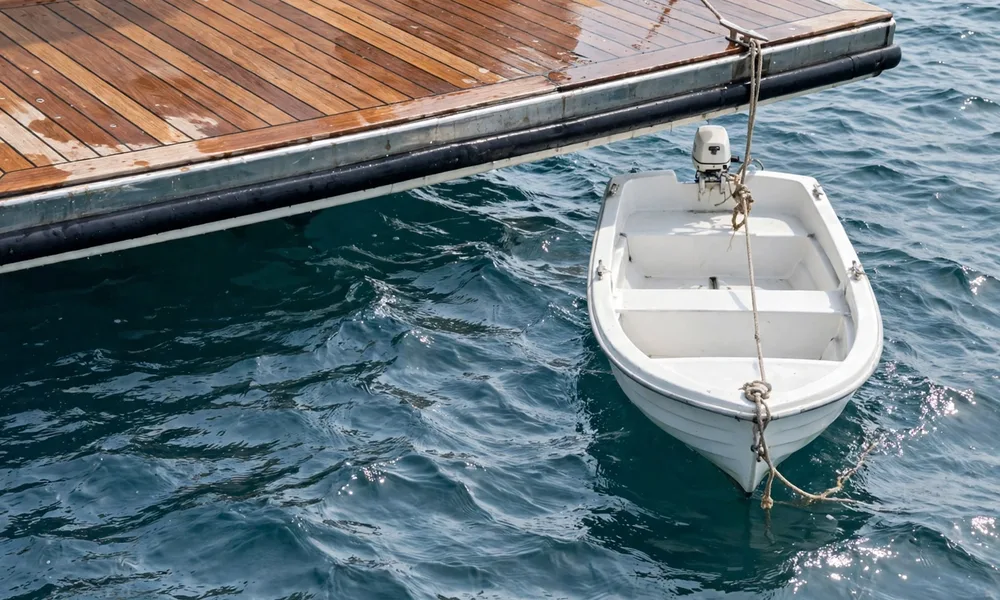
Many swim platforms double as a garage for the tender, the small boat the yacht carries for trips ashore. The tender sits on the platform itself, held by chocks and straps, and when the platform lowers, the tender floats off it into the sea. The crew then unhook the straps and drive it away.
Bringing it back is the reverse. The tender is driven onto the lowered platform, the crew hook the straps and centre it on the chocks, and the rams lift platform and tender together out of the water. The whole lift takes a minute, and the tender ends up stored flat on the stern, out of the way.
Step 4: The controls keep everyone safe
The platform is controlled from two places: a panel on the aft deck and a second control in the engine room. Both need a key or a code, so a guest cannot lower the platform by accident, and an alarm sounds while it moves. The crew check that nobody is swimming underneath before they press the button.
Sensors watch the rams as they move. If one side moves faster than the other, the system stops and levels the platform before it can twist. Limit switches cut the pump at the top and bottom of the travel, and a manual hand pump in the engine room can raise the platform if the electrics fail. The hand pump is kept in a marked locker beside the engine room door, where any engineer can reach it in the dark.
Step 5: The platform folds away for sea
When the yacht is under way, the platform folds up against the transom and becomes part of the stern. It locks flush, with its teak face outwards, so from behind the yacht looks like any other transom. The rams hold it tight, and a second mechanical lock keeps it from rattling in a following sea.
Before folding, the crew wash the platform down and check the hinges for weed and salt. The ladder is folded flat, the control panel is covered, and the tender is strapped down if it is carried on top. A platform left down at speed would be torn off by the water within minutes.
Step 6: The system is serviced every season
At the end of the season the platform gets a full service. The rams are inspected for leaks, the hydraulic oil is checked and changed if it has gone cloudy, and the hoses are examined for cracks where they flex. The hinges are greased, the seals are replaced, and the teak is scrubbed and oiled.
The platform is then tested in the water, lowered and raised a dozen times with a load on it, to prove the rams still lift evenly and the locks still hold. Only when it passes every test is the yacht signed off for the next season, with a platform that will drop into the sea at the touch of a button.
| Spec | Detail |
|---|---|
| Platform | Teak over fibreglass or aluminium core, hinged to the transom, rubber bumper edge |
| Lifting | Hydraulic rams driven by a pump in the engine room, about half a minute to lower |
| Locking | Hydraulic hold plus mechanical backup lock, level sensors stop any twist |
| Tender | Carried on chocks and straps, floats off when lowered, lifted out in a minute |
| Controls | Keyed panels on deck and in the engine room, alarm while moving, manual backup pump |
| Service | Seasonal check of rams, oil, hoses, hinges and seals, load tested in the water |
The hardest part of a swim platform is the salt. Every hinge, ram and seal lives at the waterline, washed by the sea every day, and a platform that is not rinsed and greased will seize solid in a single season at anchor.
What One Costs
A luxury yacht swim platform typically costs an estimated $50,000 to $250,000, set mostly by its size, the lifting system and whether it carries a tender. A simple fixed platform sits near the bottom, while a large hydraulic platform with a tender garage costs far more. The stern space above it opens up too, and how a yacht beach club is made shows the room built into the transom, while how a luxury yacht pool is made covers the water carried on deck instead.
A Rare Fact
Some swim platforms are strong enough to lift a small car. The rams are sized for the tender plus a safety margin, so a platform rated for a half-tonne tender can carry several times that weight without strain.
A yacht swim platform is a hinged teak deck, a pair of hydraulic rams, a locking system and a ladder, controlled from the aft deck and serviced every season. It turns the stern into a beach in half a minute, then folds away and disappears. The whole stern can be a beach, and why a yacht beach club is so expensive explains what that larger version costs.