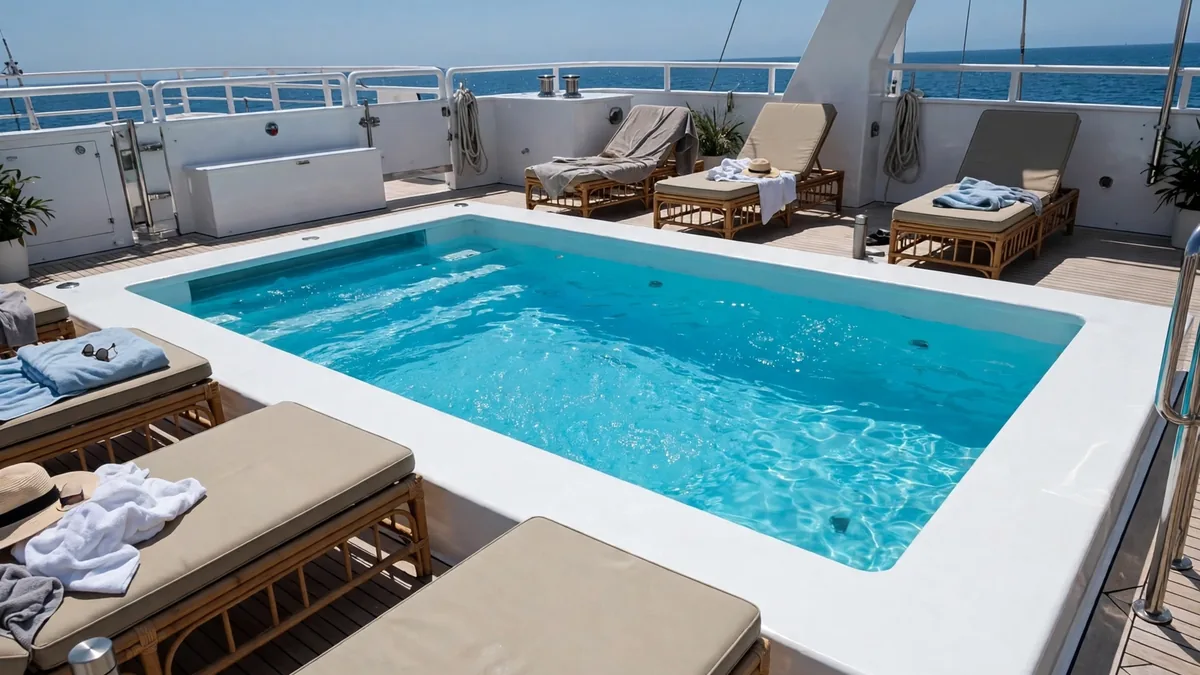
On the main deck of a superyacht, between the sun loungers and the bar, there is a rectangle of turquoise water that looks like it was poured straight from a hotel. Guests swim in it while the sea slides past a few metres below, and children splash in it while the yacht is at anchor in a bay. It is a swimming pool on a boat, and it is one of the most demanding things a shipyard ever builds, because a pool is a heavy box of water sitting on a deck that moves, and water does not like to stay still.
A pool on land is a hole in the ground. A pool on a yacht is a tank balanced on a ship, and it has to hold tonnes of water without leaking, without sloshing over the edge in a swell, and without adding so much weight high up that the yacht becomes top-heavy. Building one means designing the shell, the plumbing, the heating and the safety systems as one piece of the ship. This is how it is done.
How It Is Made
Step 1: The pool is designed into the yacht
Everything starts long before the steel is cut, because a pool cannot be added to a yacht as an afterthought. Naval architects decide where it will sit, usually on the main deck or the sun deck, and work out how its weight will affect the yacht’s stability, since several tonnes of water high above the waterline changes how the boat rolls. The pool’s size and depth are set by that maths, and by the deck space around it, because a pool that is too big makes the yacht tender in a swell, while a pool that is too small is not worth swimming in.
Step 2: The shell is fabricated in stainless steel
The pool itself is usually a shell of stainless steel, welded up from shaped panels in the yard’s metal shop. Stainless is chosen because it does not rust in salt water, it can be welded into a watertight box, and it can be polished to a finish that looks like a mirror under the water. Welders join the panels with full-penetration welds, then grind and polish every seam until it is smooth, because a rough weld would catch dirt and corrode.
Step 3: The shell is lifted in and sealed to the deck
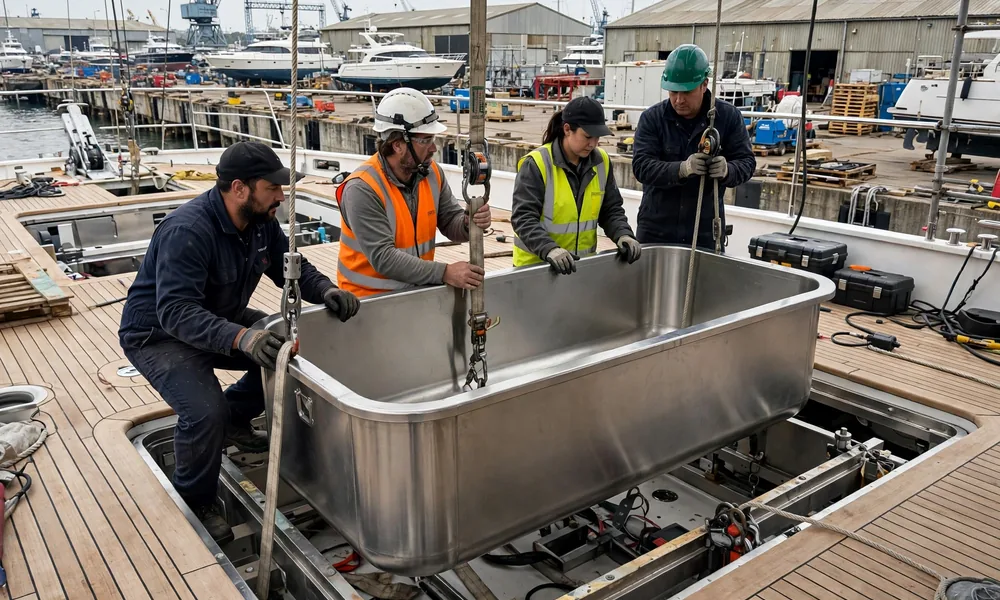
Once the shell is tested, it is craned aboard and lowered into its opening in the deck, a slow job that needs the shell to land within millimetres of its design position. Fitters bolt it to the yacht’s structure and seal the joint with flexible compounds that can move as the hull flexes in a seaway, because a rigid joint would crack the first time the yacht met a wave. The deck around the pool is finished with teak or non-slip stone, and the edge is detailed so water cannot run across the deck and into the cabins below.
Step 4: The plumbing, filtration and heating go in
A yacht pool is a small water treatment plant, and its machinery lives in a room below the deck. Pumps circulate the water through filters that catch sand and sunscreen, a heater warms it to a comfortable temperature, and a dosing system adds the chemicals that keep it clear and safe. The pipes are run with falls and drains so the whole pool can be emptied quickly, and the water is usually taken from the yacht’s own fresh-water makers, because filling a pool from a shore hose would take hours in port.
Step 5: The glass edge and the cover are fitted
Many yacht pools have a glass wall or an infinity edge, so swimmers look straight out to sea over the water, and fitting that glass is a specialist job. Panels of thick laminated glass are set into the steel shell with flexible seals, checked for level, and tested under load, because the water pressing on the glass weighs tonnes. A cover is fitted too, often a slatted deck that slides across the pool, turning it into extra deck space when it is not in use and keeping the water warm overnight.
Step 6: It is filled, tested and balanced
Before the yacht is delivered, the pool is filled and the yacht goes to sea. Testers watch how the water behaves as the yacht rolls, checking that the baffles and the cover keep sloshing under control, and they measure the yacht’s stability with the pool full, half full and empty, because a half-full pool is the worst case of all. Only when the water stays put, stays clear and stays warm does the pool get its final polish and its first swimmers.
| Specification | Typical figure |
|---|---|
| Shell | Welded stainless steel, polished smooth and pressure-tested |
| Size | Around 4 to 8 metres long, 1 to 1.5 metres deep on a superyacht |
| Water weight | An estimated 5 to 15 tonnes when full, depending on size |
| Filtration | Pumps, filters, heater and chemical dosing below deck |
| Edge | Often a laminated glass wall or infinity edge facing the sea |
| Cover | Sliding deck cover, strong enough to walk on when closed |
The enemy of a yacht pool is not the sea outside but the water inside, because a pool that is half full behaves like a loose weight sliding from side to side. Naval architects call this the free surface effect, and it can make a yacht roll further with every wave, so the pool is designed with baffles, shallow sections and a cover that stops the water moving. Some pools are even fitted with a system that empties them automatically in rough weather, trading a swim for stability in a few minutes.
What One Costs
A yacht pool typically costs an estimated $300,000 to $1,500,000, and the price is set mostly by its size, the glass work and the machinery below deck. A simple pool on a modest yacht sits at the low end, while a large infinity pool with a glass wall, a sliding cover and its own heating plant can cost more than a house. The water and power behind it come from the yacht’s own systems, and how a luxury marine engine works explains the machinery that powers a yacht, while how a luxury ship lifeboat is made shows a very different use of a small boat-shaped shell.
A Rare Fact
Some yacht pools can change their depth, and the floor rises on hydraulic rams until it is flush with the deck, turning the pool into a dance floor or a helipad in a matter of minutes. The most famous version is a pool that doubles as a landing pad, so a helicopter can land where guests were swimming an hour earlier.

A yacht pool is a small piece of a hotel balanced on a ship, built from welded steel, glass and pumps, and tested against the one thing it cannot control, which is the sea moving underneath it. When it works, guests swim above the ocean while the ocean slides past below, and nobody thinks about the tonnes of water, the baffles or the stability maths. For the machines that go under the water instead of floating on it, how a luxury submersible works dives to the deep.


