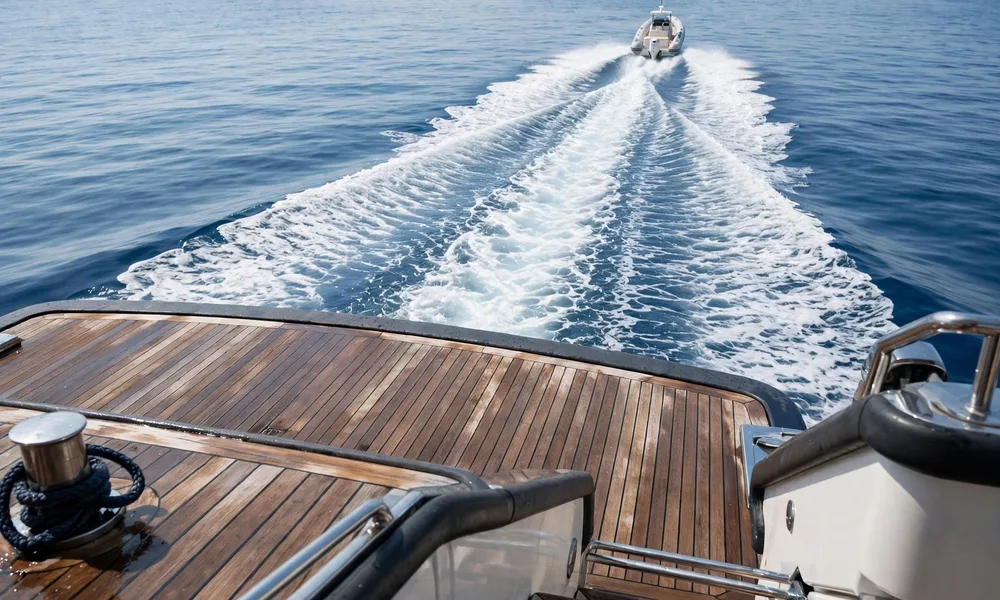
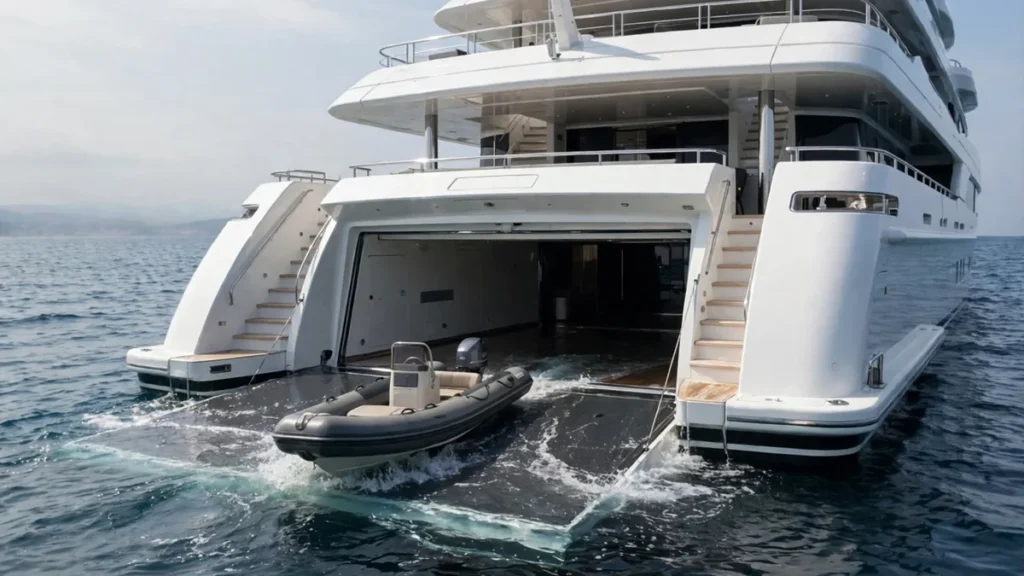
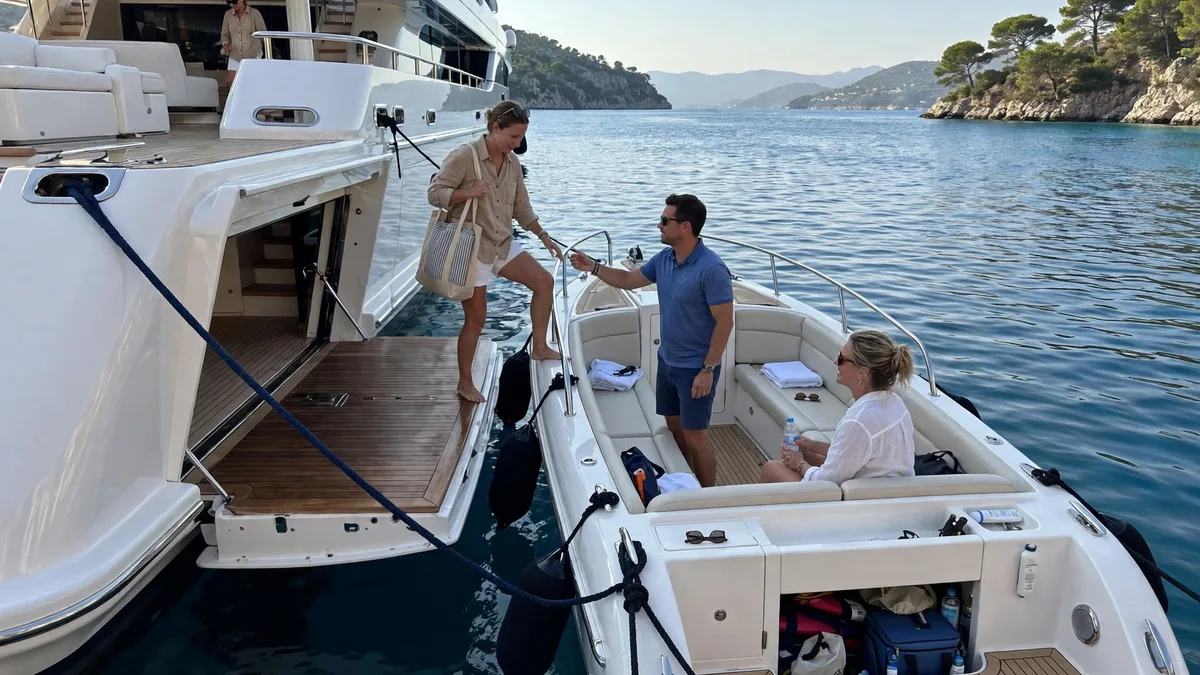
The superyacht is anchored in a bay so clear you can see the anchor chain on the sand below, and the guests want to go ashore. Nobody lowers a rope ladder and rows. The stern opens, a small boat slides out on rails, and within minutes the guests are stepping from a teak deck onto a white sand beach, dry and unhurried. That small boat is the superyacht tender, and it is one of the hardest-working machines on the whole yacht. It ferries guests, lands the crew on docks, tows the water toys, runs to the harbour for fuel and provisions, and rescues the occasional swimmer who has drifted too far. This is what its spec sheet means, number by number.
The spec sheet at a glance
| Figure | Typical range | What it tells you |
|---|---|---|
| Length overall | Roughly 5 to 12 metres | How long the tender is, and how many guests it carries |
| Beam | Roughly 2 to 3.5 metres | How wide it is, and whether it fits the garage |
| Displacement | Roughly 1 to 4 tonnes | How heavy it is, and what crane can lift it |
| Engine power | Roughly 150 to 600 horsepower | How much power drives it |
| Top speed | Roughly 30 to 50 knots | How fast it can run flat out |
| Cruising speed | Roughly 20 to 30 knots | How fast it travels day to day |
| Passenger capacity | Roughly 6 to 12 guests | How many people it carries, plus crew |
| Fuel capacity | Roughly 100 to 400 litres | How far it can go between fills |
| Price | Roughly $150,000 to $1.5 million | What the tender costs, as an estimate |
Length, beam and weight: built to fit the garage
Length overall on a luxury superyacht tender usually runs from roughly 5 to 12 metres, and the length is decided backwards, by the garage it has to fit into. The tender lives inside the mothership, in a floodable compartment in the hull or on a deck cradle under a cover, and every centimetre of length has to clear the garage doors, the rails and the launching gear. Beam, the width, usually runs from roughly 2 to 3.5 metres, and it decides how stable the tender feels when guests step aboard in a swell. A wider beam means a steadier deck and more seating, but it also means a wider garage, so designers shape the hull with flared sides that give stability without adding width at the waterline. Displacement usually runs from roughly 1 to 4 tonnes, and weight matters twice over, because the yacht’s crane or davit has to lift the tender out of the water, and a heavy tender eats into the yacht’s own weight budget. That is why the best tenders are built from carbon fibre or vacuum-infused glass fibre over a foam core, with teak decks laid thin and fittings made from titanium or polished stainless steel. The garage itself is a machine in its own right, and the best of them are judged on launch speed and dryness, as the ranking of the best superyacht tender garages, ranked shows, but the tender is the boat that has to survive being launched from it, day after day.
Engines and speed: fast enough to be useful
Engine power on a luxury superyacht tender usually runs from roughly 150 to 600 horsepower, and most tenders use either a single outboard, twin outboards, or a stern-drive inboard, depending on the size. Outboards are the common choice on smaller tenders because they are light, easy to service, and they tilt clear of the water when the tender is parked. Larger tenders often use an inboard diesel with a water jet, because a jet has no exposed propeller, which matters when the tender is picking up swimmers or running onto a beach. Top speed usually runs from roughly 30 to 50 knots, and cruising speed from roughly 20 to 30 knots, which is fast enough to run ten miles to the nearest harbour and back inside an hour. The hull shape decides how the speed feels. A deep-V hull cuts through chop and stays comfortable at speed, while a flatter hull planes earlier and uses less fuel, so designers tune the V to the waters the yacht will visit. Fuel capacity usually runs from roughly 100 to 400 litres, and that gives a range of roughly 100 to 200 nautical miles at cruising speed, more than enough for a day of ferrying guests, with reserve for the unexpected. The tender’s bigger cousin, the chase boat, does the same job at a larger scale, as the guide to how a luxury chase boat works explains, carrying more people and more gear over longer distances.

The hull and the deck: tough, pretty and dry
The hull of a luxury superyacht tender has to survive treatment that would horrify a yacht owner. It gets beached on sand, bumped against docks, loaded with dive tanks and shopping, and lifted by a crane in a rolling sea, and it has to come back looking new every time. Builders use a tough outer skin, often with a rubbing strake of rubber or polyurethane around the widest point, so that contact with a dock leaves a mark on the strake instead of the paint. The deck is laid in teak or a synthetic teak that looks the same and needs less care, and the seating is arranged so that guests sit facing forward, with handholds within reach and a dry locker under every seat. A small console at the helm carries the instruments, a chart plotter and the throttle, and the best tenders add a shower, a drinks cooler and a swim ladder, because the tender is often the platform for the afternoon swim. There is a growing argument that tenders should be smaller and electric, as the case for smaller electric yacht tenders makes, trading top speed and range for silence and simplicity, and a few yards now build electric tenders that charge from the mothership overnight.
What it costs
The estimated price of a new luxury superyacht tender is roughly $150,000 to $1.5 million, and that figure is an estimate only, because the cost depends on the length, the engine, and how much of the build is carbon fibre and hand-finished teak. The hull and the engine account for the largest share, followed by the interior, the electronics and the custom paint matched to the mothership. Many owners order two tenders, a large guest tender and a smaller crew tender, and the pair together can cost more than a comfortable house, which is why the tender is specified as carefully as any room on the yacht itself.
A rare fact
Few people know that the tender is often the first part of a superyacht to be built, not the last. Because the tender has to fit the garage exactly, the yard builds the tender first, then builds the garage around it, measuring the doors, the rails and the cradle against the real boat. Change the tender later and the garage may not fit it, which is why owners choose their tender before the yacht’s steel is even cut.