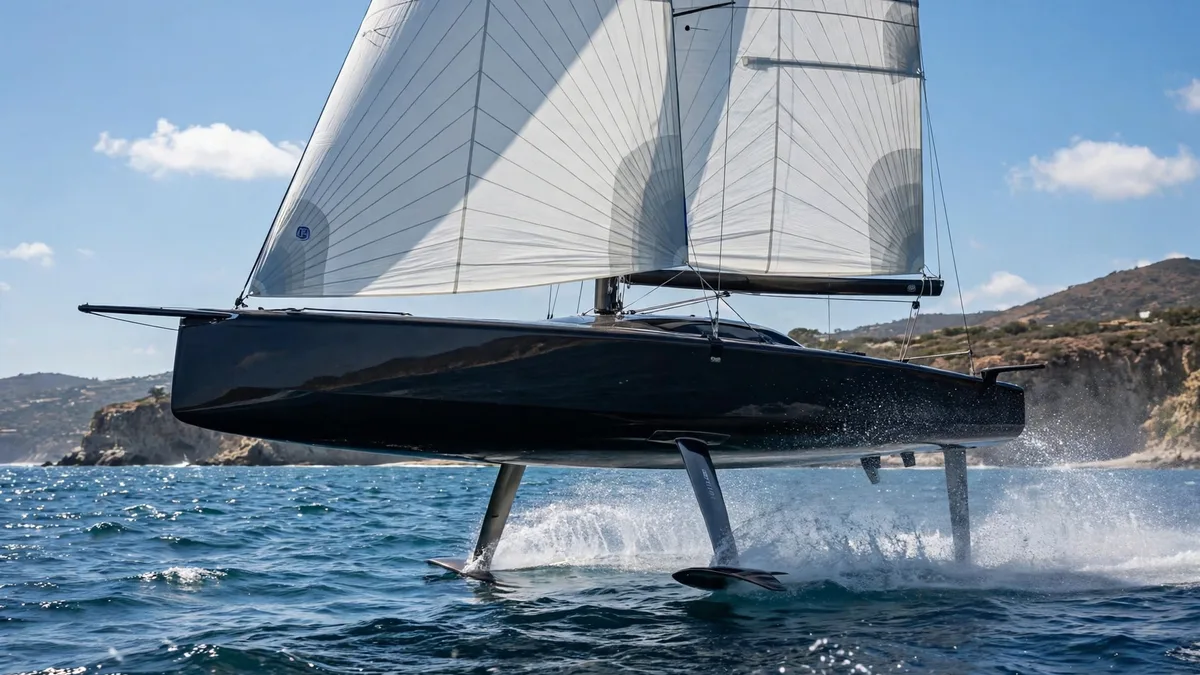
Watch a foiling yacht at full speed and the first thing you notice is what is missing. There is no hull in the water at all. The boat hangs in the air, a metre or so above the waves, held up by two thin blades and a rudder foil, and only a small part of it still touches the sea. The spec sheet for a machine like this is only a few pages long, and most of its numbers look strange to anyone used to ordinary yachts, yet those numbers decide whether the boat flies cleanly or never leaves the water at all.
A luxury foiling yacht is a sailing yacht fitted with hydrofoils, shaped underwater wings that generate lift as water flows over them, and its spec sheet is where the maker proves the boat is more than a fast-looking shape. This guide reads that sheet number by number, from the foils and the take-off speed to the weight, the sail area and the price, so you can tell a genuinely quick foiler from one that only looks the part. For the plain idea behind the boat, the guide to what a foiling yacht is sets out the parts and the thinking behind them.
The spec sheet at a glance
| Figure | Typical range | What it tells you |
|---|---|---|
| Length overall | Roughly 10 to 20 metres | How long the boat is, and how much room it carries |
| Take-off speed | Roughly 10 to 15 knots | How fast it must go before the hull lifts |
| Top speed | Roughly 30 to 50 knots | How fast it can sail once flying |
| Displacement | Roughly 3 to 12 tonnes | How heavy the boat is, foils and all |
| Foil span | Roughly 2 to 5 metres | How wide the lifting wings reach |
| Sail area | Roughly 80 to 250 square metres | How much wind power the boat can catch |
| Crew | Roughly 4 to 10 people | How many hands it takes to sail |
| Draft, foils down | Roughly 2 to 4 metres | How deep the water must be |
| Price | Roughly $2 million to $15 million | What the yacht costs, as an estimate |
Take-off speed: the number that decides everything
Take-off speed is the first number to read, usually roughly 10 to 15 knots, and it is the speed at which the lift from the foils equals the weight of the boat. Below that speed the yacht sails like an ordinary boat, hull in the water, dragging through the waves. Above it, the hull rises and the drag falls away, and the boat accelerates sharply. A low take-off speed matters because it means the boat flies in lighter wind, on more days, in more places. A boat that needs 15 knots of wind just to lift off will spend much of its life sailing slowly, hull down, like a very expensive ordinary yacht.
The take-off figure depends on weight and foil size together. A lighter boat lifts earlier, and a bigger foil lifts earlier too, but a bigger foil drags more at low speed, so the designer balances the two. The flying itself is a balancing act, and the guide to how a luxury foiling yacht works follows it from the first push through the water to take-off, the balance that keeps it in the air, and the landing when the wind drops.
Top speed and sail area: how fast, and how it gets there
Top speed on a luxury foiling yacht is usually roughly 30 to 50 knots, which is roughly 55 to 93 kilometres per hour, and the fastest racing foilers now sail at more than 50 knots. That is faster than the wind itself in many conditions, because once the hull is out of the water the boat makes its own apparent wind, and the sails keep pulling harder as it goes faster. Ask what wind speed it was measured in, because a boat that reaches 40 knots in 20 knots of wind is a different machine from one that needs 30 knots of wind to do the same.
Sail area runs roughly 80 to 250 square metres, and it is the engine of the whole machine. A bigger sail catches more wind, but it also needs a stronger mast, a heavier rig and more crew to handle it. The ratio of sail area to weight is the figure that really matters: a light boat with a big sail accelerates quickly and lifts early, while a heavy boat with a modest sail may never reach take-off at all.

Displacement, foil span and draft: the weight of flight
Displacement, the weight of the boat, runs roughly 3 to 12 tonnes on a luxury foiler, and every tonne is the enemy of flight. Carbon fibre is used almost everywhere, in the hull, the foils, the mast and the rigging, because it is strong and light enough to carry a whole yacht on two thin blades.
Foil span, roughly 2 to 5 metres, is the width of the lifting wings, and it decides both lift and drag. Draft with the foils down runs roughly 2 to 4 metres, which decides where the boat can go: it needs deep water to sail with the foils lowered, and many harbours are too shallow, so the foils must be raised or retracted before coming in. That is one of the practical numbers owners forget to check until the first time they try to enter a marina.
Crew, controls and the price of flying
Crew runs roughly 4 to 10 people, and the number tells you how automated the boat is. Racing foilers need a full crew working constantly, trimming sails and adjusting the foils by hand or by hydraulics, while the newest luxury foilers use sensors and automatic controls to hold the boat steady, so a small crew or even a couple can sail it.
Price is the last line on the sheet and the hardest to read, because a luxury foiling yacht costs roughly $2 million to $15 million as an estimate, and the range is wide for a reason. The foils alone, machined from carbon fibre to tolerances measured in fractions of a millimetre, can cost as much as a whole ordinary yacht, and the control systems, sensors and hydraulics add more. The ordinary luxury yacht is a useful comparison, and the guide to luxury yacht specs, explained shows how the numbers for a conventional hull differ from the numbers for a boat that flies.

The rare fact
The rare fact is this: water is about 800 times denser than air, so a hydrofoil the size of a coffee table can lift a yacht that weighs several tonnes, and the fastest foilers now sail at more than twice the speed of the wind pushing them. Read the sheet with that in mind. The take-off speed tells you how often it flies, the sail area tells you how it gets there, the weight tells you how hard the foils must work, and the price tells you whether the maker believes its own numbers. When all four agree, the boat hanging in the air above the waves is worth every second look it gets.