There is a moment, just before a McLaren W1 reaches 200 miles per hour, when the car stops feeling like a car at all. The steering goes light and then heavy again, the body hunkers down as if the road has reached up and grabbed it, and the air itself seems to become a hand pressing the car into the tarmac. Nothing visible has changed. There is no giant wing bolted to the back like a racing car, no obvious aero device shouting for attention. The W1 looks clean, almost restrained. And yet at speed it generates more downforce than a car twice its visual drama, because its aerodynamics were not added to the design — they were carved into it.
The W1 is McLaren’s successor to the P1, a hypercar built around a hybrid V8, and its body is a study in what engineers call active aerodynamics: surfaces that move, ducts that open and close, and a rear wing that stretches and tilts like a living thing. Making that body is not a matter of bolting parts onto a chassis. Every panel is shaped by thousands of hours in the wind tunnel and in simulation, then built in carbon fibre to tolerances measured in fractions of a millimetre.

How It’s Made
Step 1: Shaping the air in simulation
Long before any carbon fibre is cut, the W1 exists only as numbers. McLaren’s aerodynamicists run computational fluid dynamics simulations — virtual wind tunnels that divide the air around the car into millions of tiny cells and solve the equations of airflow for each one. They test thousands of shapes: a millimetre more curve here, a duct a fraction wider there, a floor edge sharpened by half a degree. The goal is a contradiction: minimum drag on the straights, maximum downforce in the corners, and cooling air delivered exactly where the hybrid powertrain needs it. The best shapes go forward to the physical wind tunnel, where a 60-percent scale model is tested with real smoke and sensors.
Step 2: Designing the active surfaces
The W1’s signature device is its Active Longtail rear wing, which extends rearwards by 300 millimetres and tilts to act as an airbrake under heavy braking. Designing it means solving a mechanical puzzle: a wing that must be rigid enough to carry hundreds of kilograms of downforce, yet fold away flush with the bodywork when the car is cruising. Hydraulic actuators, linkages, and position sensors are packaged into the rear bodywork alongside the exhaust and cooling systems, all fighting for the same cubic centimetres. The same philosophy of moving surfaces appears in the active aerodynamics of earlier McLarens, but the W1 takes it further — the wing, the front aero flaps, and the underbody work as one system, choreographed by software that reads speed, steering, and braking a hundred times a second.
Step 3: Moulding the carbon fibre body
Every exterior panel of the W1 is carbon fibre, laid up by hand in moulds machined from the simulation data. Technicians cut prepreg sheets — carbon cloth already impregnated with resin — and lay them into the moulds layer by layer, orienting the fibres along the loads each panel will carry. The lineage is direct from carbon monocoque production, where the same craft turns cloth into structure. Once laid up, each panel is vacuum-bagged and cured in an autoclave under heat and pressure, a process that takes hours and cannot be hurried without risking voids in the laminate.
Step 4: Sculpting the underbody
Most of the W1’s downforce comes not from wings but from underneath. The flat floor and rear diffuser are shaped to accelerate air beneath the car, creating a low-pressure zone that sucks the car down — ground effect, the same principle that made Formula 1 cars of the early 1980s so fast. The floor is a single sculpted piece, with venturi tunnels and strakes that must hold their shape to within a millimetre, because the air beneath the car moves faster than the air above it and punishes any imperfection. This is the part of the car almost no owner ever sees, and it does more work than everything visible above it.
Step 5: Ducts, cooling, and the air’s second job
Air does not only hold the W1 down; it also keeps it alive. The hybrid V8 and its electric motor generate enormous heat, and the radiators, intercoolers, and brakes all need airflow — but every cooling duct is also a source of drag. McLaren’s engineers route the air with obsessive care: intakes in the doors feed the radiators, channels through the body feed the rear brakes, and hot air is vented through louvres placed where the exiting flow actually helps downforce instead of hurting it. It is plumbing, but plumbing at 200 miles per hour.
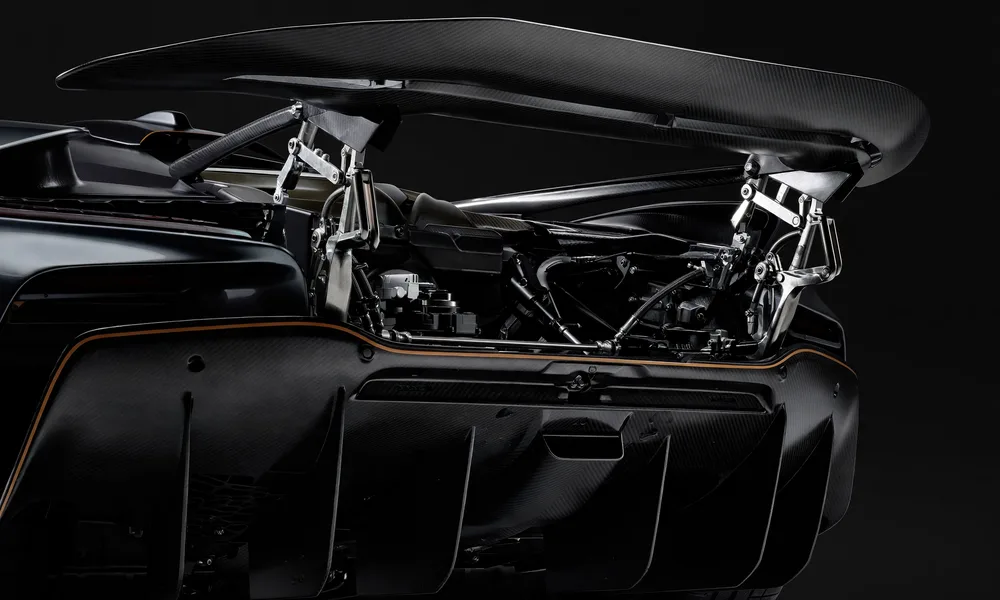
Step 6: Assembling and aligning the aero
With panels cured, the body is assembled onto the carbon monocoque in a dedicated aero build cell. Technicians fit the active wing mechanism, the front aero devices, and the underbody, then measure every gap and flushness with laser scanners. A panel sitting a millimetre proud of its neighbour would trip the airflow and cost downforce, so shims thinner than a sheet of paper are used to bring surfaces into alignment. Only when the whole system moves as one — wing, flaps, and underbody in perfect coordination — is the car signed off for the wind tunnel.
Step 7: Validation at full speed
Final validation happens in the wind tunnel and on the track, where the W1 is run to its top speed and the measured downforce is compared against the simulation. McLaren quotes up to 1,000 kilograms of downforce in Race mode, and the car must deliver it without instability, buffeting, or surprises when the wing deploys at speed. Each answer feeds back into tiny adjustments until the air and the car agree. The result is a hypercar whose aerodynamics are invisible at rest and unmistakable at speed, much like the hand-built engine that powers it, a cousin in craft to the hand-built hypercar V12 built in the same Woking factory.

Specifications
| Property | McLaren W1 |
|---|---|
| Powertrain | 4.0-litre twin-turbo V8 hybrid |
| Combined output | 1,258 hp |
| Top speed | 217 mph (350 km/h) |
| 0–62 mph | 2.7 seconds |
| Maximum downforce | 1,000 kg (Race mode) |
| Active Longtail extension | 300 mm |
| Dry weight | ~1,399 kg |
| Production run | 399 cars |
Price
The McLaren W1 was launched at a price of around £2 million before options — roughly $2.1 million at launch exchange rates — and all 399 cars were allocated before production began. That figure is a verifiable launch price, not an estimate, though the final cost of any individual car rises with McLaren Special Operations options, bespoke paint, and tailored interiors. What the price buys, aerodynamically speaking, is a body that took thousands of simulation hours and hundreds of hours of hand lay-up per car to create.
Rare Fact
The W1’s rear wing does more than push the car down: under hard braking it tilts to become an airbrake, and McLaren says the aerodynamic braking it provides is so strong that the car can shed speed measurably faster with the wing deployed than with the brakes alone. It is the closest thing on the road to a fighter jet’s speed brake — and it folds away completely when the car is parked, leaving the W1 looking almost demure.


