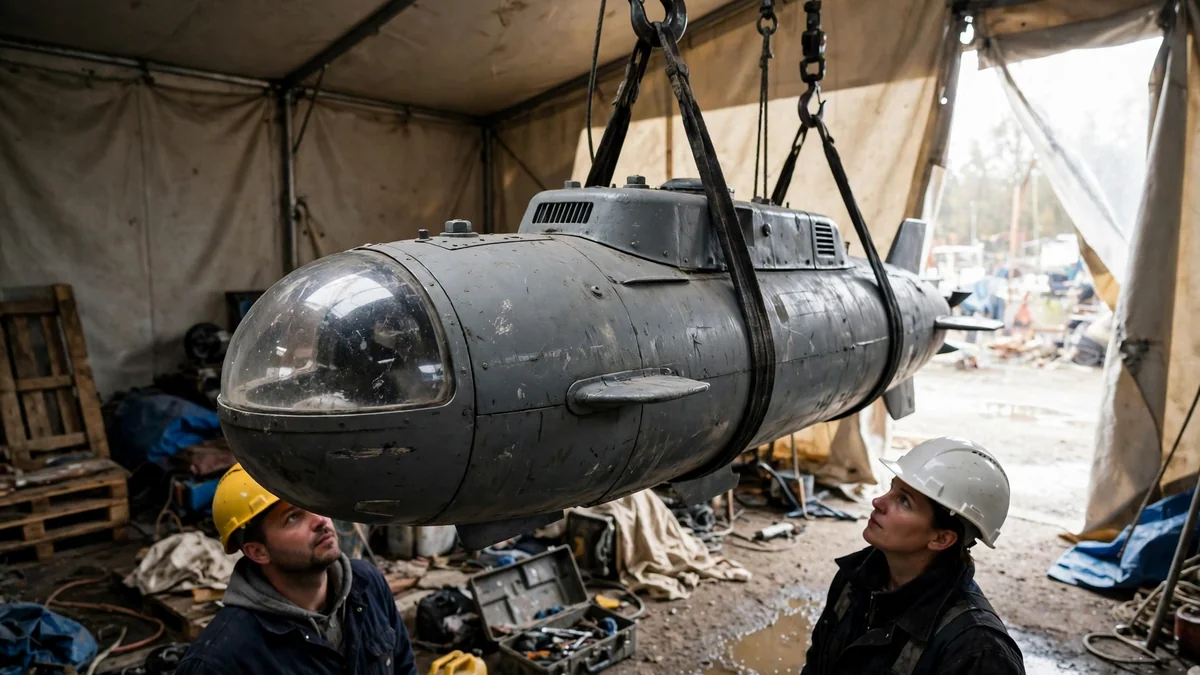
The crane operator holds the hull steady while the wind picks up off the harbour. Below, in a white tent the size of a warehouse, a small submarine hangs from its lifting straps, a smooth grey capsule with a glass dome at the front and a ring of thrusters at the back. It is barely longer than a city bus, and it is about to be lowered into the water for the first time. The man who paid for it stands on the dock in a borrowed hard hat, watching the machine he will one day pilot to the bottom of a reef, or under the ice, or simply down into the blue quiet where no surface boat can follow.
A private submarine is one of the strangest machines a person can own. It is not a toy, although it looks like one beside a superyacht. It is a pressure vessel, a life-support system, and a small ship all at once, built to carry two or three people hundreds of metres below the surface and bring them home safely. The companies that build them are few, and their order books are measured in single figures. Each boat is made to order, and each owner has different ideas about what matters: a bigger viewing dome, a longer dive time, a manipulator arm to pick up a shell.
How It’s Made
Every private submarine follows the same broad sequence, from a steel or titanium sphere to a finished boat that can dive, hover, and surface on command. The order matters, because the pressure hull must be perfect before anything is bolted to it, and the life-support system must be tested before anyone climbs inside. Here is how a private submarine is built, step by step.
1. Designing the pressure hull. The design starts with a single question: how deep will this boat go? The answer decides almost everything. The hull is usually a sphere, or a cylinder with spherical ends, because a round shape spreads the crushing force of the water evenly. No private submarine is built without that outside check.
2. Machining and joining the hull. The hull is made from thick plates or forgings that are machined to exact curves on huge lathes and milling machines. The sections are then welded together in a clean room, and every weld is examined with ultrasound and X-rays, the same techniques used on aircraft parts. A single flaw in a weld can end a dive, so welders who work on submarines are among the most tested tradespeople in the world.
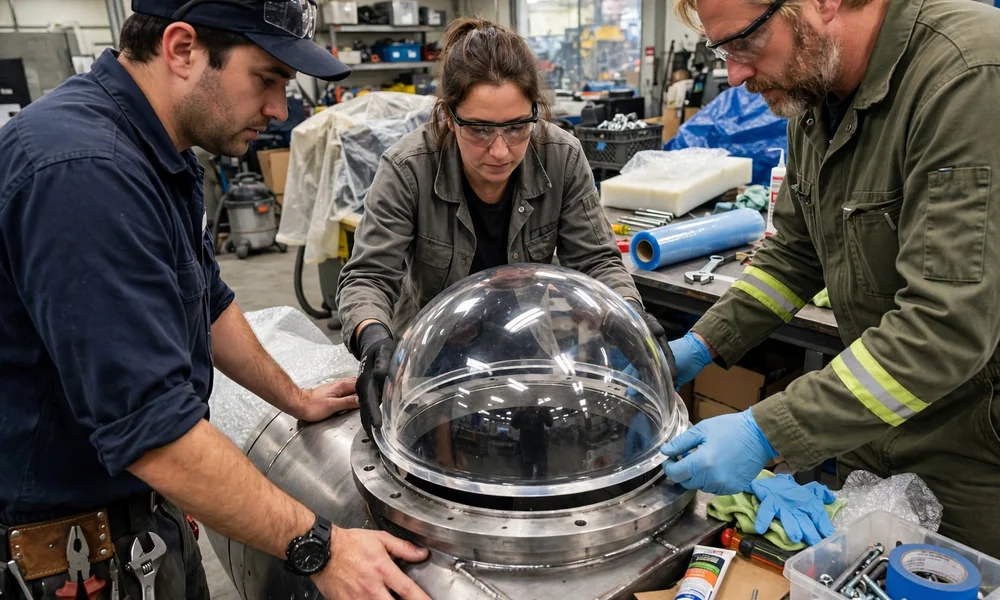
3. Fitting the viewing dome. The most recognisable part of a private submarine is its big clear dome, and it is also one of the hardest parts to make. The dome is cast from thick acrylic, sometimes more than 150 millimetres thick, and then machined and polished until it is optically clear. Owners choose the dome size carefully: a bigger dome gives a wider view but adds weight and cost.
4. Installing propulsion and ballast. A private submarine moves with electric thrusters, small propellers in pods that can turn in different directions. The power comes from large battery banks, usually lithium, which also run the lights, the instruments, and the life support. Ballast is handled with fixed weights and variable tanks: water is pumped in to sink and out to rise, and dropping a weight brings the boat up in an emergency. The whole system is designed so that the submarine is slightly buoyant if everything fails. The way a large expedition yacht is specified for self-reliance at sea follows the same idea.
5. Life support and controls. Inside the hull, the air must stay breathable for hours, so the submarine carries oxygen supplies and scrubbers that remove the carbon dioxide the crew breathes out. Sensors watch the oxygen and carbon dioxide levels constantly and sound an alarm if either drifts out of range. The controls are deliberately simple: a joystick for the thrusters, a small screen for depth and battery, and a set of manual valves that work even if the electronics fail. The pilot sits in the centre with the best view through the dome, and the passengers sit beside or behind, with their own small windows.
6. Testing, trials, and certification. A finished private submarine is tested in stages. The first dives are shallow and short, with a support boat overhead and a rescue plan in place. The training takes weeks, and it covers normal diving, emergencies, and the discipline of never pushing past the boat’s limits. The choice between steel and aluminium in a yacht hull is a gentler version of the same trade-off engineers make here: strength, weight, and cost, balanced against the job the vessel must do.
Operating a private submarine is a different world from sailing a yacht, and owners learn quickly that the boat is only half the story. The other half is the support: a mother ship or a shore base, a trained pilot, and a maintenance team that checks every seal and battery cell between dives. The craft that goes into a luxury cruise ship suite is about comfort in plain sight; the craft in a submarine is about safety that nobody sees, and the owners who understand that difference are the ones who enjoy their boats the longest.
Specifications
| Detail | Typical figure |
|---|---|
| Length overall | 5 to 8 metres |
| Passengers | 2 to 5 people |
| Hull material | Steel or titanium pressure hull |
| Maximum depth | 300 to 1,000 metres |
| Dive endurance | 8 to 12 hours |
| Propulsion | Electric thrusters, battery powered |
| Top speed | 2 to 4 knots underwater |
| Build time | 12 to 18 months |
Price
A new private submarine is estimated at roughly $2 million to $5 million, depending on its depth rating, passenger capacity, and the size of the viewing dome. A compact two-person boat rated for a few hundred metres sits near the lower end, while a larger titanium boat rated for 1,000 metres with a manipulator arm and a big dome can pass the upper end. These are estimates, not quotes, and the price does not include the support equipment: the launch crane, the charging system, and the training for the pilot and crew.
Running costs are estimated at roughly $100,000 to $200,000 a year, covering annual inspection, battery care, seal replacement, and recertification. Batteries are the largest recurring cost, and they are replaced on a schedule set by the manufacturer, not when they fail. Insurance is arranged separately and depends on where the boat will dive. Most owners keep their submarine on a yacht or at a shore base with a dedicated team, and they budget for maintenance the way an aircraft owner does: as a fixed cost of owning a machine that must never fail.

A Rare Fact
The first private submarines were built for wealthy adventurers in the 1960s, and one early model was so small that the pilot had to lie flat inside it, steering with a stick and watching the sea through a single small window. Modern boats are far more comfortable, but the idea has not changed: a private submarine exists so that a handful of people can go somewhere no surface boat can take them, and come back with a story nobody else can tell. The deepest private dives have reached places where sunlight has never arrived, and the pilots who made them describe the same thing: silence, cold, and a view that makes the cost feel irrelevant.


