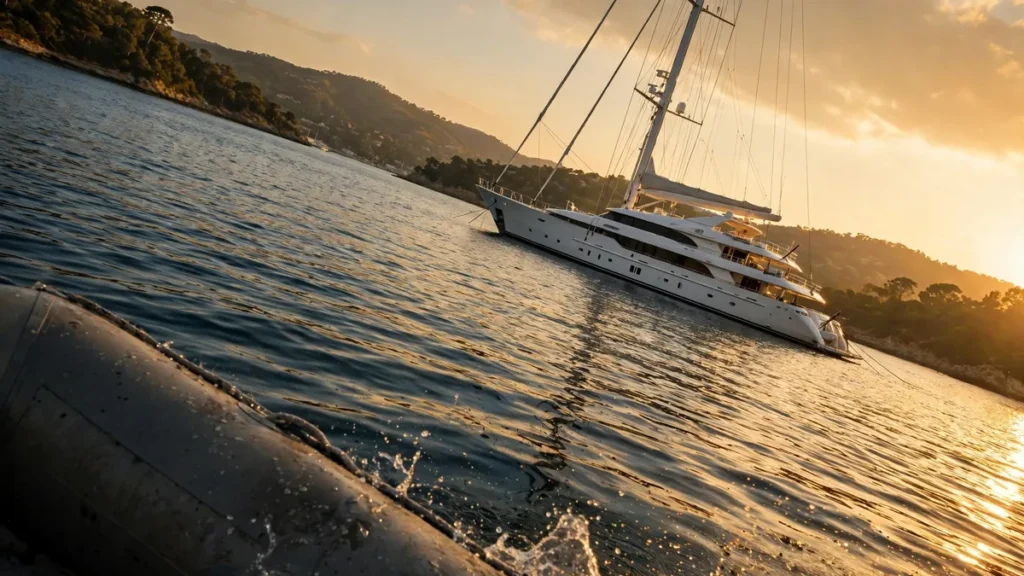
The chart showed open ocean for nine days in every direction, then a coastline with no marina, no fuel dock, and no town. The yacht anchored anyway, off a black-sand beach in a place the guidebooks barely mention, and stayed for a week. Nobody on board worried about fuel, fresh water, or a breakdown, because the boat had been built for exactly this: to go where the cruising grounds end and keep going. That is the expedition yacht, a vessel that trades the superyacht’s gleaming speed for range, strength, and the freedom to disappear.
An expedition yacht, often called an explorer yacht, is a long-range motor yacht built to cruise far from support, in rough water and remote places. Where a conventional superyacht is shaped for fair-weather speed and marina life, an expedition yacht is shaped for endurance: a heavy steel hull, huge fuel tanks, a workshop instead of a second saloon, and equipment for launching tenders, helicopters, and submersibles. The numbers on its spec sheet look modest next to a sleek superyacht, until you read what they actually buy. This guide reads the sheet the way a buyer and a captain would, number by number, and explains what each figure means at sea.

Expedition Yacht Specs Explained
Expedition yacht specifications are written in a different language from superyacht brochures. Top speed barely matters. What matters is range at cruising speed, fuel capacity, hull strength, and how long the boat can look after itself. Here is what the key numbers mean, and why each one shapes where the yacht can go.
Length and hull: steel, heavy, and built to take a knock
Expedition yachts typically run 40 to 90 metres long, with steel hulls and aluminium or steel superstructures. The steel hull is the defining choice: it is heavier than aluminium or composite, but it can take a grounding, a collision with ice, or a bump against a concrete quay in a fishing port and be repaired by any steel welder in the world. The case for steel-hull yachts rests on that trade, and expedition yachts are where the argument is won. The hull is usually a full-displacement shape with a bulbous bow, which is slow but efficient, and many carry an ice-class notation, meaning the plating and framing are strengthened for working in polar water.
Range and fuel: the number that sets the map
Range is the expedition yacht’s headline figure. A typical boat carries 100,000 to 400,000 litres of fuel and can cruise 5,000 to 10,000 nautical miles at ten to twelve knots without refuelling, enough to cross an ocean and keep exploring on the far side. That range comes from displacement speed: the yacht moves slowly, and slow is cheap in fuel. At fifteen knots the same boat would burn far more and go half as far, so the crew plans passages at economical speed and treats fuel as the currency of freedom. Water makers, freezers, and stores are sized to match, so the boat can stay away from port for weeks. Some owners add extra tankage in void spaces or carry fuel in deck drums for the longest passages, trading deck space for even more reach.
Speed and engines: slow, steady, and easy to fix
Most expedition yachts make twelve to fifteen knots flat out, and cruise at ten to twelve. Their engines are usually medium-speed commercial diesels, the same kind found in fishing boats and supply ships, chosen because spare parts exist in every port and any marine engineer can service them. A single-engine boat saves fuel and space, but many owners choose twins for redundancy: if one engine fails a thousand miles from help, the other brings the boat home. Superyacht or explorer yacht is a choice that starts here, with the engine room, because the two kinds of yacht are built around opposite answers to the same question.
Draft and stability: getting close without going aground
Draft, the depth of hull below the waterline, is typically 3 to 4.5 metres on an expedition yacht, shallow enough to enter anchorages and river mouths that a deep superyacht cannot risk. Stabilisers, either fin or gyroscopic, keep the boat steady at anchor and underway, which matters more on a long ocean passage than on a weekend cruise. The wide beam and heavy displacement also help: the boat rolls slowly and gently, and the crew can work on deck in weather that would keep a lighter yacht in port.

Deck equipment: a working boat, not a floating lounge
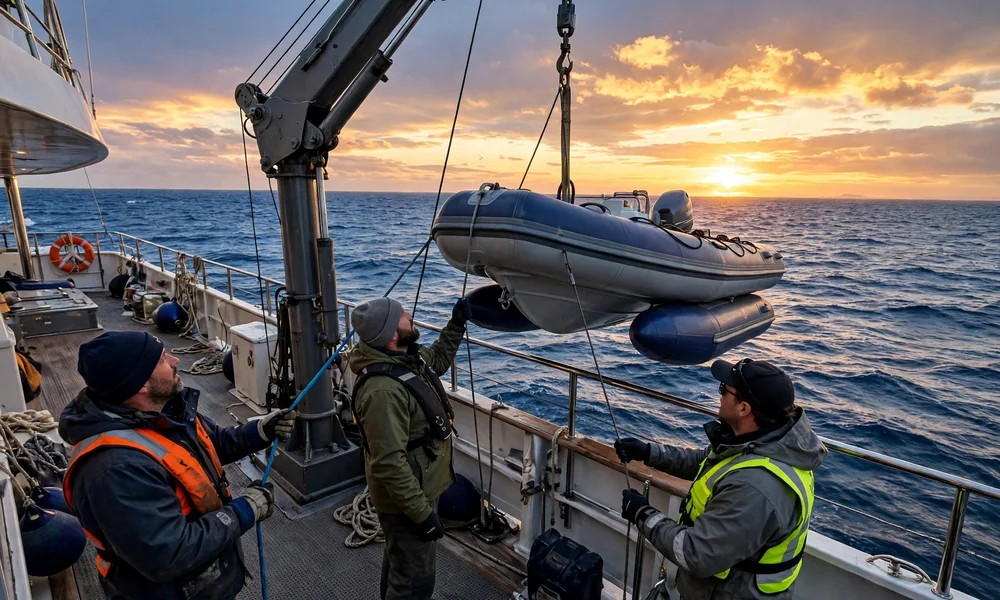
The deck of an expedition yacht looks like a working ship. A crane, often rated to lift three to ten tonnes, launches tenders, jet skis, and even a small submersible. There is a helipad or a helicopter deck on larger boats, a dive store with compressors and tanks, and a workshop with a lathe, welding gear, and shelves of spares. Yacht toys and tenders ranked shows what the leisure side looks like, but on an expedition yacht the toys are tools: the tender is how you reach the beach, and the submersible is how you see what lies below it. Crew cabins are larger than on a superyacht of the same length, because the crew works longer hours and the boat stays out longer.
Expedition Yacht Specifications
| Specification | Typical figure |
|---|---|
| Length | 40 to 90 metres |
| Hull | Steel, full displacement, often ice-class |
| Range | 5,000 to 10,000 nautical miles at 10 to 12 knots |
| Fuel capacity | 100,000 to 400,000 litres |
| Top speed | 12 to 15 knots |
| Draft | 3 to 4.5 metres |
| Endurance | Weeks away from port, fully self-sufficient |
What an Expedition Yacht Costs
An expedition yacht costs an estimated $20 million to $150 million new, depending on length and outfitting, and running costs run an estimated $2 million to $10 million a year, covering fuel, crew, maintenance, and insurance. A used expedition yacht can cost far less, but refitting a commercial hull to yacht standard is itself an estimated $5 million to $30 million job. The steel hull itself is cheaper per tonne than a composite or aluminium superyacht hull, but the long-range systems cost more: bigger tanks, water makers, a workshop, cranes, and redundant machinery all add up. The real expense is the crew and the fuel for long passages, and owners accept it because the alternative, a faster yacht that must stay near marinas, cannot do the job at all.
A Rare Fact About the Expedition Yacht
Many expedition yachts began life as something else entirely: offshore supply ships, fishing trawlers, and even icebreakers, converted into yachts by owners who wanted a working hull under a comfortable interior. The most famous conversions keep their commercial bones, including the big crane and the steel wheelhouse, and their owners say the boat’s past life is the point. A yacht designed as a yacht has never been tested by the North Sea in January. A converted supply ship has, every winter of its working life.
An expedition yacht is not the fastest or the prettiest boat in the marina, and it does not try to be. It is the boat that leaves the marina behind, crosses an ocean at twelve knots, and anchors off a beach no superyacht can reach. The spec sheet is the map, and the map is the whole point.