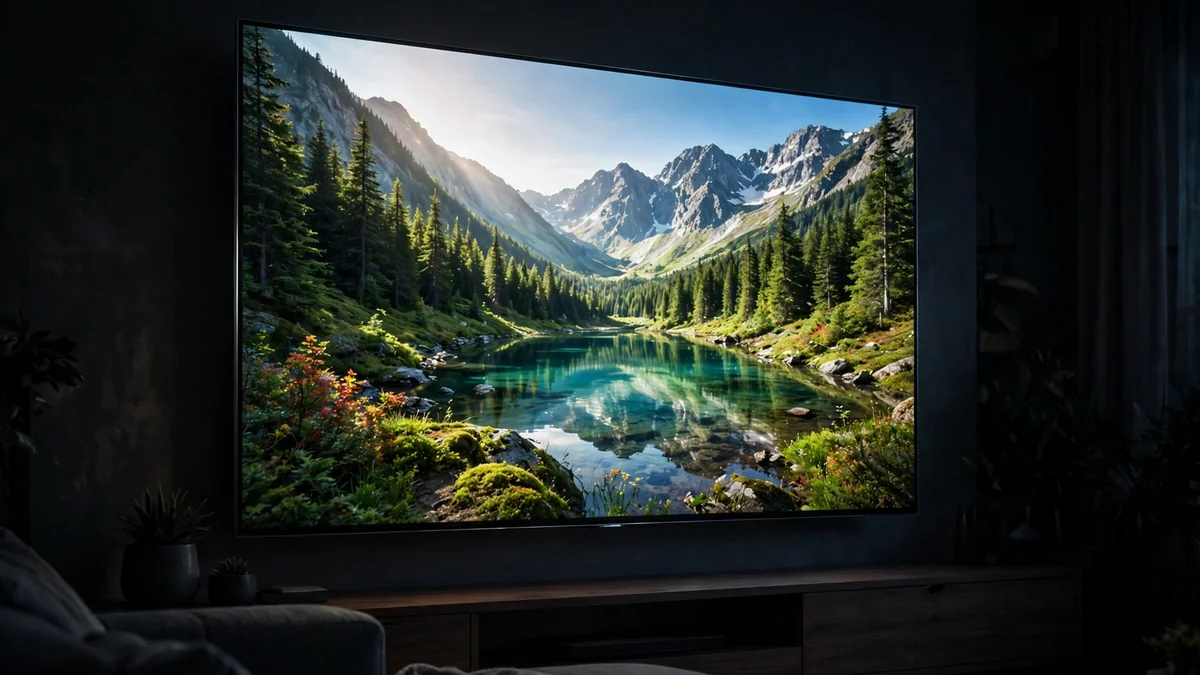
Look at a modern television in a dark room and the colours seem to glow from inside the screen — reds deeper than paint, greens brighter than grass, all of it sharp enough to fool the eye. Much of that colour comes from particles so small that a million of them would fit on the head of a pin. They are quantum dots, tiny crystals of semiconductor that turn blue light into pure, precise colour, and they are the reason the best screens today look almost alive.
Making a quantum dot display means handling materials measured in billionths of a metre, coating them onto film thinner than a hair, and sealing them into a panel that must survive years of heat and light without fading. The dots themselves are grown in a chemical reactor, one batch at a time.
From a flask of glowing liquid to a television on a wall takes a chain of factories and a dozen precise steps. This is how a quantum dot display is made.
How It’s Made
Step 1: Growing the quantum dots
The quantum dots are born in a chemical reactor, where cadmium or indium compounds are heated in a solvent until tiny crystals form. The trick is size: a dot about two nanometres across glows blue, one about three glows green, and one about five glows red. Chemists control the size by timing the reaction to the second and cooling it at exactly the right moment. The result is a liquid full of dots, each one almost exactly the same size, glowing under ultraviolet light like coloured ink.
Step 2: Coating the dots into a film
The dots are mixed into a resin and coated onto a thin plastic film, in a layer only a few microns thick. The coating must be perfectly even: a patch that is too thick will look brighter than its neighbours, and a patch too thin will look dull. The film is cured with ultraviolet light, locking the dots in place, and then inspected under special lamps that reveal any unevenness. Some makers print the dots directly onto the display’s colour filter instead, but the film method remains the most common. The factory process around this stage is described in inside quantum dot display production, where the production line is laid out in detail.
Step 3: Making the glass and the backlight
Meanwhile, the display’s glass panels are made. Two sheets of thin glass are coated with transparent electrodes and the thin-film transistors that switch each pixel on and off — millions of them, each smaller than a human hair is wide. Behind the glass sits the backlight: a sheet of blue LEDs whose light will pass through the quantum dot film and be converted into red and green. The blue light that passes straight through becomes the blue of the picture, so the three colours together make white. The glass work is as delicate as the work behind OLED display panel specs, where the same transistor backplane carries a different kind of light.
Step 4: Laminating the layers together
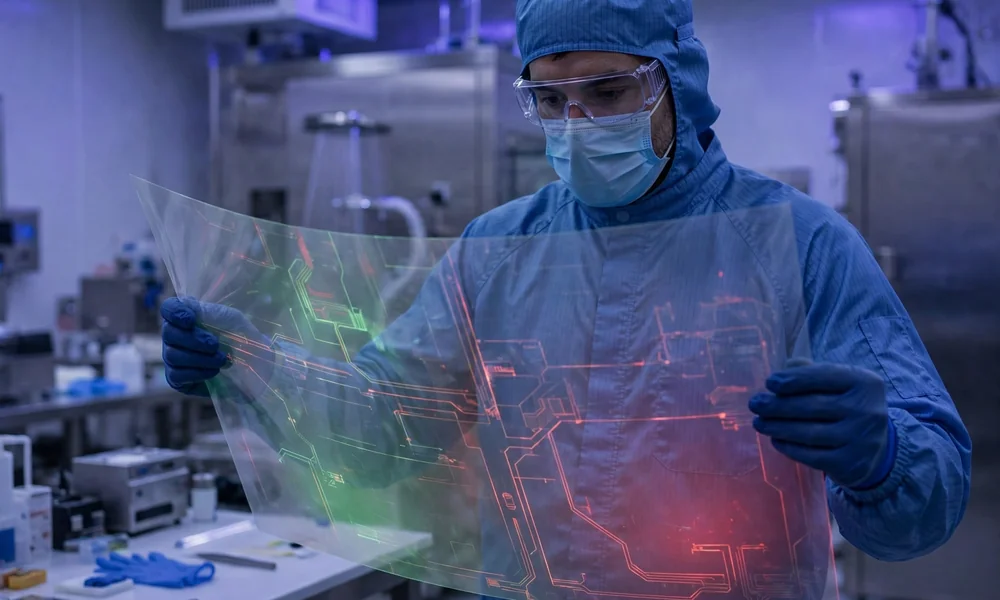
Next, the layers are laminated into a single panel: the backlight at the back, the quantum dot film in front of it, the liquid crystal layer that shapes the light, and the glass with its colour filters and transistors at the front. Each layer is aligned to within microns and bonded without a single bubble or speck of dust, because any flaw will show on screen as a bright spot or a dead patch. The work is done in a cleanroom by machines that handle the glass with vacuum grippers, and the finished panel is already a working display, with no frame, no electronics, and no power yet.
Step 5: Adding the driver electronics and the frame
The panel is fitted with driver chips along its edges — small processors that tell each row and column of pixels what to do, millions of times a second. A timing controller coordinates them, and a power board feeds the backlight. Workers connect flexible ribbon cables finer than thread, then mount the panel in its frame with the bezel, the stand or wall mount, and the outer casing. The television is now a complete machine, ready for its first switch-on. The colour science behind it is a close cousin of the materials science in why the quantum dot display is so expensive, which explains what the dots themselves cost to make.
Step 6: Calibrating the colour and testing the panel
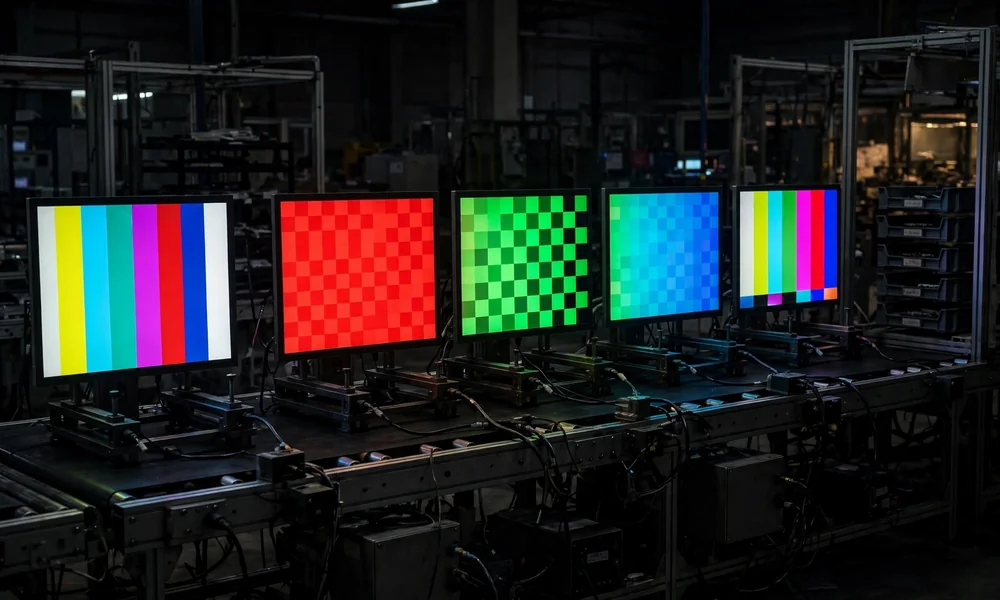
Every display is calibrated before it leaves the factory. It is switched on in a dark room, and cameras measure the colour of test patterns against a reference, adjusting the drivers until the reds, greens, and blues match the standard. The panel is checked for dead pixels, uneven brightness, and backlight bleed, and it is run for hours to catch early failures. A panel that fails calibration is reworked or scrapped; the best panels are graded for premium models, and the rest become cheaper sets. Only after passing every test is the display boxed and shipped.
| Main material | Semiconductor nanocrystals, usually cadmium selenide or indium phosphide |
| Dot size | About 2 to 5 nanometres, depending on the colour produced |
| Film thickness | Only a few microns of quantum dot resin on plastic film |
| Backlight | Blue LEDs, converted to red and green by the quantum dots |
| Colour range | Can cover nearly the full cinema colour standard |
| Panel size | From small monitors to televisions over 85 inches across |
| Manufacturing time | Days for the panel, after months of dot and glass production |
| Testing | Every panel is colour-calibrated and checked for dead pixels |
What Does a Quantum Dot Display Cost?
A quantum dot television is estimated at roughly $800 to $3,000, depending on size and brand, with large premium models estimated at $4,000 or more. The dots themselves are a small part of the cost — the glass, the backlight, and the calibration are what drive the price. Smaller quantum dot monitors are estimated at $300 to $800. Prices have fallen as production has scaled up, and the technology now sits between ordinary LED televisions and OLED sets: more vivid than the first, usually cheaper than the second. For most buyers, it is the brightest picture available at the price.
A Rare Fact
Quantum dots were discovered by accident. In the early 1980s, a Russian physicist studying tiny semiconductor crystals in glass noticed they changed colour with their size — a piece of glass that should have been one colour glowed another, simply because its crystals were smaller. The effect was a curiosity for decades, too hard to control for any practical use. It took thirty years of chemistry to make dots of exactly the right size, reliably, in bulk — and the first televisions to use them did not reach shops until 2013. A laboratory oddity became the brightest screen in the house.
The quantum dot display will never be the part a television owner thinks about. It hangs on the wall, silent, showing films and games in colours that seem too vivid to be real. But every red that looks like fresh paint and every green that looks like spring comes down to crystals smaller than a virus, grown in a flask and coated onto film thinner than a hair. It is the smallest machine in the house — and one of the most beautiful to make.


