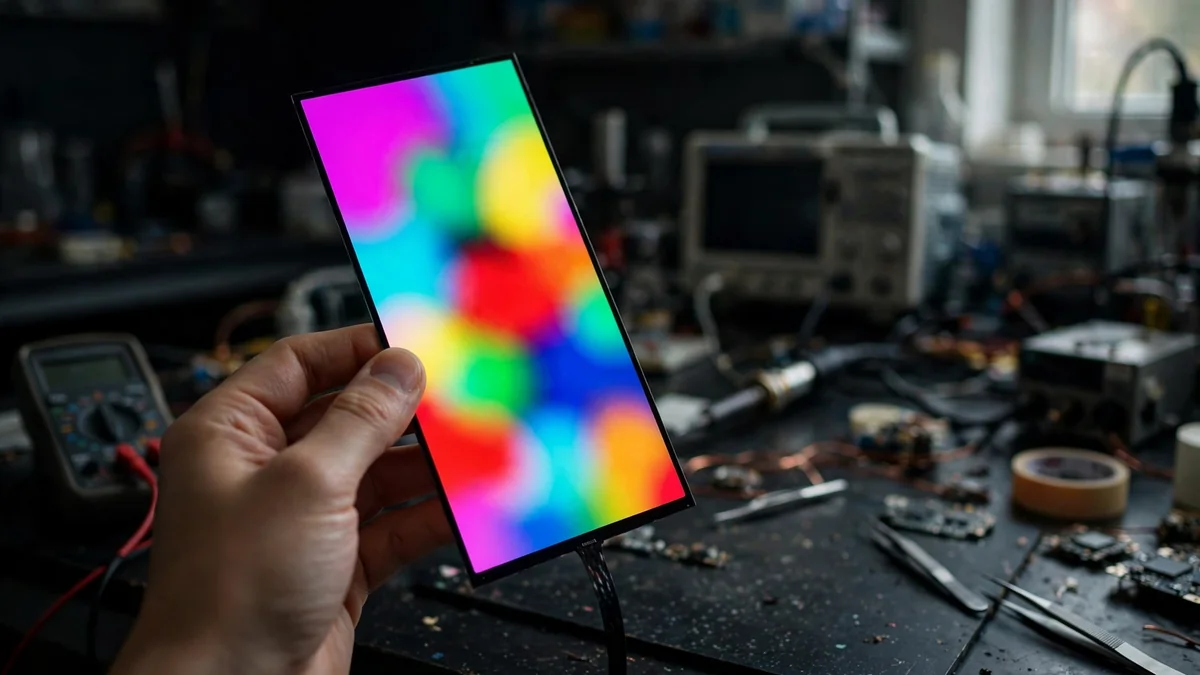
The lights in the laboratory are off, and that is exactly the point. On the bench sits a phone with no case, its screen facing the ceiling, and the whole room is lit by it — a photograph of a coral reef glowing in impossible colour, the black water around it so dark it seems to swallow the light at the edges. There is no backlight humming behind the glass, no pale grey wash where black should be. Each tiny point of the picture is making its own light, and the points that are meant to be dark are simply switched off.
That is the trick of an OLED display panel, and once you have seen it in a dark room you cannot unsee the difference. Hold an ordinary LCD next to it and the LCD looks like a picture taped over a lamp: the blacks are really a dim grey, because the lamp behind the screen is always on. The OLED beside it looks like a window cut into the night, its colours floating on the glass itself, and when the picture goes black the panel disappears into the dark around it.
It feels like magic, but it is chemistry and precision engineering at a scale smaller than a human hair. An OLED panel is a sandwich of microscopically thin organic layers, laid down on glass or flexible plastic, with millions of individual light sources controlled one by one. The numbers on a specification sheet are just a way of describing how well that sandwich does its job. Here is what those numbers mean, and how the panel behind them actually works.
How It Works
Step 1: Switching on a single pixel
Every pixel on an OLED panel is its own light source, and that is the whole idea. OLED stands for Organic Light-Emitting Diode: when an electric current passes through the organic material inside a pixel, the material glows. There is no separate lamp behind the screen, as there is in an LCD, so a pixel told to show black simply receives no current and stays dark. That is why OLED blacks look truly black.
Step 2: Building the organic sandwich
Inside each pixel sits a stack of organic layers only a few hundred nanometres thick — far thinner than a sheet of paper. At the heart of the stack is the emissive layer, the material that actually produces the light. Around it are transport layers that carry electric charges toward the centre: one side delivers electrons, the other delivers positively charged holes. When an electron and a hole meet inside the emissive layer, they combine and release their energy as a photon, a particle of light.
Step 3: Controlling millions of pixels with a TFT backplane
A phone screen can hold more than two million pixels, and each one needs its own instructions many times a second. That control comes from a thin-film transistor backplane, a grid of microscopic transistors laid down beneath the organic layers. Each pixel has its own transistor acting as a tiny tap, deciding exactly how much current flows through it and therefore how brightly it glows. That grid lets the display set every pixel’s brightness independently.
Step 4: Mixing colour from red, green, and blue subpixels
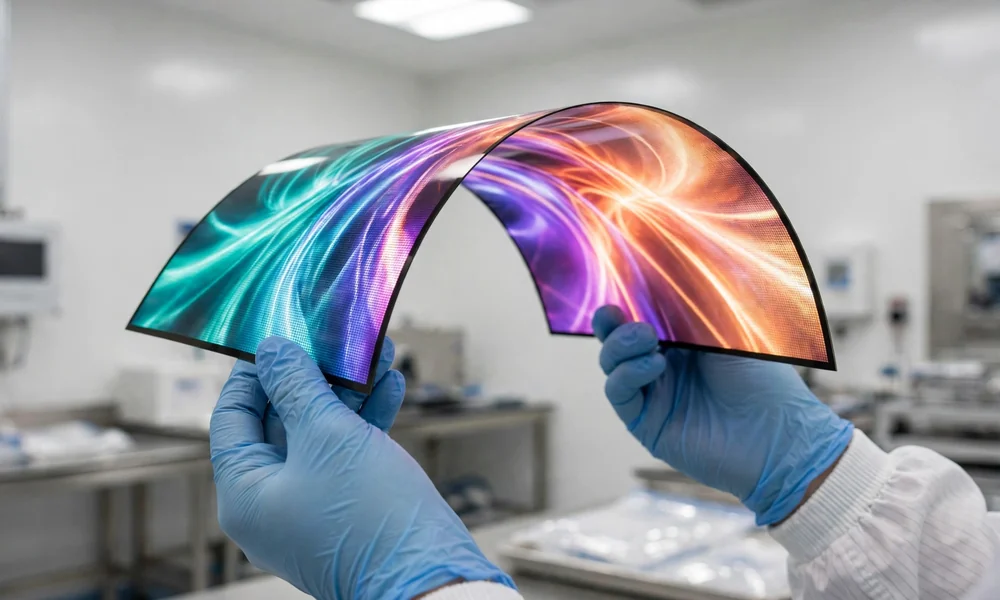
Look closely at an OLED screen under a magnifier and the picture dissolves into stripes of red, green, and blue. Each pixel is made of three smaller subpixels, one for each primary colour, and the screen creates every other colour by mixing them. A white pixel turns all three up to full brightness; a yellow pixel lights red and green together and leaves blue dark. The subpixels are so small — tens of micrometres across — that the eye blends them into a single smooth colour at normal viewing distance.
Step 5: Refreshing the picture many times a second
A still photograph on a phone is not really still. The panel redraws the whole image dozens of times a second, a rate called the refresh rate, and each redraw is a chance to change what every pixel shows. A 60-hertz panel refreshes sixty times a second; a 120-hertz panel does it twice as often, which makes scrolling and animation look smoother and reduces blur when something moves quickly. Keeping all of that fast switching cool is a serious design problem, and it shares ground with the challenge of cooling sustained performance in any compact device that works hard in a small space.
Step 6: Powering the panel without wasting energy
Because each pixel makes its own light, an OLED panel only spends energy where the picture is bright. A dark interface, a black wallpaper, or a video of a night scene all draw far less power than a white web page at full brightness — which is why dark mode genuinely saves battery on OLED phones, and does almost nothing on LCD phones. Engineers manage this with careful current control and by shifting static images by a pixel or two, so no one subpixel is stressed in the same spot for hours.
OLED Display Panel Specs
| Specification | Typical range |
|---|---|
| Panel type | AMOLED or OLED, rigid glass or flexible plastic substrate |
| Peak brightness | About 800 to 2,000 nits, higher in small highlights |
| Resolution | About 2,340 by 1,080 up to 3,200 by 1,440 on flagship phones |
| Refresh rate | About 60 to 120 hertz, some panels from 1 to 144 hertz |
| Colour gamut | About 100 percent of DCI-P3 on good panels |
| Contrast ratio | Effectively infinite, often quoted as 1,000,000 to 1 or higher |
| Response time | About 0.1 milliseconds or less, pixel to pixel |
| Power draw | About 0.5 to 4 watts depending on brightness and content |
What Does an OLED Display Panel Cost?
An OLED panel is one of the most expensive parts of a phone, and its price depends above all on size, resolution, and how many of them a manufacturer orders. A replacement OLED panel for a typical mid-range phone is estimated to cost roughly $60 to $150 as a spare part, while a large, high-refresh-rate panel for a flagship phone is estimated at roughly $150 to $300. Prices are estimates only and vary widely by model, supplier, and order size.
A Rare Fact
The first practical OLED device was not built by a phone company at all. In 1987, two researchers at Kodak, Ching Tang and Steven Van Slyke, built the first efficient organic light-emitting diode, a small device that glowed green when a current passed through it. Twenty years later came the first commercial OLED television, Sony’s 11-inch XEL-1 in 2007. The machining that makes such precision possible at scale rests on techniques like the ones behind titanium machining challenges, where tolerances are measured in micrometres and there is no room for error.

An OLED panel is a strange and elegant thing: millions of tiny lights, each one lit by chemistry and switched by a transistor, blending into pictures that look more real than the glass they sit behind. Brightness, contrast, gamut, and refresh rate all describe the same achievement from different angles — a screen that makes its own light, exactly where it is needed, and nowhere else. Like the layers inside stacked camera sensors, it is engineering you look straight through without noticing.


