Switch on a top-end television in a dark room and the first thing you notice is the black. Not the dark grey of an ordinary screen, but a true black, deep and empty, with a bright image floating on it as if it were painted on glass. That black is the reason an OLED display panel costs so much. Each pixel on an OLED panel makes its own light, and when a pixel is meant to be black, it simply switches off. No backlight leaks through, no glow washes out the shadows, and the picture looks the way the film maker intended.
What you are looking at is not a screen with a light behind it. An OLED panel is a sandwich of glass, transparent electrodes and organic layers thinner than a human hair, built in a vacuum, in a clean room, by machines the size of houses. Every pixel is a tiny lamp, and there are millions of them, each one laid down with a precision that would shame a watchmaker. An OLED display panel is one of the most expensive screens ever made for its size, and the reasons are deposited layer by layer.
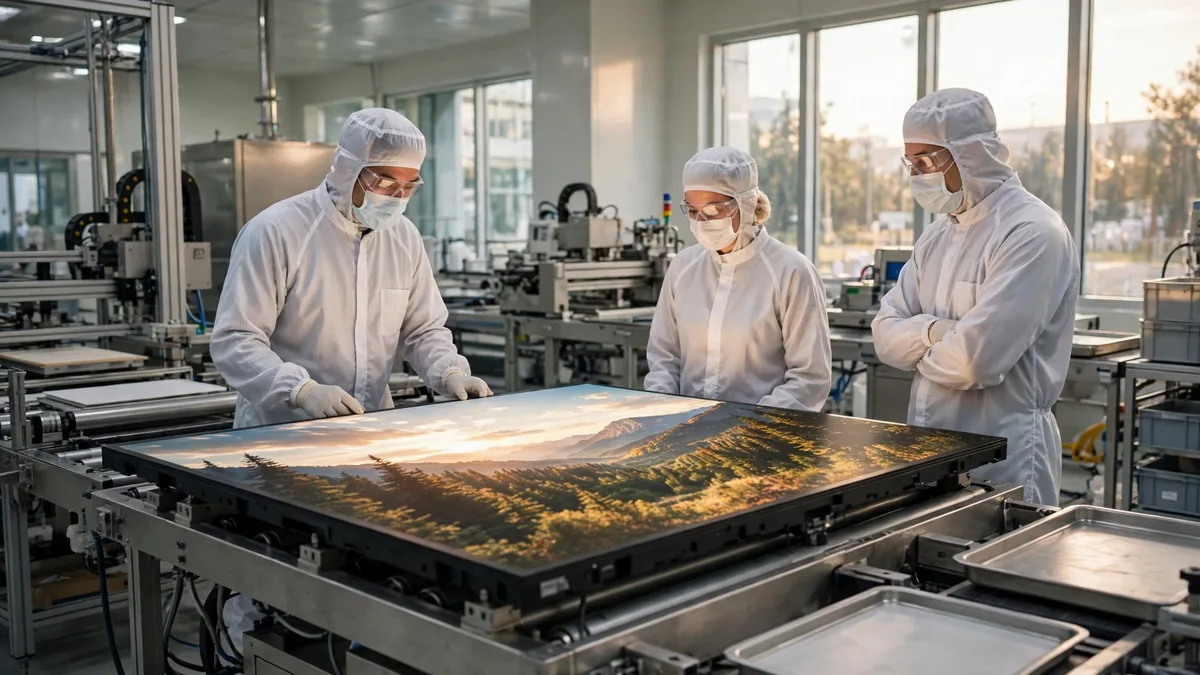
Why It Costs So Much
The price of an OLED display panel is not the price of glass. Raw materials are only a small part of the bill. The real money goes into the clean rooms, the vacuum deposition, the organic materials and the low yields, and into doing it at all, because there is no cheap way to make millions of perfect pixels on a sheet of glass the size of a door. A factory that rushes this work ends up with dead pixels, uneven brightness and panels that age in patches.
1. Organic layers thinner than a human hair
The heart of an OLED panel is a stack of organic layers, each one only a few dozen nanometres thick, that glow when electricity passes through them. How an OLED display panel is made walks through the build step by step, and the organic stack is the step where most panels fail.
2. Vacuum deposition in rooms cleaner than a hospital
The organic layers are deposited in a vacuum, inside machines that heat the materials until they evaporate and condense onto the glass in a fine mist. The clean rooms around them are kept cleaner than an operating theatre, because a single speck of dust landing on the glass becomes a dead pixel or a dark spot that grows with time. The clean room alone costs hundreds of millions of dollars to build, and it must run day and night without stopping.
3. Fine metal masks that must never stretch
To place the red, green and blue materials exactly where they belong, the factory uses fine metal masks, thin sheets of metal with millions of tiny holes, held a hair’s breadth above the glass. How an OLED display panel works explains the pixel structure and the mask, and why the mask is one of the most expensive tools in the whole factory.
4. Yields that would bankrupt an ordinary factory
In a mature LCD factory, almost every panel that comes off the line is good enough to sell. In an OLED factory, especially for large television panels, a large share of the panels fail testing, because a dead pixel, an uneven patch or a contaminated layer ruins the whole sheet. Every failed panel wastes the glass, the organic materials, the clean-room time and the labour that went into it, and the cost of the good panels must carry the cost of the bad ones.
5. Encapsulation that keeps air out for a decade
The organic layers in an OLED panel are poisoned by oxygen and moisture, so the finished panel must be sealed against the air for its whole life. The factory bonds a thin glass or film cover over the panel, seals the edges with a special adhesive, and sometimes adds layers of inorganic film a few atoms thick to block any leak.
6. Testing every pixel before the panel is trusted
An OLED panel is not finished when it leaves the line. Every pixel is lit and photographed, the brightness and colour of each one are measured, and panels with too many dead pixels or uneven patches are rejected. OLED display panel specs, explained show what the panels are measured against, and the testing is the moment of truth for the whole factory, because a panel that passes is one of the few that survived.

What the Numbers Say
| Specification | OLED display panel |
|---|---|
| Panel type | Self-emissive organic light-emitting diode |
| Typical television size | 55 to 83 inches for a large panel |
| Pixel count | About 8.3 million for a 4K panel |
| Organic layer thickness | A few dozen nanometres per layer |
| Contrast ratio | Effectively infinite, with true black |
| Response time | Less than a millisecond per pixel |
| Design life | Tens of thousands of hours of viewing |
What It Costs, and Why
An OLED display panel for a large television typically costs an estimated $800 to $2,000 to make, depending on size and grade, and the panel alone can be more than half the price of the finished television. The figure is an estimate because no two panels are alike: a larger panel wastes more glass when it fails, a brighter panel needs more demanding materials, and a panel with a higher refresh rate needs tighter manufacturing. The clean rooms, the deposition machines, the masks and the low yields are where the money goes.
That cost is spread over very few factories. The world has only a handful of plants that can make large OLED panels, so the cost of the buildings, the vacuum machines and the specialist workforce is divided among a tiny number of lines.

Why the Price Stays High
The price stays high because the work cannot be automated away. Machines can deposit the layers, but the design, the mask engineering and the failure analysis all depend on people with years of experience, and those people are few. The technology is also unfinished, which means the factories being built today may need new masks and new materials tomorrow when a better blue emitter or a better encapsulation arrives.
There is also the matter of what the panel has to survive. It shows a picture for tens of thousands of hours, it takes the heat of its own light again and again, and it has to keep its colours true for years without the maintenance budget of a cinema projector. A panel built cheaply would cost less on the day it is sold and far more over the life of the television, and nobody who buys a top-end screen wants to discover that in a dark room.
A Rare Fact
Some OLED factories keep their clean rooms so clean that a worker’s skin, breath and even the fibres of a suit are treated as contamination, and the air inside is filtered so thoroughly that a cubic metre of it contains fewer particles than the air on a mountaintop. A single speck of dust can kill a pixel, and the whole factory is built to keep dust out.