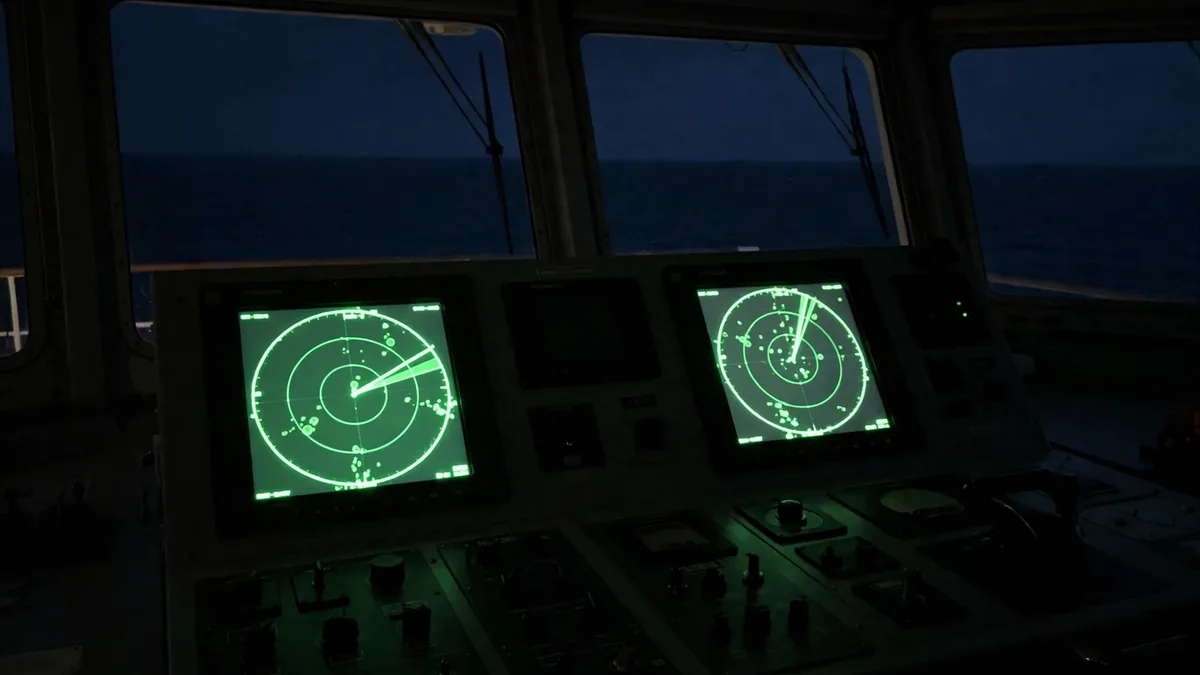
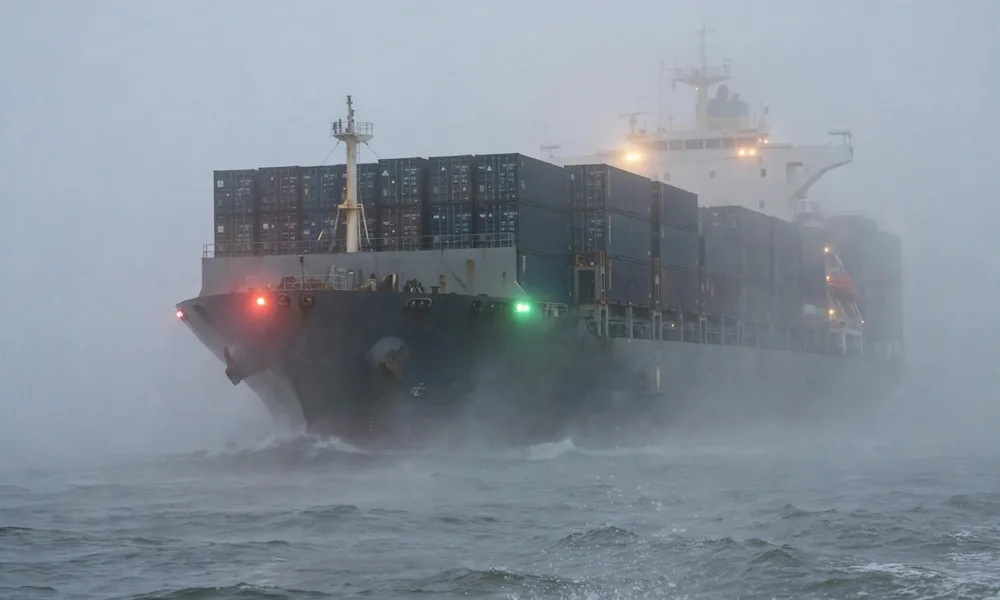
On a dark night in thick fog, a ship’s bridge is blind in the ordinary sense. There is no horizon, no coastline, no other vessel to be seen through the windows. Yet the officer of the watch can still see for miles in every direction, because the radar is painting a picture of everything around the ship: the coastline, the buoys, the other ships, and the rain squall closing in from the north. It does this without light and without asking anything of the targets it detects. It simply sends out pulses of radio energy and listens for what comes back.
Radar is one of the oldest electronic navigation aids at sea, and it remains one of the most important. Satellite navigation tells a ship where it is. Radar tells a ship what is around it, right now, including the vessels that are not broadcasting their position.
This guide explains how ship radar works, from the pulse leaving the scanner to the collision warning on the bridge display.
How Ship Radar Works
Ship radar works by pulse and echo. A transmitter sends out a very short burst of microwave energy, the scanner antenna radiates it in a narrow beam, and the set then listens for the fraction of that energy that bounces back off a target. The time between sending and receiving gives the range, because radio waves travel at the speed of light, a known and constant speed. The direction the antenna was pointing when the echo arrived gives the bearing. As the scanner rotates through 360 degrees, the set assembles those ranges and bearings into the familiar circular picture with the ship at the centre, refreshed with every sweep.
Step 1: The transmitter makes the pulse
The pulse starts in the transmitter, traditionally a magnetron, a vacuum tube that produces a powerful burst of microwaves lasting less than a microsecond. Modern sets increasingly use solid-state transmitters, which are more reliable, use less power, and need no warm-up time, but the job is the same: a short, powerful pulse at a precise frequency. A modulator triggers the transmitter and sets the pulse length and the pulse repetition frequency. A short pulse gives finer range discrimination, so two close targets show as two echoes rather than one, while a longer pulse carries more energy and reaches further.
Step 2: The scanner sends and catches
The scanner is the rotating antenna, usually a long slotted waveguide bar mounted high on the mast, turning steadily at around 20 to 30 revolutions a minute. It radiates each pulse in a narrow horizontal beam, only a degree or two wide, and a broad vertical fan that copes with the ship pitching and rolling. The same antenna catches the returning echo, and a component called the duplexer makes that possible: it connects the antenna to the transmitter during the pulse and to the receiver while listening, and shields the sensitive receiver from the powerful outgoing burst. The scanner reports its angle to the display continuously, so every echo is plotted at the correct bearing.

Step 3: The receiver hears the echo
By the time an echo returns, it is astonishingly faint, often weaker than a billionth of a watt, and mixed with reflections from waves, rain, and the ship’s own structure. The receiver amplifies it enormously and filters it, then passes it to the display. The set applies controls every watchkeeper learns: sea clutter control, which suppresses the returns from waves close to the ship, and rain clutter control, which suppresses the haze of a rain squall. The range itself comes from a simple calculation: range equals the speed of light multiplied by the echo time, divided by two, because the pulse travels out and back.
Step 4: Two bands do two jobs
Large ships carry two radars because no single frequency does everything well. X-band, around 9 gigahertz with a wavelength near 3 centimetres, gives a sharp, detailed picture. It picks out small targets, buoys, and coastline features, and it is the band that triggers radar beacons and search-and-rescue transponders. Its weakness is weather: the short wavelength is scattered by rain and by the sea surface, so the picture clutters badly in bad conditions, exactly when it is needed most. S-band, around 3 gigahertz with a wavelength near 10 centimetres, shows less fine detail but punches through rain and sea clutter and holds onto targets at long range in heavy weather. The two sets complement each other.
Step 5: ARPA tracks the targets
A raw radar picture shows where things are, but it does not say where they are going. That is the job of ARPA, the automatic radar plotting aid. ARPA acquires the echoes it sees and follows them from sweep to sweep, working out each target’s course and speed, and how close it will pass: the closest point of approach, and the time until it gets there. If the bearing of a contact stays steady while the range falls, the two vessels are on a collision course, and ARPA raises an alarm. International rules require ARPA on vessels above 10,000 gross tons. ARPA is a superb tool and a fallible one: it can swap two targets that cross, it lags after a target alters course, and it loses contacts in heavy clutter, so its output is to be checked against the raw picture, not obeyed blindly.
Step 6: Radar joins the rest of the bridge
Modern ship radar does not stand alone. It overlays the electronic chart, so echoes sit on top of the coastline and the planned route. It fuses with AIS, the automatic identification system, matching radar echoes to the position reports broadcast by other ships, which flags the vessel that is there on radar but silent on AIS. Some solid-state sets add Doppler processing, measuring the tiny frequency shift of returning pulses to tell a moving target from a stationary wave crest. The radar remains the only sensor in the set that detects what is really there regardless of whether the other vessel cooperates.
What Limits Radar
Radar has hard physical limits, and a good watchkeeper knows them. The beam travels in a straight line, so a low target beyond the horizon is invisible no matter how powerful the set, which is why the scanner is mounted as high as possible. Small wooden or fibreglass boats reflect poorly and can vanish among wave clutter, which is why they fit radar reflectors. Heavy rain can hide a target even on S-band, and a strong echo from a nearby steel hull can mask a smaller vessel behind it. While the set is transmitting it cannot listen, so a target very close to the ship can fall inside the blind gap after each pulse. None of these limits makes radar unreliable. They make it a tool that rewards a trained operator, and that is why it still sits at the centre of the bridge, decades after it was first fitted to ships.
For the smaller-scale version of the same technology, see how a yacht radar system works on a leisure vessel, what the cruise ship bridge specs say about the equipment around the radar, and how a ship bridge works as a whole. The screen on the bridge is only the end of the chain; the scanner on the mast is where the seeing happens.


