It is three in the morning in the middle of the Atlantic, and the largest moving object most of the passengers will ever stand on is gliding through the dark at twenty-two knots. Up on deck fourteen, behind tinted glass that wraps almost all the way around the bow, two officers watch a wall of glowing screens. The captain is asleep below, but the ship is never unwatched. The bridge of a modern cruise ship is the command centre for a floating town of six thousand people, and it has to do three jobs at once: see everything, steer a vessel longer than three football fields, and keep every system talking to every other system without a single missed message.
From the outside, the bridge looks like a quiet room with a good view. Inside, it is one of the most densely engineered spaces on the ship. There are no wheels the size of a car, no brass telegraphs, and no shouting down speaking tubes. Instead there are touchscreens, joysticks, radar displays, and a single panoramic window built from heated glass panels that never fog. Every control is duplicated, every screen has a backup, and the whole room is designed so that one officer can run the ship alone in an emergency. The numbers behind it are remarkable, and they explain why a cruise ship bridge costs tens of millions of dollars to build and fit out.
The Key Specs, Explained
Size and layout. A large cruise ship bridge is typically twenty-five to thirty metres wide, spanning the full width of the ship, and around ten metres deep. The forward window is made of individual glass panels, each roughly two metres wide, tilted slightly outward so reflections do not blind the watch at night. The glass is heated to stop condensation, laminated to survive a wave strike, and in some designs fitted with wipers the size of a car windscreen wiper. The watchkeeper stands or sits at a central console, with the captain’s chair behind, and every station within a few steps. The layout follows a simple rule: the officer of the watch should never have to turn their back on the sea to read a screen.

Navigation and radar. The heart of the bridge is the integrated navigation system, which fuses data from satellite positioning, gyrocompasses, radar, and electronic charts onto a handful of displays. Modern cruise ships carry two independent radars, one X-band set for sharp close-range detail and one S-band set that sees through rain. The satellite positioning is accurate to within a few metres, and the gyrocompass holds the ship’s heading to a fraction of a degree. When the ship enters a busy port, the officer can overlay the radar picture directly onto the chart, so a blip on the screen becomes a named vessel with a course, a speed, and a predicted closest approach.
Steering and propulsion control. A cruise ship does not steer with a wheel in the old sense. The officer steers with a small joystick or a tiller the size of a dinner plate, and the command travels by wire to the rudders and the podded propulsors beneath the hull. The bridge also controls the bow thrusters, the stabilisers that stop the ship rolling, and the engines themselves. On most large cruise ships the engines are diesel-electric, so the bridge orders power rather than turning a shaft directly, and the ship’s computers decide how to split that power between propulsion, air conditioning, and the thousands of cabins below. The same console that steers the ship also talks to the podded propulsors that swing beneath the hull, giving the vessel a turning circle far tighter than its size suggests.
Communication and safety systems. The bridge carries satellite phones, very-high-frequency radios, and a global distress system that can summon help from anywhere on Earth with a single button press. A voyage data recorder, the ship’s black box, captures every radar image, every radio call, and every helm order, storing it in a capsule designed to survive a sinking. Fire alarms, watertight door controls, and the public address system are all managed from the bridge, so the captain can seal a section of the ship or order an evacuation without leaving the room. There is even a dedicated console for the lifeboats and the muster stations, showing at a glance which boats are ready and which decks have been cleared. The bridge is also where the ship’s officers monitor the engines that power the whole vessel, watching fuel use, exhaust temperatures, and electrical load on the same screens as the navigation picture.

Cruise Ship Bridge Specs at a Glance
| Specification | Typical Value |
|---|---|
| Bridge width | 25 to 30 metres, full beam of the ship |
| Forward window panels | Heated, laminated glass, about 2 metres each |
| Radar sets | Two, X-band and S-band, fully duplicated |
| Position accuracy | Within a few metres by satellite |
| Heading accuracy | Gyrocompass to a fraction of a degree |
| Steering control | Joystick or mini tiller, triple-redundant |
| Watch team | Two officers minimum, four-hour watches |
| Ship length controlled | Up to 360 metres, over 6,000 people aboard |
What a Cruise Ship Bridge Costs
Nobody sells a cruise ship bridge on its own, so there is no catalogue price, but shipbuilding estimates put the cost of the bridge and its navigation, communication, and control systems at roughly fifteen to thirty million dollars on a large new cruise ship, depending on the size of the vessel and the level of automation. That figure covers the consoles, the glass, the radar and satellite systems, the integrated navigation software, and the kilometres of cabling that tie it all together. It does not include the cost of the officers who train for years to use it, or the simulators on shore where they practise handling storms, engine failures, and port approaches before they ever stand a real watch. A full-bridge simulator, a faithful copy of the room that can be tilted and shaken to mimic heavy weather, can itself cost several million dollars.
A Rare Fact From the Bridge
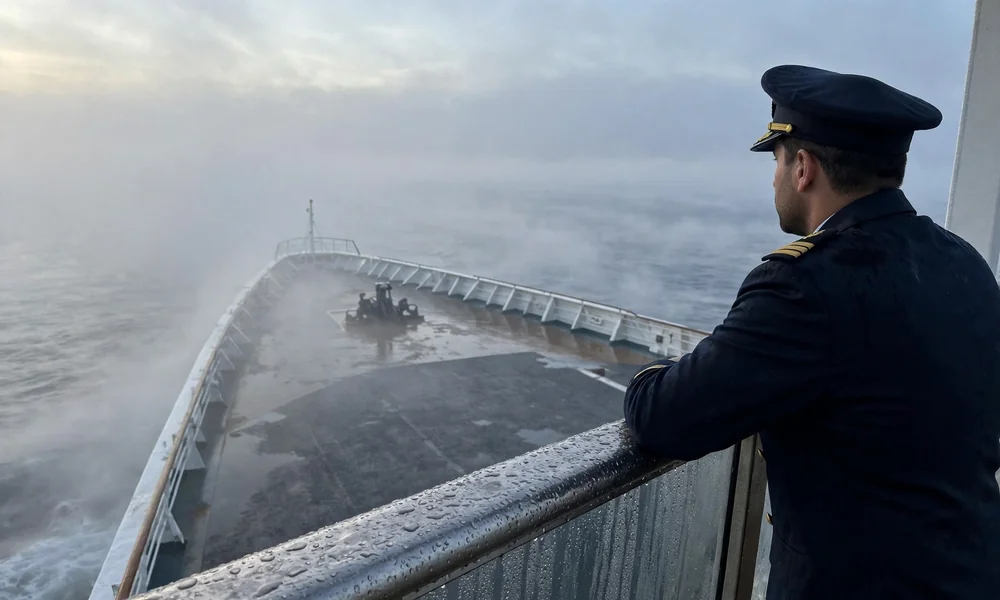
Here is a detail that surprises even seasoned cruisers: on many large cruise ships, the bridge has a pair of enclosed wings that extend out over the sides of the ship, giving the officers a clear view straight down the hull when the vessel is docking. From those wings, the officer conning the ship can see the gap between the hull and the pier shrink to a few centimetres, and can call the final orders to the tugs and the thrusters. It is the closest thing to parking a building, and it is done by eye, by feel, and by numbers on a screen all at once. The bridge wings are why a ship longer than the Eiffel Tower is tall can slide into a berth with less room to spare than the length of a family car.
The next time you board a cruise ship and look up at the wide band of glass at the very front, remember what sits behind it. It is not a lounge and it is not a viewing deck. It is a room where a handful of people, a wall of screens, and a joystick the size of a dinner plate hold six thousand lives in their hands, hour after hour, in fair weather and foul. The bridge is the quietest room on the ship, and it is also the one that matters most. To see how the rest of the ship is steered, read about how a giant ship is steered from the bridge, and the picture becomes complete.