Hold a phone up to a distant mountain and pinch to zoom. The mountain fills the frame, sharp and steady, as if you were standing ten times closer. Nothing on the phone moves. No lens slides out, no barrel extends, and the phone is still less than nine millimetres thick. A camera that can magnify a scene five or ten times needs a long tunnel of glass to do it, and there is no room for a long tunnel inside a phone. So how does it fit?
The answer is a trick borrowed from a submarine: fold the light. A smartphone periscope camera turns the light sideways with a prism, sends it running along the length of the phone instead of through its thickness, and lets a full telephoto lens hide flat inside the body. It is the reason the best phone cameras can now reach further than many dedicated cameras. This is how it works.
How a Smartphone Periscope Camera Works
Step 1: The problem is thickness, not glass
A normal phone camera points straight out of the back. Light enters the lens, travels a few millimetres, and lands on the sensor. That works for a wide-angle lens, but a telephoto lens needs a long focal length, the distance between the lens and the sensor, to magnify the scene. A 5x zoom needs a focal length of roughly 120 millimetres, and a 10x zoom needs more still. No phone is 120 millimetres thick, and nobody wants a camera that sticks out like a telescope.
Step 2: A prism bends the light by ninety degrees
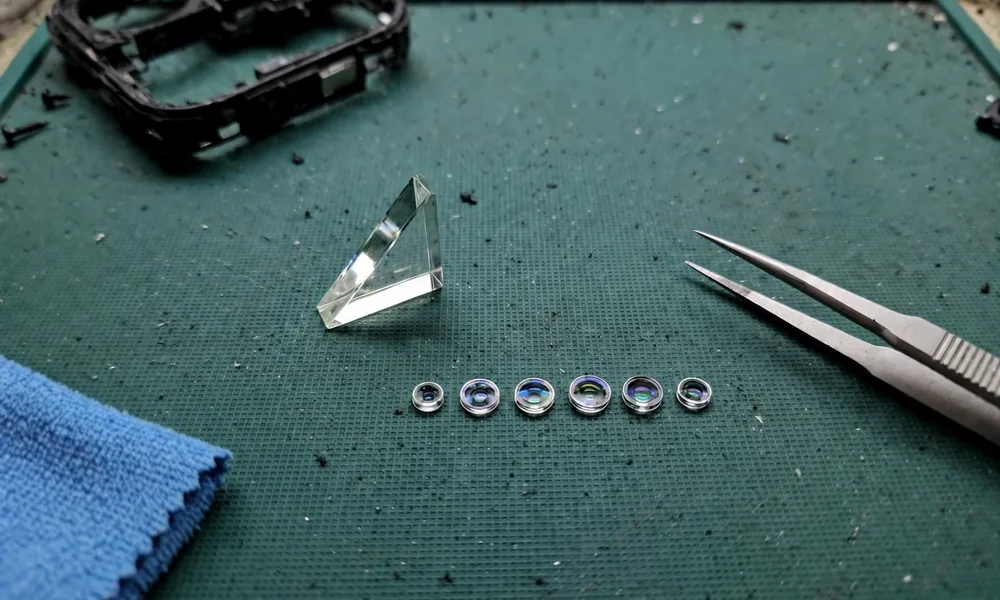
Light enters through a small, usually rectangular window on the back of the phone and immediately hits a prism, a wedge of glass set at 45 degrees. The prism bends the incoming light by 90 degrees, sending it sideways along the body of the phone instead of straight back into it. The light now travels horizontally, through a row of lens elements laid flat, and the focal length is limited not by the phone’s thickness but by its width, which gives the designers ten times as much room to work with. The design is called folded optics, because the optical path is folded like a periscope in a submarine, and the sensor sits perpendicular to the back of the phone, facing sideways, at the end of the folded tunnel. The lens itself is covered by how a periscope zoom lens folds light in a phone.
Step 3: A row of lenses magnifies the folded image
Once the light is travelling sideways, it passes through a series of concave and convex lens elements, each one bending the light a little further and magnifying the image. The longer this internal arm of the periscope, the greater the zoom range, which is why a 10x periscope module occupies a significant slice of the phone’s interior. The image is formed on a sensor at the end of the tunnel, and because that sensor is small and the light has travelled a long way, the lens works at a narrow aperture, often around f/2.8 to f/3.5, which lets in less light than the phone’s main camera. That is the periscope’s real weakness, and the reason it shines in daylight and struggles after dark.
Step 4: The prism itself steadies the shot
At 10x zoom, the tiniest shake of your hand becomes a wild swing of the frame, so stabilisation matters more here than in any other phone camera. A normal camera steadies the shot by shifting its lens or its sensor sideways, but that is hard to do inside a folded tunnel without disturbing the alignment. Periscope cameras solve it differently: they tilt the prism itself, by tiny fractions of a degree, before the light even reaches the lens stack. This fold-element stabilisation corrects the shake at the point where the light enters, and it is now used by Apple, Samsung, Google, and Xiaomi alike.
Step 5: The sensor captures the image, and software finishes it
The sensor at the end of the periscope is usually smaller than the phone’s main sensor, because the folded module leaves little room for a large one, but modern designs are closing the gap. Vivo’s X100 Ultra, for example, pairs its periscope with a 200-megapixel sensor, so it can crop into the image for extra reach without losing detail. Once the sensor captures the frame, the phone’s processor takes over: it merges several exposures, sharpens edges, and uses AI upscaling to stretch the optical zoom further, turning a 5x optical image into a usable 20x or 30x shot, and a 10x optical image into the 100x zoom that Samsung made famous. The main camera is covered by how a smartphone camera lens works.
Step 6: Different makers fold the light differently
The idea is the same everywhere, but the details differ. Huawei’s P30 Pro pioneered the periscope camera in a phone in 2019, with a 5x optical zoom. Samsung’s Galaxy S20 Ultra followed with a 10x hybrid zoom, and periscope cameras have been standard on Galaxy Ultra models since. Apple took a different path with the iPhone 15 Pro Max, calling its design a tetraprism: instead of one prism and a row of lenses, it bounces the light four times inside a small prism assembly, folding the path even tighter to fit a 5x zoom into the same body. The best are ranked in the best smartphone cameras of 2027.
Smartphone Periscope Camera Specifications
| Specification | Typical figure |
|---|---|
| Optical zoom | 3x to 10x |
| Hybrid and digital zoom | Up to 100x or 120x |
| Light path | Folded 90 degrees by a prism |
| Sensor orientation | Perpendicular to the phone back |
| Aperture | About f/2.8 to f/3.5 |
| Stabilisation | Fold-element OIS, tilting prism |
| Tetraprism example | iPhone 15 Pro Max, 5x |
How Much Does a Periscope Camera Cost?
There is no shop price for a periscope camera on its own, because it is sold as part of a phone. The module is one of the most expensive parts inside a flagship handset, with its precision prism, moulded lens stack, and stabilisation mechanism costing several times more than a standard camera module. That is why they appear almost only in flagship phones. A phone with a good periscope camera costs more than one without it, and the difference buys reach that no amount of digital zoom can fake.
A Rare Fact

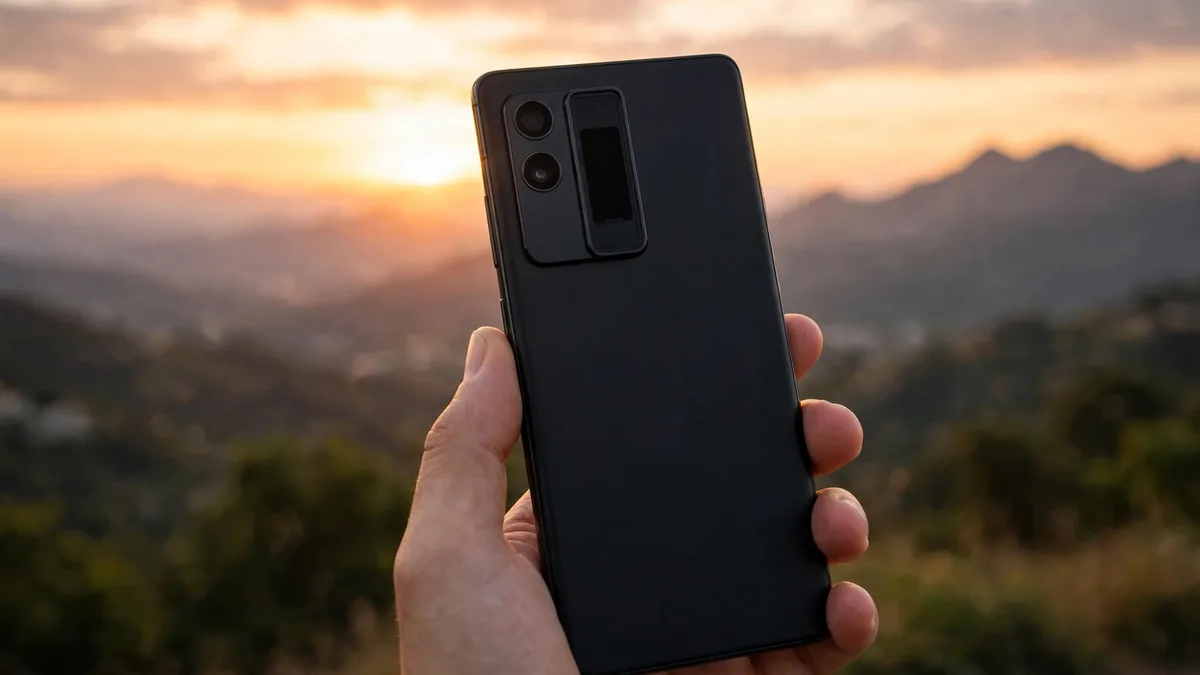
Here is something few people realise: you can spot a periscope camera without turning the phone on. Look at the camera bump on the back. The main and ultra-wide cameras have round windows, because their lenses are round. The periscope camera has a rectangular window, because the prism behind it is rectangular, and the light enters through a slot rather than a circle.
So the next time you zoom in on something far away and the picture stays sharp, remember what is happening inside the glass: light entering a rectangular window, bending ninety degrees off a prism, running sideways through a row of lenses, steadied by the prism itself, and landing on a sensor that faces the wrong way on purpose. The periscope camera does not break the laws of optics. It just folds them, and fits a telescope into a pocket.