Hold your phone up to a mountain ridge a kilometre away and tap the zoom button. The ridge rushes towards you, crisp and steady, as if you had walked half the distance in an instant. Nothing on the outside of the phone moved. There is no barrel sliding out, no lens extending towards the scene. Yet it is suddenly seeing like a telescope. That quiet trick is the work of a periscope zoom lens, a folded optical path hidden sideways inside a body barely eight millimetres thick.
A normal camera lens needs length. To magnify a distant subject, light must travel a long way through a stack of glass elements before it reaches the sensor, and in a phone there simply is not room for that journey. The periscope design solves the problem by turning the light through ninety degrees, so the long optical path runs along the width of the phone instead of through its thickness. This is how it works, step by step.
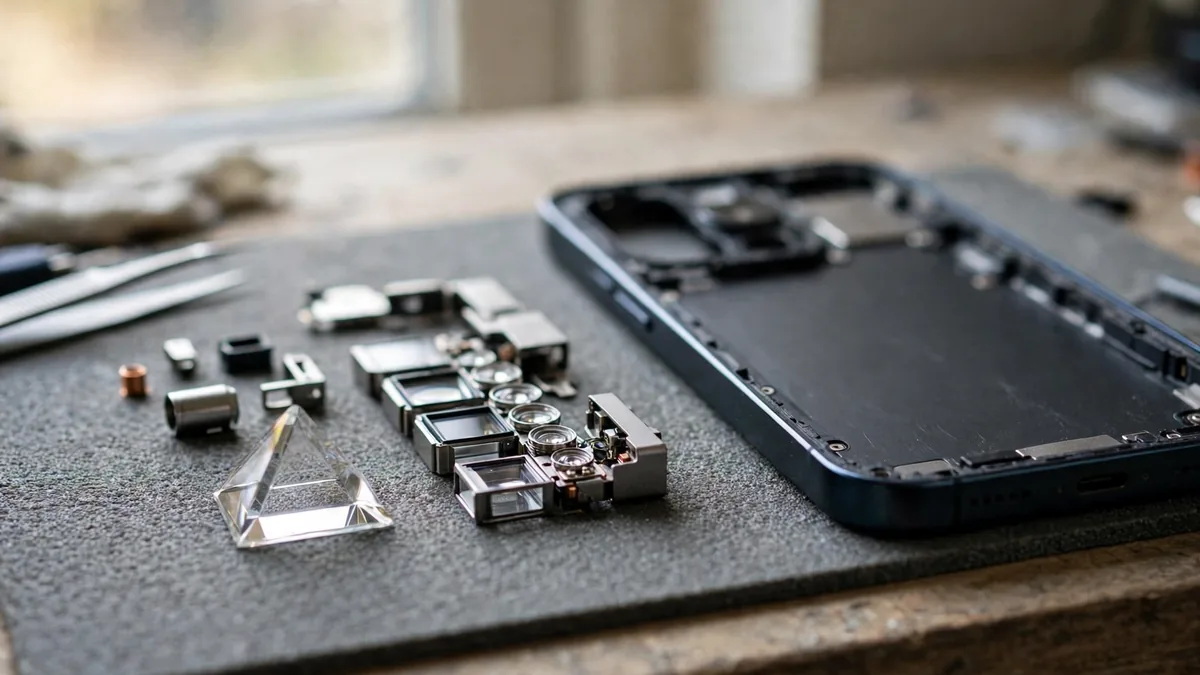
How a Periscope Zoom Lens Works
Step 1: Light enters through a small window
Everything starts at a modest square of glass on the back of the phone, often the only visible clue that a periscope lens is inside. Light from the scene passes through this front element and immediately meets the first critical component: a tiny prism. The prism is a solid block of precision-ground glass with one face set at 45 degrees, and its job is to bend the incoming light sideways, down the length of the phone. The window is small on purpose, because every millimetre of its size is a millimetre of phone thickness saved.
Step 2: The prism folds the light path
The prism works by total internal reflection, the same effect that keeps light trapped inside a fibre-optic cable. Light strikes the angled face and reflects cleanly sideways, turning the vertical path into a horizontal one. The quality of this single bounce matters enormously, because any imperfection scatters light and washes out the image, so the glass is polished to a tolerance measured in fractions of a wavelength. This folded layout frees the design from the thickness of the phone, and the same care with light shapes every lens in the handset, from the main camera to the smartphone camera lens beside it.

Step 3: Lens groups magnify the image
Once the light is travelling sideways, it passes through a series of lens groups arranged in a row along the phone, like a tiny telescope laid on its side. These groups do the actual magnifying: the first bends the light to form an image, the middle groups correct distortion and colour fringing, and the last focuses the result onto the sensor. Some are made of moulded glass, others of high-index plastic, and several are aspheric, with curves that change across their surface to squeeze out aberrations a simple spherical lens could never fix. The longer this folded path, the greater the magnification.
Step 4: A moving group changes the zoom
A fixed telescope would give only one magnification, so at least one lens group in the periscope module is mounted on a tiny rail and can slide back and forth along the optical path. Moving that group changes the focal length, and with it the zoom level, and the movement is driven by a voice-coil motor or a miniature stepper. The travel is only a few millimetres, but it must be controlled to within microns, because a shift of a hair’s breadth at this scale turns a sharp image into a soft one. The autofocus mechanism that makes this possible shares its DNA with the camera autofocus motor that moves the main lens, shrunk down and laid flat.
Step 5: Stabilisation steadies the view
Magnification is merciless about shake. At five times zoom, the tiny tremor of a hand is magnified five times as well, and a distant subject can jitter clean off the frame. To fight this, the prism itself is mounted on a gimbal-like suspension, and gyroscopes in the phone sense every tremble hundreds of times a second. Tiny motors tilt the prism in the opposite direction, bending the light path to cancel the movement before the image reaches the sensor. The image must sit still on the sensor even while the hand holding the phone does not.
Step 6: The sensor and software finish the job
At the end of the folded path sits the image sensor, a chip far smaller than a fingernail, mounted sideways so its face meets the light coming along the phone. The sensor is usually smaller than the one behind the main camera, because the periscope module has to share space with the battery and the circuit board, and a smaller sensor gathers less light. That trade-off is why periscope shots can look noisier in dim conditions than the main camera’s. The sensor reads the image line by line and hands the raw data to the image processor, which corrects the remaining distortion, merges several frames taken in a burst to suppress noise, and blends in detail from the main camera where the zoom falls between the optical steps. At the highest magnifications it uses machine-learning models to rebuild textures the small sensor could not resolve on its own. The result is a photograph that looks as if it were taken through a far larger lens, and the whole chain has to work in perfect concert for the illusion to hold. It is a reminder that the thinnest part of a phone is often where the most engineering hides, just as the hinge that lets a handset fold packs its own quiet complexity, as the foldable phone hinge shows.

Periscope Zoom Lens at a Glance
| Specification | Detail |
|---|---|
| Optical principle | Prism folds light 90 degrees, path runs along phone width |
| Typical optical zoom | 3x to 5x, with some designs reaching 10x |
| Module size | Roughly 25 to 30 millimetres long, under 8 millimetres thick |
| Prism material | Precision-ground optical glass, polished to sub-wavelength tolerance |
| Lens elements | Five to seven groups, mixed moulded glass and high-index plastic |
| Stabilisation | Prism or lens group tilted by voice-coil motors, guided by gyroscopes |
| Sensor size | Smaller than the main camera sensor, typically 1/2 to 1/3.5 inch class |
| Main drawback | Less light gathered, noisier images in dim conditions |
| Main uses | Flagship phone cameras, distant subjects, portraits, concerts, wildlife |
What Does It Cost?
A periscope zoom module is one of the most expensive parts in a phone camera system. As rough estimates, the module itself costs a manufacturer somewhere around 15 to 40 dollars depending on the zoom range and the quality of the glass, while a replacement module fitted by a repair shop typically runs from about 80 to 200 dollars including labour. Those figures are estimates, not quotes.
A Rare Fact
The periscope lens owes its existence to a problem that had nothing to do with photography. Early smartphone makers wanted longer zoom but refused to make phones thicker, and the answer came from the periscopes of submarines, which had been folding light around corners for more than a century. The first phone to use the idea commercially arrived in 2019.
The periscope zoom lens is a neat reminder that engineering is often about refusing the obvious trade-off. The phone could not get thicker, the lens could not get shorter, so the light itself was asked to turn a corner.


