A submarine floats or sinks by changing its own weight, and ballast control is the system that makes that change happen. The boat carries tanks that can be filled with seawater to make it heavier, or emptied with compressed air to make it lighter, and the crew controls that water and air through a network of valves, pumps, pipes and gauges.
The idea behind it is buoyancy. A submarine displaces a certain weight of water, and it floats when that displaced water weighs the same as the boat. Let water into the ballast tanks and the boat gets heavier than the water it displaces, so it sinks. Blow the water out with air and it gets lighter, so it rises.

The main ballast tanks
The main ballast tanks are the big ones, built into the space between the pressure hull and the outer casing, and they do the coarse work of diving and surfacing. To dive, the crew opens the vents at the top of the tanks and lets the air escape; seawater floods in through openings at the bottom, the tanks fill, and the boat grows heavy enough to sink. To surface, the crew does the reverse, forcing high-pressure air into the tanks, which pushes the water out through the bottom openings until the tanks are full of air again and the boat is light enough to float.
These tanks are either full or empty in normal use, which is why the control system treats them as a simple pair of states rather than a fine adjustment. The vents and the air valves are the controls that matter: open the vents and the boat floods down, open the air valves and it blows up. The way submarine ballast tanks work covers the tanks themselves, the steel, the flooding ports and the structure; this article is about the system that operates them, the valves and the people who work them.
Trim and auxiliary tanks
Fine control comes from a different set of smaller tanks, the trim and auxiliary tanks, which sit inside the pressure hull where the crew can reach them. These are used to adjust the boat’s attitude: a little water moved forward makes the bow heavy, a little moved aft makes the stern heavy, and pumping water between them levels the boat without changing its overall weight. The trim system is what keeps the submarine level as fuel is burned, stores are used up, or the crew moves around inside.
The trim tanks are filled and emptied by pumps rather than by flooding, which gives the crew precise control over small amounts of water. A trim pump moves water from one tank to another, or overboard, at a steady rate, and the diving officer watches a trim indicator that shows the boat’s fore-and-aft balance in real time. Getting trim right is a quiet skill: a well-trimmed boat holds depth with almost no effort from the planes, while a badly trimmed one fights its crew all watch long.
Valves, air and the blow system
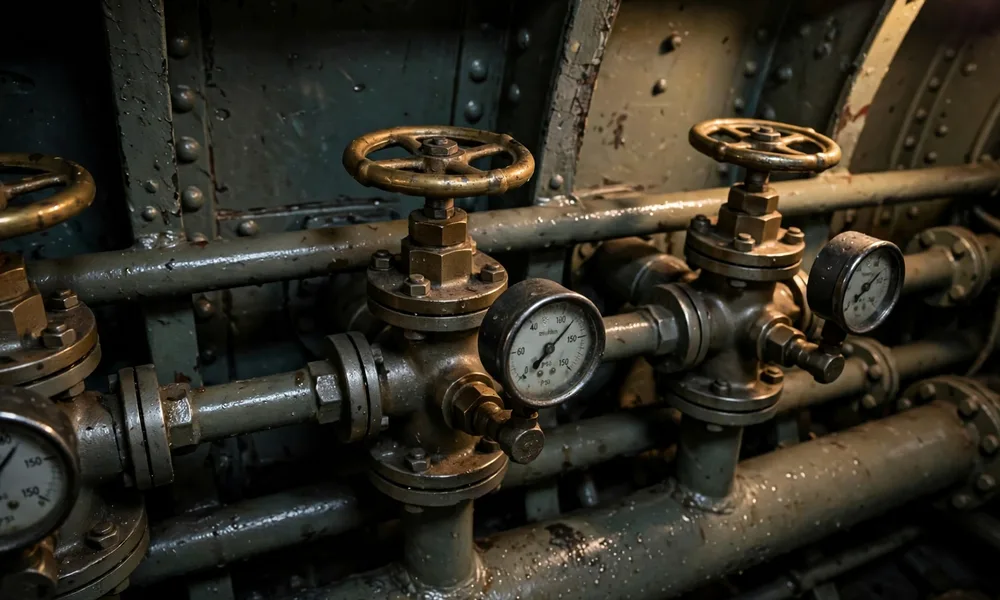
The heart of ballast control is the valve panel, a board of handwheels, levers and gauges that connects the tanks to the sea and to the high-pressure air banks. Each main tank has a vent valve at the top and a blow valve that admits air from the banks, and each valve is worked by hand on older boats, with hydraulic or pneumatic actuators doing the heavy work on newer ones. The operator follows a sequence, opening vents in a set order so the boat floods evenly, and closing them before the blow so the air goes into the tanks rather than out through the vents.
The air itself is stored in banks of steel bottles at very high pressure, charged by compressors while the boat is on the surface or at snorkel depth. Blowing the tanks is a loud, violent event: the air rushes in, the water is driven out in a rush, and the boat surges upward as its weight falls away. An emergency blow opens everything at once to get the boat to the surface as fast as possible.
Depth control and the planes
Ballast control sets the boat’s weight, but depth is held by the diving planes, the small wings on the sail and the stern that work like an aeroplane’s elevators. When the boat is trimmed to neutral buoyancy, the planes hold it at a chosen depth with small adjustments, and the crew changes depth by angling the planes and letting the boat’s forward motion carry it up or down. If the boat is heavy, the planes have to work hard to keep it up; if it is light, they have to work hard to keep it down, and that constant effort is the sign that the ballast needs adjusting.
The two systems work together all the time. The diving officer orders a depth change on the planes, watches the depth gauge and the bubble indicator that shows the boat’s angle, and then orders a trim adjustment if the boat will not sit level at the new depth. The best submarine propulsion systems compared shows how the boat’s engines fit into the same picture, since speed through the water is what makes the planes effective at all.
What happens when it goes wrong
Ballast control fails in a few classic ways, and submariners train for all of them. A vent valve stuck open lets a tank flood when it should be dry, a blow valve stuck shut leaves a tank full of water when the boat needs to rise, and a leak in a high-pressure air line can drain the banks the boat depends on. The crew’s answer is redundancy: duplicate valves, cross-connections between air banks, and manual overrides on every powered valve, so that a single failure never leaves the boat without a way to change its weight.
The most feared failure is losing the ability to blow the tanks while the boat is deep, since the water pressure outside grows with depth and the air banks must beat it to push the water out. That is why the air banks are kept charged, why the blow system is tested before every dive, and why an emergency blow is drilled until it is automatic. A submarine that cannot get lighter cannot get to the surface, and every part of the ballast control system exists to make sure that never happens.
The verdict
Submarine ballast control is a simple idea worked through a complicated machine: water in to go down, air in to come up, and small pumps and tanks to keep the boat level in between. The main tanks do the big moves, the trim tanks do the fine ones, the valves and the air banks connect them, and the crew ties it all together with gauges, orders and practice. It is a system with no room for guesswork, because the sea notices every mistake at once, and the best luxury submarine experiences ranked is a reminder that the same physics that takes a naval boat down is what lets a tourist boat hang quietly under the surface too.


