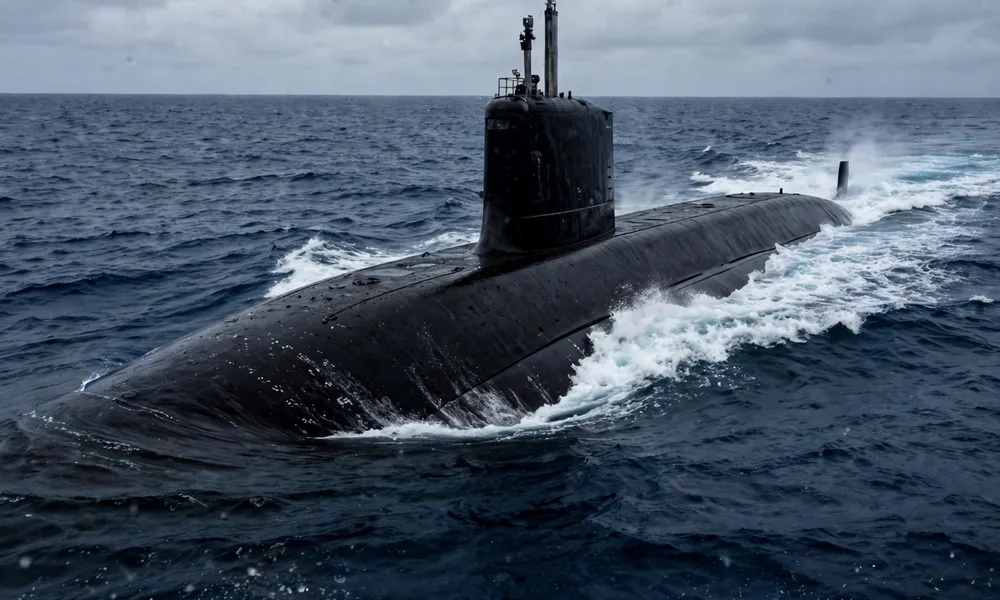
There is a moment, just before a submarine disappears, when the sea seems to swallow it whole. One minute a long grey hull is cutting through the waves, water streaming off its deck, and the next there is nothing but a patch of disturbed water and a fading wake. It looks like magic, but it is plumbing: ballast tanks fill with seawater to sink and empty with air to rise.
A submarine is, in the simplest terms, a steel tube that has learned to control its own buoyancy. Left alone it floats, because the steel and the air inside it weigh less than the water it pushes aside. To dive, the crew deliberately makes the boat heavier, letting seawater flood into tanks built into the hull. To surface, they force that water back out with compressed air, and the boat becomes light enough to float again. Every dive is a negotiation between those two states.

How Submarine Ballast Tanks Work
Step 1: The boat floats on the surface with empty tanks
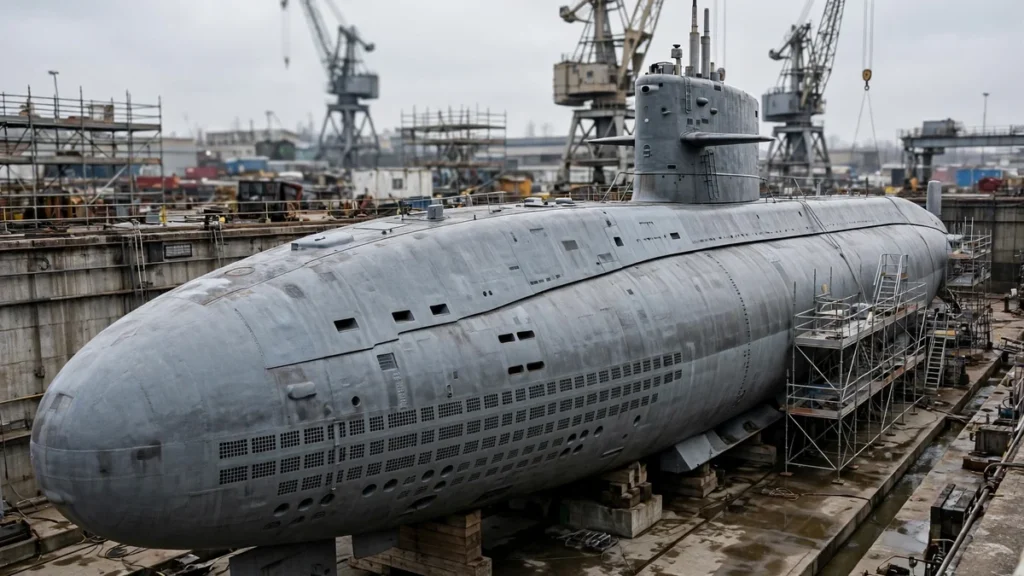
On the surface, a submarine’s main ballast tanks are full of air and almost completely empty of water. The tanks sit between the pressure hull, the thick inner tube where the crew lives, and the lighter outer hull that gives the boat its smooth shape. With the tanks full of air, the vessel displaces more water than it weighs, so it floats like any other ship. In this state the boat is positively buoyant, which means that if nothing changed, it would stay on the surface forever.
Step 2: Vents open and seawater floods in to dive
To dive, the crew opens large vents at the top of the main ballast tanks. The air trapped inside rushes out through the vents with a loud roar that every submariner knows, and seawater pours in through open flood ports at the bottom of the tanks. No pumps are involved; the sea simply flows in to replace the escaping air. As the tanks fill, the boat grows heavier, and the waterline creeps up the side of the hull. Within a minute or two the deck is awash, the conning tower follows, and the submarine slips below the surface. The propeller that drives the boat through the water is a precision piece of engineering in its own right, and its design is a story of silence and efficiency, as the submarine propeller materials guide explains.

Step 3: Trim tanks fine-tune the boat’s balance
Main ballast tanks are blunt instruments: they are either full or empty, and they make the boat either heavy or light. But a submarine also needs to sit level, neither nose-down nor tail-heavy, and that is the job of the smaller trim and auxiliary tanks. These sit fore and aft and amidships, and the crew pumps water between them to shift the boat’s centre of gravity. Water is moved forward or aft as needed. Trim is adjusted constantly, because fuel is burned, stores are eaten, and even the crew moving around changes the balance. A well-trimmed boat needs almost no effort from its diving planes to hold depth.
Step 4: Depth is held with the diving planes, not the tanks
Once submerged, the crew closes the vents and the boat is close to neutrally buoyant, weighing almost exactly the same as the water it displaces. From here, the ballast tanks mostly stay as they are, and depth is controlled with the diving planes, the small wings on the sail and the stern that work like an aeroplane’s elevators. A slight angle on the planes drives the boat gently up or down while the propeller pushes it forward,. The tanks are only adjusted when the water’s saltiness or temperature changes its density. Keeping a submarine at a steady depth is a quiet, constant conversation between the planes, the tanks and the sea itself.
Step 5: High-pressure air blows the tanks to surface
Surfacing is the reverse of diving, and it is the dramatic part. The crew opens valves from banks of high-pressure air flasks, and air at hundreds of times atmospheric pressure roars into the main ballast tanks, forcing the seawater out through the flood ports at the bottom. The boat grows lighter by the second, the bow lifts, and the submarine rises, often breaking the surface with a rush of spray and a great sigh of escaping air. The same diesel-electric thinking that moves the biggest ships at sea is at work here in miniature, turning stored energy into motion, as the cruise ship engine guide shows on a much larger scale.
Step 6: The tanks are dried, checked and readied again
A submarine does not simply dive and surface once. After surfacing, the crew drains any remaining water from the tanks, checks the vents and valves for leaks or damage, and recharges the high-pressure air flasks with the boat’s compressors, because every blow spends air that must be replaced. The tanks are inspected for corrosion, since seawater is relentless against steel, and the seals on the vent valves are tested before the next dive. On a long patrol this cycle repeats dozens of times. If the tanks cannot be blown, the boat cannot surface, and that is why the system is built with backups for its backups. The vessels built to survive the deepest water face the same unforgiving physics, and their pressure hulls are a study in extreme engineering, as the deep-sea submersible specs guide explains.
Submarine Ballast Tanks at a Glance
| Specification | Detail |
|---|---|
| System type | Main ballast tanks between pressure hull and outer hull |
| How diving works | Vents open, air escapes, seawater floods in by gravity |
| How surfacing works | High-pressure air forces seawater out through flood ports |
| Fine control | Trim and auxiliary tanks, water pumped fore and aft |
| Depth control underway | Diving planes on sail and stern, tanks mostly left alone |
| Air storage | Banks of high-pressure air flasks, recharged by compressors |
| Dive time | Typically one to three minutes from surface to submerged |
| Main advantage | Simple, reliable, no pumps needed to flood the tanks |
| Main drawback | Compressed air is limited, corrosion is constant, failure is critical |
What Does It Cost?
A submarine’s ballast system is priced as part of a vessel that costs hundreds of millions to billions of dollars, so there is no separate price tag. As rough estimates, the high-pressure air system and its flasks alone can cost several million dollars on a modern boat, while a single set of replacement vent valves runs into the tens of thousands. Those figures are estimates, not quotes.
A Rare Fact
Early submarines had no powered way to blow their tanks at all, and some relied on the crew hand-pumping air or simply dropping heavy lead weights to rise in an emergency. The most famous emergency measure was the drop keel: a huge weight bolted under the hull that could be released to make the boat suddenly buoyant. Modern boats still carry the idea in spirit, and the ballast system is checked before every dive.
A submarine’s ballast tanks work because they turn the boat’s greatest problem, its own weight, into its greatest tool. Flood the tanks and the sea pulls the boat down; blow them with air and the same sea pushes it back up. It is a system of vents, valves and compressed air barely changed in a century, and it is the difference between a submarine and a very expensive anchor.