A luxury sail catamaran is a sailing yacht with two hulls instead of one, built to a standard where space, comfort and finish matter as much as speed. The two hulls sit side by side, joined by a broad bridge deck, and the whole vessel is wider, steadier and roomier than a single-hull yacht of the same length. Sails provide the power, with engines fitted for harbour work and calm days, and the interior is finished more like a floating apartment than a boat.
Plenty of catamarans are built for charter fleets and sailing schools. A luxury sail catamaran starts where those stop: larger cabins, proper beds instead of narrow bunks, a full galley, air conditioning, generous deck space, and the kind of joinery and upholstery you would expect in a high-end home. The hull shape is the same idea, but almost everything else is a step up.
Why two hulls
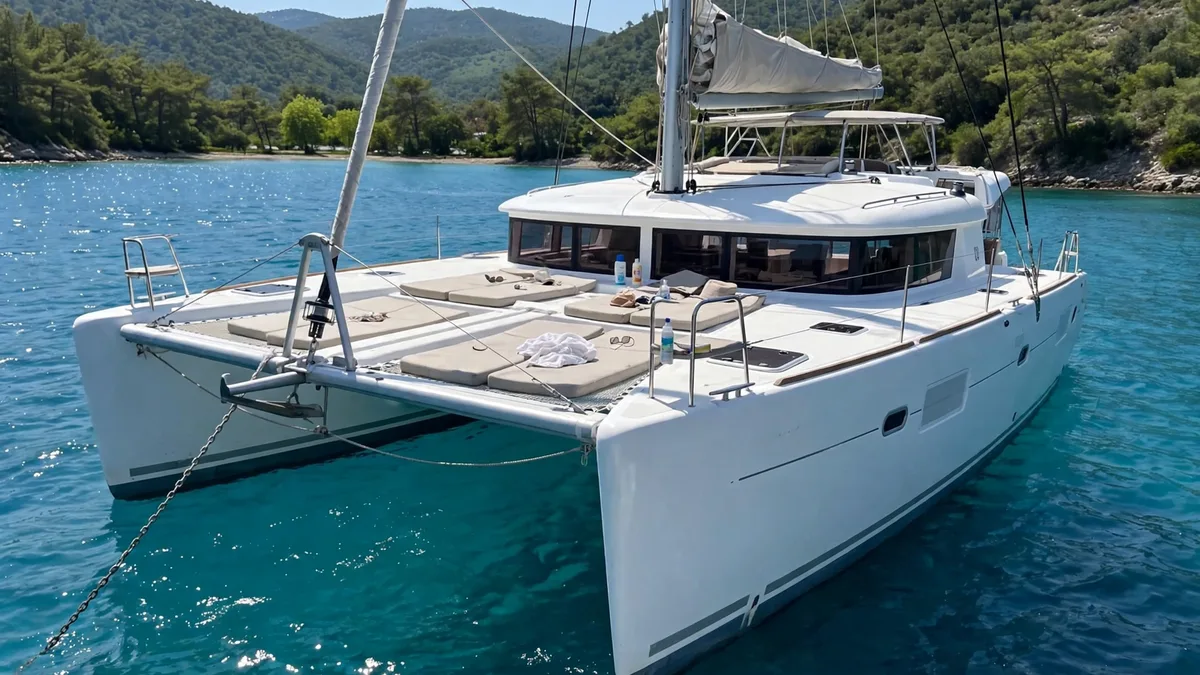
The twin-hull layout is the defining feature, and it changes the boat in three ways. First is stability: a catamaran does not heel over in the wind the way a single-hull yacht does, so the deck stays nearly level while sailing, glasses stay on tables, and people who dislike the lean of a heeling yacht feel comfortable. Second is space: the gap between the hulls becomes a wide saloon and cockpit, far larger than anything a single hull of the same length can offer. Third is shallow draught, since each narrow hull draws less water than a deep-keeled yacht, which lets the boat anchor close to beaches.
Each hull has its own job. One usually holds the owner’s cabin and the other the guest cabins, with bathrooms and storage tucked along their length, while the bridge deck between them carries the saloon, the galley and the main cockpit. An engine sits at the back of each hull, one per side, so the boat can turn almost in its own length by driving one forward and one in reverse. The mast stands on the bridge deck, and the sails are handled from the cockpit, often with electric winches on a luxury model.
The sailing rig
A luxury sail catamaran is still a sailing boat first, and the rig is a conventional one, usually a tall mainsail and a headsail, set on a mast that can be very high indeed on a large boat. The mainsail is often handled with a furling system that rolls it into the mast or the boom at the push of a button, and the headsail furls the same way, so a small crew can set and shorten sail without going on deck in rough weather. That ease of handling is part of the luxury: the boat is designed to be sailed by two people, or even one, without heroics.
Performance is respectable rather than extreme. A catamaran’s wide, flat form is fast off the wind and in light airs, and a good one will outsail a similar-sized single-hull yacht on a reaching course. It points less well into the wind, and it can be slower to tack, but for long-distance cruising, where the wind is usually behind the beam, that hardly matters.

Life on board
Life on board is where the luxury shows. The saloon typically has a proper dining table for eight, a lounge area, a galley with a full-size fridge, oven and plenty of worktop, and windows all round that make the space feel open. The cabins are at hull level, reached by steps down from the saloon, and the owner’s cabin often spans the full width of one hull, with a large bed, a dressing area and a bathroom with a separate shower. Guest cabins are smaller but still have standing headroom and a proper double bed.
Outside, the deck is built for living rather than just sailing. The cockpit is covered by a hard top or bimini, with seating that converts to a sunbed, and the foredeck has a trampoline net stretched between the hulls, which is the classic catamaran sunbathing spot. The aft deck carries a swim platform between the hulls, so stepping into the water or boarding a tender is easy. The best luxury yacht interiors ranked shows how much of a luxury boat’s value sits in these living spaces rather than in its speed.
How it differs from other catamarans
Three things separate a luxury sail catamaran from its plainer cousins, and none of them is the hull shape. The first is size: luxury models usually start at around 45 feet and run to 70 feet or more, because the space that makes them luxurious needs length to work with. The second is fit-out: real wood, stone worktops, quality fabrics and custom furniture instead of moulded plastic and standard fittings.
The comparison that confuses people most is with the motor catamaran, which has the same two hulls but no sails, and with the solar catamaran, which uses the sun to help power its electric motors. A luxury sail catamaran keeps the sailing rig as its main source of power, and that choice shapes everything else, from the tall mast to the wide decks built for handling sails. The solar-powered catamaran explained shows the alternative approach, where the roof carries panels and the motors do the work that sails do here.
Costs, crew and upkeep
A luxury sail catamaran costs more to buy than a single-hull yacht of the same length, and more to keep. The width means a standard marina berth often will not fit it, so berthing fees are higher, and the two engines, two hulls and large sail area all add to the maintenance bill. Annual upkeep is commonly estimated at around a tenth of the purchase price, covering servicing, antifouling, sail care and the steady replacement of equipment, and a boat this size usually needs at least a part-time professional crew, or an owner willing to learn a lot of systems.
The running costs are also shaped by how the boat is used. Sailing is cheap once the boat is bought, since the wind is free, but a luxury catamaran spends much of its life at anchor with the generator running, the air conditioning on and the water maker working, and that fuel and servicing adds up. Even so, for owners who live aboard for months at a time, the space and comfort are the point, and the best sailing yacht brands ranked shows which builders have learned to package that comfort into a boat that two people can actually sail.
The verdict
A luxury sail catamaran is a sailing yacht that trades the romance of a heeling single hull for space, stability and comfort, and then finishes the result to a very high standard. The twin hulls give it a level deck, a huge saloon and cabins that feel like rooms rather than berths, and the sailing rig keeps it a proper sailing boat rather than a floating apartment with engines. It costs more to buy and to berth than a single-hull yacht, and it needs more care, but for long, slow cruising in warm water, with family or guests aboard, there is nothing else quite like it.


