A submarine weighing thousands of tonnes hangs in the water, neither sinking nor rising, as still as a rock in a stream. Then the captain gives an order, valves open, and with a roar of compressed air the boat rises to the surface, water pouring off its decks. Nothing about that is magic. It is ballast, and the tanks that hold it are among the largest structures ever built to be flooded on purpose.
A submarine’s ballast tanks are steel chambers built into the hull, and they decide whether the boat floats, sinks, or hangs in between. Fill them with water and the boat goes down. Blow them out with air and it comes up. Building them means welding steel plates thicker than a book, shaping them into curves that can take the crushing pressure of the deep sea, and testing every seam until it holds against the ocean. Here is how submarine ballast tanks are made, step by step.
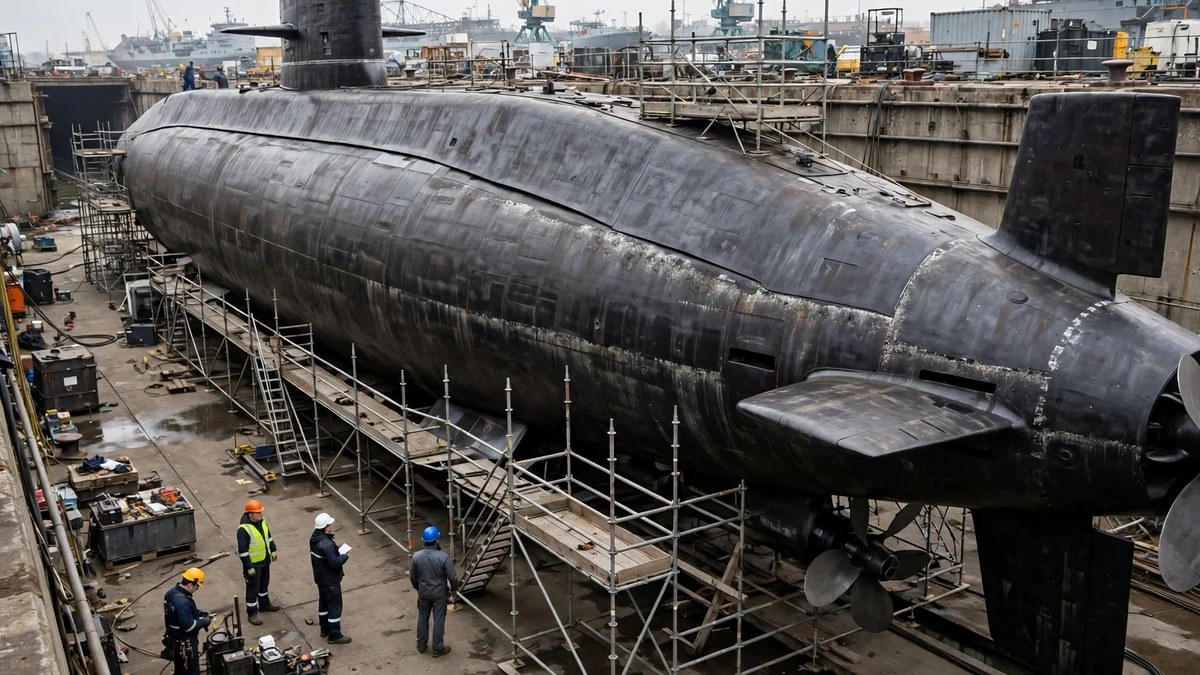
How Submarine Ballast Tanks Are Made
Step 1: Designing the tanks into the hull
The tanks are not added to a submarine, they are part of it. Naval architects decide how much water the boat must take on to dive, and that number sets the size of the main ballast tanks, usually built into the spaces between the inner pressure hull and the outer hull. Smaller trim tanks sit inside the pressure hull, holding water that is moved fore and aft to level the boat. The team calculates the volume of every tank to the litre. The hull around the tanks is its own feat, built the way other great steel hulls are, as described in how a container ship hull works, where steel plates are also shaped to take the sea’s full force.
Step 2: Cutting and rolling the steel plates
Ballast tanks are built from high-strength steel, often a special alloy that stays tough in cold water. The plates arrive at the yard by the tonne, and are cut to shape with plasma torches or laser cutters following computer-drawn patterns. Each plate is then rolled into a curve on huge bending machines, because the tanks follow the rounded shape of the hull. The edges are bevelled so the weld can reach deep into the joint. Every plate is marked with its position in the boat, so the right curve ends up in the right place.
Step 3: Welding the tank sections together
The plates are fitted together in a fabrication hall and welded into tank sections. Welders work in teams, laying down weld after weld, and the work is slow because the welds must be perfect. A single bad weld in a ballast tank can let seawater into places it should never reach, or let high-pressure air escape when the boat needs it most. Each weld is checked as it is made, first by eye, then by X-ray or ultrasound, which can see cracks hidden inside the metal. Failed welds are ground out and redone.

Step 4: Fitting the flood valves and air pipes
A ballast tank is useless without its valves. At the bottom of each main tank sits a flood valve, a large opening that lets seawater in when the boat dives. At the top sits a vent valve that lets the air out as the water comes in, and a connection to the high-pressure air system that blows the water out again when the boat surfaces. The air is stored in steel bottles at pressures of hundreds of bar, and the pipes that carry it are thick-walled and tested to far above their working pressure. The valves are huge, some as wide as a dinner plate, and they are built to open and close in seconds, even after months sitting in salt water.
Step 5: Assembling the tanks into the submarine
The finished tank sections are lifted by crane and joined to the submarine’s hull on the building way. The sections are aligned to the millimetre and welded to the pressure hull and to each other, and the whole structure is checked for shape as it grows. Inside the boat, the trim tanks are fitted with their pumps and pipes, and the air bottles are bolted into their cradles. The pipework that links the tanks to the control room is run through the hull, with each pipe labelled and pressure-tested. The work is much like assembling any great ship’s machinery, and the engines that share the hull are built with the same care, as explained in how a cruise ship engine is made, where huge steel parts are also fitted to the millimetre.
Step 6: Pressure testing and sea trials
Before the submarine ever touches the water, its tanks are tested. Each tank is filled with water and pressurised, and engineers watch for leaks at every weld and valve. Then the boat is launched and put through harbour trials, diving in shallow water while the crew opens and closes the valves, timing how fast the tanks flood and blow. Finally come sea trials, where the boat dives deep and the tanks are worked again and again. Only when the boat dives on command, hangs level, and surfaces cleanly is it handed over to its crew. The flight deck of a carrier is tested with the same seriousness, as described in how an aircraft carrier flight deck is made, because at sea there is no second chance.

Submarine Ballast Tanks Specs
| Specification | Typical figure |
|---|---|
| Tank type | Main ballast plus trim tanks |
| Steel type | High-strength naval steel alloy |
| Air pressure | Up to around 200 to 300 bar |
| Flood valve size | Up to around half a metre across |
| Weld inspection | X-ray and ultrasound of every seam |
| Location | Between inner and outer hulls |
What Submarine Ballast Tanks Cost
The ballast tank system is estimated to cost a submarine builder roughly 10 to 30 million dollars as part of a new boat, though the exact figure is an estimate and varies with the size of the boat, the steel used, and the navy buying it. The tanks themselves are a large share of the hull’s steelwork, and the cost covers thousands of hours of welding, inspection, and testing. A modern attack submarine can cost well over a billion dollars in total, and the ballast system is one of the parts that can never be allowed to fail, which is why no expense is spared on its welds and valves.
A Rare Fact About Submarine Ballast Tanks
Here is a detail most people never hear: a submarine can hover underwater without moving at all, and it does it with water alone. By moving small amounts of water between the trim tanks, fore and aft, the crew can balance the boat so precisely that it hangs motionless in the water, neither rising nor sinking, for hours. The trick is called neutral buoyancy, and it is so delicate that the crew must allow for the weight of a single meal eaten on board, or the water used in a shower. When a submarine hovers silently in the deep, it is the ballast tanks, full of nothing more than seawater, doing the work.


