On the top deck of the largest yachts there is a room that does not belong on a boat at all: a quiet, wood-panelled space with a telescope pointing at the sky through a dome of glass. It is the observatory, a place to watch the stars from the middle of the ocean, far from city lights. It is also one of the hardest rooms on the yacht to build, because it asks a shipyard to do two things that fight each other — keep the sea out completely, and let the sky in.
The dome must survive green water over the bow, the glare of the sun, and the constant flexing of a hull at sea, while its glass stays clear enough to see a planet through. This is how it is made.

How It’s Made
Step 1: Designing the dome and its structure
The build begins with the naval architects, who must fit a glass dome onto a deck that was never meant to carry one. The observatory sits high on the yacht, where every kilogram hurts stability, so the structure is drawn in aluminium and composite rather than steel. Engineers calculate the loads of a wave striking the dome, the wind at thirty knots, and the weight of the glass itself, then design a ring beam to carry it all down into the deck. The dome is drawn as a series of curved panels rather than one piece of glass, because a single huge pane would be too heavy to make and too dangerous to replace at sea.
Step 2: Making the curved glass panels
Each glass panel is made by bending flat laminated glass over a mould. Sheets of glass and clear plastic interlayer are laid up, heated in a furnace until they sag onto a curved steel form, then cooled slowly so the curve sets without distortion. The laminated build matters: if the outer layer ever cracks, the plastic holds the pieces in place instead of showering the room below with shards. The glass used here is a close relative of the specialist glazing elsewhere on the yacht, made with the same care as superyacht glass.

Step 3: Building the frame and the opening sections
Between the glass panels sits a frame of aluminium or stainless steel, machined to follow the dome’s curve exactly. Some observatories open: panels slide or hinge aside so the telescope can look straight at the sky with no glass in the way, and those moving sections run on sealed tracks with motors strong enough to close them in a squall. The frame is assembled on a jig in the workshop, panel by panel, and each joint is sealed with marine-grade compound before the glass goes in. A gap of a millimetre at this stage becomes a leak at sea, so fitters check every seam with a straight edge.
Step 4: Lifting the dome onto the yacht
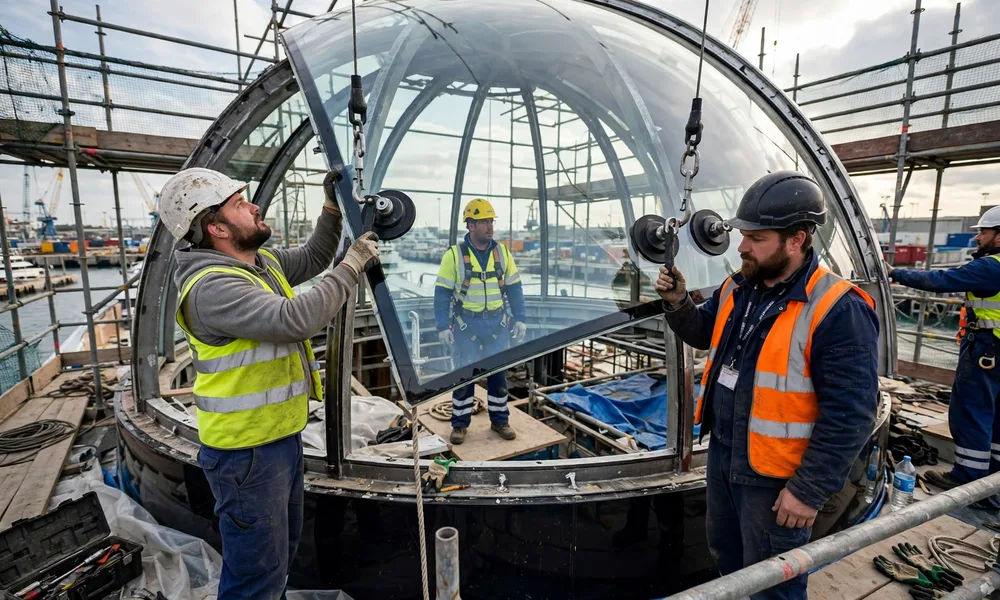
The finished dome is too big to build on the yacht itself, so it is assembled in the workshop and lifted onto the deck by crane. The yacht’s deck opening is prepared first, with a reinforced ring that spreads the dome’s weight into the structure below — the same kind of load path that carries the superyacht mast and its rigging. The dome is lowered onto the ring, bolted down, and sealed all round. Then the shipyard tests the seal the hard way, hosing the dome with high-pressure water from every angle while someone watches from inside for a single drip.
Step 5: Fitting the telescope and its mount
With the dome sealed, the telescope itself is installed. It sits on a mount bolted through the deck to the yacht’s structure, because a telescope on a moving boat needs a base that does not flex. The mount is stabilised, either by gyroscopes or by software that tracks the stars and corrects for the yacht’s roll, so the image stays steady while the hull moves beneath it. The telescope is balanced and aligned by hand, and its optics are cleaned in a dust-free tent rigged inside the dome. The whole structure it stands on is the yacht’s backbone: the steel hull below, built to hold its shape for decades at sea.
Step 6: Fitting out the room below
Under the dome, the room is finished like the finest cabin on the yacht. Joiners fit curved wood panelling to follow the dome’s shape, upholsterers cover the seating in leather that will not mark in the sun, and electricians wire dim red lighting that lets eyes stay adapted to the dark. Climate control keeps the glass just warm enough that dew never forms on it, and blackout blinds hide the dome completely when the room is used as a lounge by day.
Step 7: Testing at sea
The final test happens on the water. The yacht sails into a swell while the crew watches the dome for flexing, listens for creaks, and checks every seal after spray comes over the bow. The telescope is pointed at a star and left tracking while the yacht rolls, and the image must stay steady. If a seal weeps or a panel hums in the wind, the yacht returns to the yard for adjustment. Only when the dome stays dry in a rough sea and the stars stay still in the eyepiece is the observatory signed off.
Specs
| Specification | Typical figure |
|---|---|
| Dome diameter | About 3–5 metres |
| Glass type | Laminated, bent, marine-grade |
| Glass thickness | About 12–20 mm laminated |
| Frame material | Aluminium or stainless steel |
| Telescope aperture | About 200–400 mm on large yachts |
| Stabilisation | Gyroscopic or software tracking |
| Build time | Several months from design to sea trial |
| Design life | The life of the yacht, with glass replaced as needed |
Price
A superyacht observatory is never sold on its own, and yards do not publish a price for one. As an estimate, a glass-domed observatory for a large yacht typically costs roughly $500,000 to $2 million complete, including the dome, the telescope and the fit-out — these are estimates, and the final figure depends on the yacht’s size, the glass, and the telescope. The telescope itself can be a large share of that cost, with research-grade instruments running into six figures before they are even mounted.
A Rare Fact
The idea of a floating observatory is older than the superyacht itself. In the nineteenth century, astronomers carried telescopes aboard sailing ships to watch eclipses from the open ocean, where the sky was dark and the horizon was unbroken. One expedition set up its telescope on a wooden warship and watched a total eclipse from the deck — and the crew, who had never seen one, reportedly stood in silence as the sky went dark at midday. Today’s glass-domed observatories are the direct descendants of those shipboard expeditions, built with the same purpose: a dark sky, a steady deck, and nowhere else to be.
From a furnace-bent pane of glass to a room where the stars stay still while the sea moves, the superyacht observatory is the most romantic space on the water. It is a shipyard’s answer to a simple wish: to stand in the middle of the ocean and look up. Glass, steel and patience — that is what keeps the sky in reach.


