Hold a turbine blade, a camera lens mount, or the bracket that holds a satellite together, and you are holding something no human hand could ever shape. Its curves are true to a few thousandths of a millimetre — thinner than a human hair, closer than the eye can judge. It was not cast, and it was not filed into shape. It was cut by a machine that follows a computer’s orders, removing metal a fraction of a millimetre at a time until only the part remains.
That is precision CNC machining: computer numerical control, a spinning cutter, and a block of metal. It is how the modern world’s most exact parts are made, from jet engines to medical implants. This is how it is done.

How It’s Made
Step 1: Drawing the part and writing the program
The build begins on a screen, where an engineer draws the part in three dimensions: every curve, hole, thread and face, with a tolerance written beside each one. That drawing becomes a program — thousands of lines of instructions telling the machine where the cutter must go, how fast it must spin, and how deep each pass must cut. The programmer plans the order of cuts like a chess game, leaving enough metal to hold the part steady until the last pass. The whole job is run first in simulation, watching the virtual cutter for collisions.
Step 2: Choosing and preparing the metal
The metal arrives as a block, bar or forging, chosen for the part’s job: aluminium for lightness, steel for strength, titanium for heat, brass for bearings. The blank is cut roughly to size on a saw, its faces are cleaned, and it is measured — because a blank that is a millimetre out will throw every cut after it off. Some blanks are forgings, shaped roughly to the finished part before they ever reach the machine, as in how titanium forging is made, which saves hours of cutting and leaves the metal’s grain flowing in the right direction.

Step 3: Clamping the blank in the machine
The blank is clamped into the machine — a vice, a fixture, or a vacuum chuck — and the machine finds its position by touching the blank with a probe. This is the moment where precision is won or lost: a clamp that distorts the metal by a few microns will spring back when released, and the finished part will be wrong. Machinists clamp gently, support thin sections, and sometimes machine the part in two setups, flipping it halfway, so that no single clamping can bend it. Once the machine knows exactly where the blank sits, the doors close and the cutting begins.
Step 4: Roughing out the shape
The first cuts are roughing: a large cutter spinning at thousands of revolutions per minute tears away the bulk of the unwanted metal in deep, fast passes. Coolant floods the cutting zone, carrying away heat and the curled chips of metal, while the machine follows its program to a fraction of a millimetre. The part that comes out of it looks like the finished piece seen through fog: the shape is there, but every surface still carries a skin of metal to be removed.
Step 5: Finishing to tolerance
Finishing is where the precision lives. Smaller cutters take lighter and lighter passes, each one removing a few hundredths of a millimetre, until the surfaces shine and the dimensions land inside tolerance. The machinist measures as the work goes on: micrometers, bore gauges, and a probe in the machine itself that checks a face and corrects the next pass. The skills here overlap with the finest joining work, where a gap of a hair is a failure, as in how steel welding is made.
Step 6: Inspection on the measuring machine
When the cutting stops, the part goes to inspection. A coordinate measuring machine touches the part with a ruby-tipped probe at dozens or hundreds of points and builds a map of the real part against the drawing. Any dimension outside tolerance is flagged, and the part is either reworked or scrapped — there is no middle ground in precision work.
Step 7: Deburring, cleaning and protection
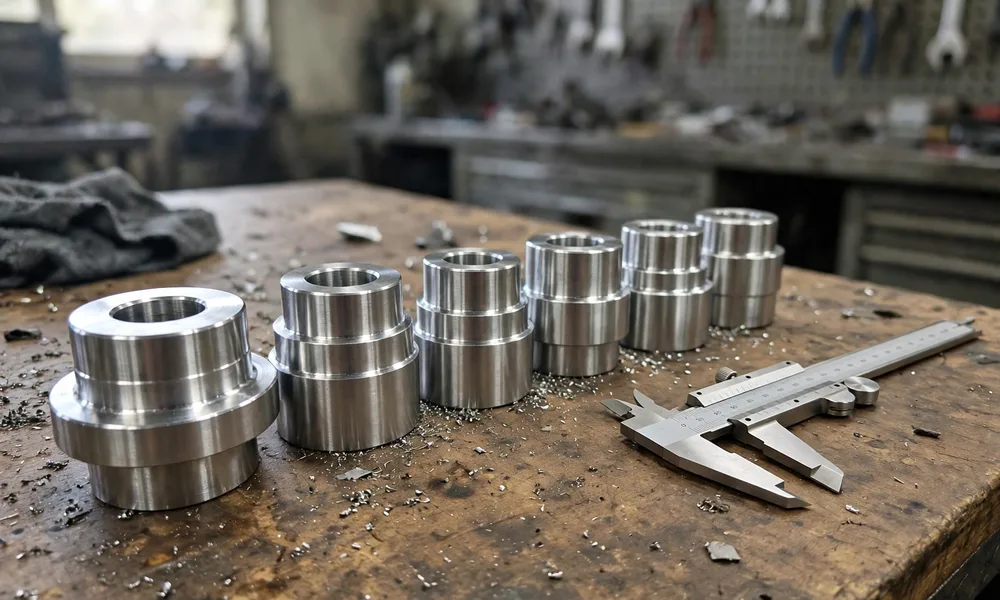
The last step is the quietest. Every sharp edge is deburred by hand with a small blade or a brush, because a burr left on a precision part can break off inside an engine. The part is washed to remove coolant and the finest chips, dried, and inspected one last time under a bright light. Then it is oiled or wrapped against rust and packed in a fitted case, labelled with its drawing number and batch. From here it may go into a jet engine, a robot, or a medical device — and it will fit first time, because it was made to. The newest rival to this subtractive craft builds parts up instead of cutting them down, as in how metal 3D printing is made, but for the finest tolerances the cutter still rules.
Specs
| Specification | Typical figure |
|---|---|
| Typical tolerance | About ±0.005–0.01 mm on precision parts |
| Surface finish | About 0.4–1.6 microns Ra |
| Spindle speed | About 10,000–30,000 rpm |
| Materials cut | Aluminium, steel, titanium, brass, plastics |
| Machine axes | 3 to 5 axes on precision machines |
| Shop temperature | About 20°C, controlled |
| Inspection | Coordinate measuring machine, ruby probe |
| Part size range | Millimetres to several metres |
Price
Precision CNC machining is sold by the hour and by the part, and prices vary enormously with the metal and the tolerance. As an estimate, a small precision-machined aluminium part typically costs roughly $50 to $300, while a complex titanium aerospace component can cost roughly $2,000 to $20,000 or more — these are estimates, and the final figure depends on the material, the size, the tolerance, and the number of parts in the batch. The machine time is the expensive part: a five-axis machine can cost several hundred dollars an hour to run, and a difficult part may need a day on it.
A Rare Fact
The first numerically controlled machines were built to make helicopter blades, and their programs were stored on punched paper tape — long ribbons of holes that the machine read one row at a time. A single tape could be hundreds of metres long, and if it tore, the machine stopped and the operator spliced it by hand. One early shop kept its tapes in a filing cabinet like a library, and a machinist who dropped a box of tape could lose a day sorting it out. Today’s programs arrive by network in seconds, but the idea is unchanged: a set of numbers, followed exactly, makes a part no hand could make.
From a drawing on a screen to a part that fits first time in a jet engine, precision CNC machining is the quiet craft behind the modern world. You never see the machine work, you never hear it over the noise of the shop, and yet almost everything exact that you own was touched by it. Numbers, steel and patience — that is what makes precision.


