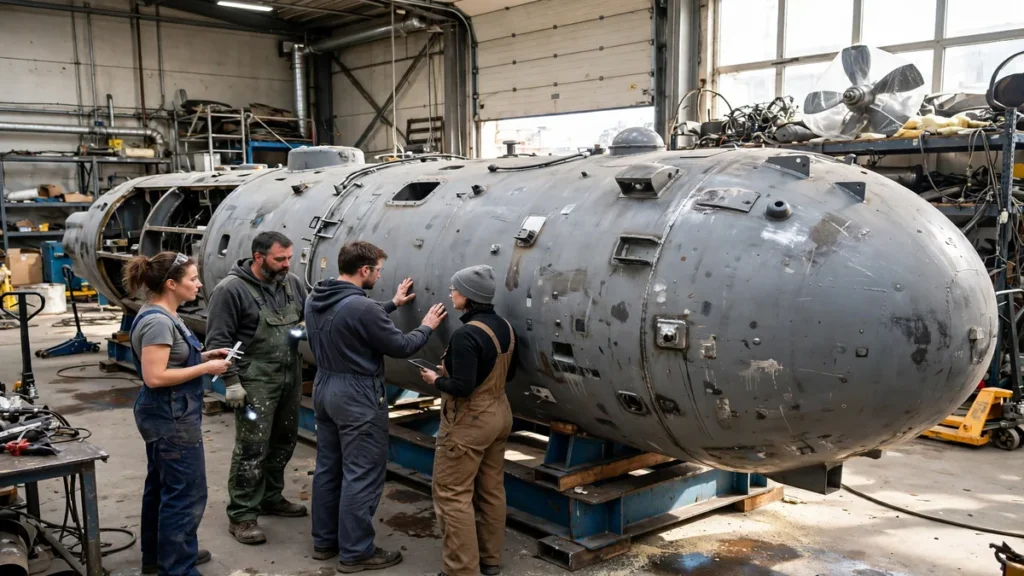
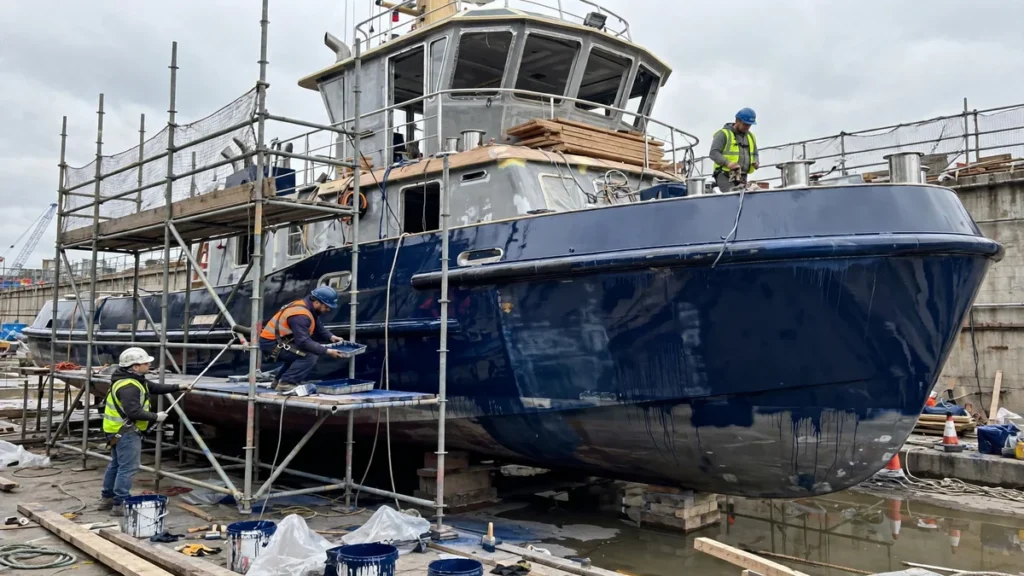
Three hundred metres down, the ocean presses on a submarine with about thirty kilograms of force on every square centimetre of its skin. There is no second chance down there: if the hull gives way, the sea comes in all at once. The only thing between the crew and that crushing dark is a single steel tube, a few centimetres thick, built to a tolerance a watchmaker would respect. It is called the pressure hull, and it is the most demanding piece of steelwork ever put to sea.
Every submarine is, at heart, a pressure hull with everything else bolted on. The crew and the engines live inside it, and the periscope and torpedo tubes pass through it. Outside it are the ballast tanks, the outer casing and the sea itself. A ship’s hull keeps water out; a submarine’s pressure hull keeps the ocean from crushing it flat, dive after dive, for thirty years. This is how that tube of steel is made.
How It’s Made
Step 1: Choosing and testing the steel
The build begins in a steel mill, long before any metal is cut. Pressure hulls are made from special high-strength steels, such as HY-80 and HY-100, far stronger than the steel of an ordinary ship. Each batch is tested to destruction: samples are pulled apart, bent, chilled and struck, because a plate that passes on paper but fails in the cold deep is worthless. Only steel that meets the specification exactly is accepted, and every plate is stamped with a number that follows it through the whole build.
Step 2: Rolling the plates into rings
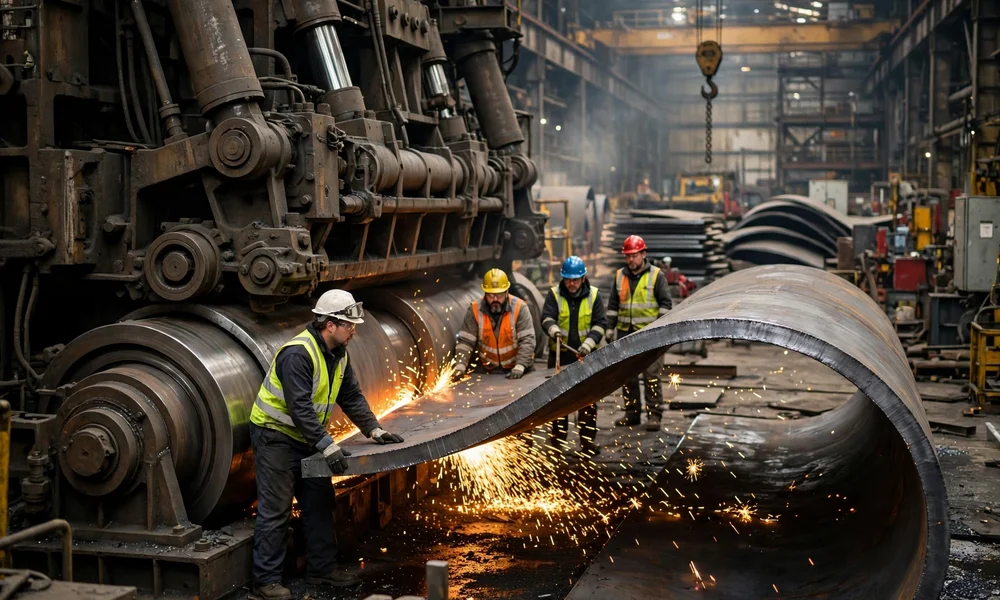
The plates arrive flat, several metres long and between 25 and 50 millimetres thick. They are fed through giant rollers that bend them slowly into curved sections, a process that can take hours for a single plate. The curve must be exact: when the ends of a section are brought together, the joint has to close with a gap of less than a millimetre, or the ring will not be a true circle. Fitters check the curve against full-size templates until the steel holds the shape of the hull.
Step 3: Welding the rings together
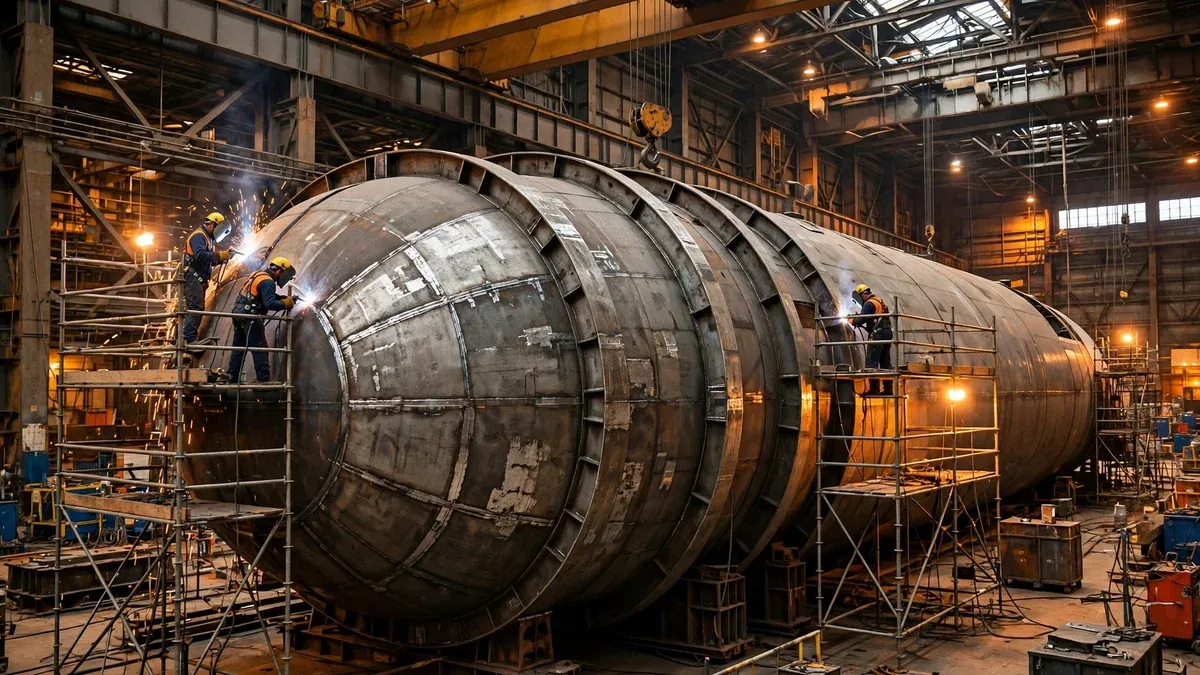
Each curved plate is welded to its neighbours to form a complete ring, and the rings are joined end to end to make the long cylinder of the hull. The welding is done by hand as well as by machine, and it is some of the most closely watched welding in the world. Every seam is welded from both sides, then examined with ultrasound, X-rays and magnetic testing to hunt for the tiniest crack. A flaw the size of a grain of sand can grow under the repeated loading of diving and surfacing, so any weld that fails inspection is cut out entirely and welded again. A single submarine can hold kilometres of pressure-hull weld.
Step 4: Adding the frames and stiffeners
A plain steel tube would collapse under deep-water pressure, so the inside of the hull is lined with ring frames and longitudinal stiffeners, welded to the shell at close intervals. These frames turn the thin shell into a rigid structure, spreading the load of the sea across the whole hull. They are fitted to the same tight tolerances as the shell, because a stiffener that does not sit perfectly against it does not work.
Step 5: Cutting the openings and fitting the penetrations
Once the cylinder is complete, the openings are cut: hatches, torpedo tube doors, the sail, and the dozens of smaller holes for periscopes, masts, cables and pipes. Every opening is a weak point in a pressure vessel, so each one is ringed with a heavy forged collar that restores the strength the cutting took away. The work draws on the same machining skills used elsewhere in hard metals — the techniques are close cousins of those used in titanium machining, where a tiny error can ruin an expensive part. When the hull is finished, it must be as strong around its holes as it is anywhere else.

Step 6: Testing the hull to almost destruction
Before the submarine is allowed to dive, the pressure hull is tested. The sealed hull is filled with water, and the pressure is raised far beyond anything it will meet at sea, while strain gauges on the steel report every flex and groan. This hydrostatic test proves the hull in a way no calculation can: if it holds, the boat is cleared to dive. The deep-sea submersible Alvin’s titanium pressure sphere is tested in a similar way, and for the same reason — the ocean does not forgive a hull that was never properly proven.
Step 7: Outfitting and the first dive
With the hull proven, outfitting begins: engines, batteries, bunks, galley, control room and sonar are lowered through the hatches and bolted into place inside the tube. The hull is closed up, the outer casing and ballast tanks are fitted around it, and the boat is launched. The first dive is slow and careful, taken in stages, with the crew listening for every creak as the pressure builds. When the boat reaches its test depth and the hull holds steady, the steelwork is proven. The building method owes much to modern shipbuilding, where whole sections are assembled separately and joined, as in modular ship construction.
Specs
| Specification | Typical figure |
|---|---|
| Hull material | High-strength steel (HY-80 / HY-100), or titanium on some boats |
| Plate thickness | 25–50 mm for the pressure hull shell |
| Hull diameter | About 10 metres for a large nuclear submarine |
| Test depth | Typically 300–500 metres, deeper for some designs |
| Pressure at test depth | About 30–50 kilograms per square centimetre |
| Weld inspection | 100% ultrasound and X-ray of pressure-hull seams |
| Build time | Several years from first plate to first dive |
| Design life | 30 years or more, with mid-life refits |
Price
A submarine pressure hull is never sold on its own, and navies do not publish a price for one. As an estimate, a modern conventional submarine typically costs roughly $500 million to $1 billion complete, while a large nuclear-powered submarine can cost roughly $2 billion to $4 billion — these are estimates, and the final figure depends on size, propulsion, sensors and weapons. The pressure hull is only a fraction of that cost, but it is the fraction that takes the longest to build and the most skill to get right.
A Rare Fact
In the Second World War, German U-boat crews found their pressure hulls creaked so loudly on a deep dive that the sound alone could give them away — and the groaning was the steel itself flexing under pressure. Modern submarines flex in the same way: the hull of a large boat can shrink by several centimetres in diameter at test depth, then spring back to its full size when the boat surfaces. The crew can hear it: a slow chorus of pings and groans as the steel takes the weight of the ocean and gives it back.
From flat plate to a tube that carries people to the bottom of the continental shelf, the pressure hull is the heart of every submarine. It is invisible once the boat is finished, but everything the submarine does depends on it holding. Steel, fire, and patience — that is what keeps a submarine alive.