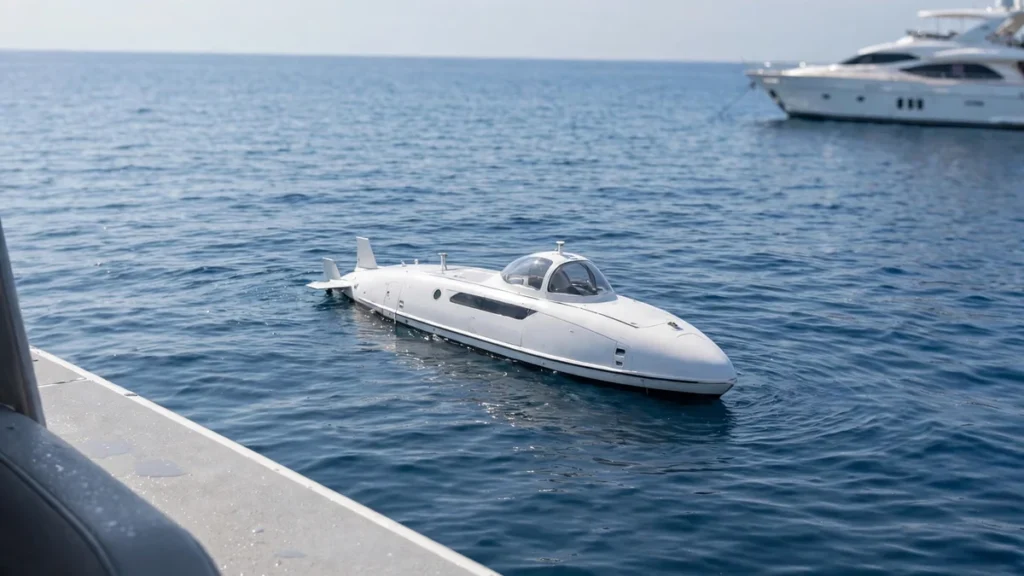
Far below the surface, where no sunlight reaches and no radio signal can follow, a long grey shape moves slowly through the dark water. There is no crew aboard. No one is steering it, no one is watching a screen, and no one is waiting for orders. The vessel is running a mission it was given hours or days ago: following a planned route, listening, measuring, and recording, and it will come home on its own when the work is done. This is an autonomous submarine, and building one is one of the hardest engineering jobs in the world.
An autonomous submarine, often called an autonomous underwater vehicle, is a self-driving vessel that works entirely underwater. Some are small enough to carry by hand, used by scientists to map the seabed or check water quality. Others are large, the size of a small boat, built for navies, energy companies and research institutes to survey pipelines, inspect offshore structures, or explore ocean depths no diver could reach. The luxury end of the field is not about gold taps or leather seats. It is about capability: longer range, deeper diving, quieter running, and sensors so good they can build a picture of the seabed in fine detail.

How an Autonomous Submarine Is Made, Step by Step
Step 1: Designing for pressure and endurance
The design starts with two questions: how deep will it go, and how long will it stay down? The answers decide almost everything. A vessel built for a thousand metres needs a far stronger hull than one built for a hundred, and a vessel meant to run for a week needs far more battery space than one that runs for a day. Designers work out the shape, usually a long cylinder with rounded ends, because that shape spreads pressure evenly and moves through the water with little drag.
Step 2: Building the pressure hull
Every opening in the hull is a risk, so hatches, cable seals and sensor windows are kept to a minimum and made to the same standard as the hull itself. The hull sections are joined, the welds are inspected with ultrasound and X-ray, and the whole hull is pressure-tested in a chamber that simulates the deep sea. Only when it passes does work move on. The principles here are the same as those behind a crewed boat, as explained in a guide to how a submarine pressure hull is made.
Step 3: Fitting batteries and power systems
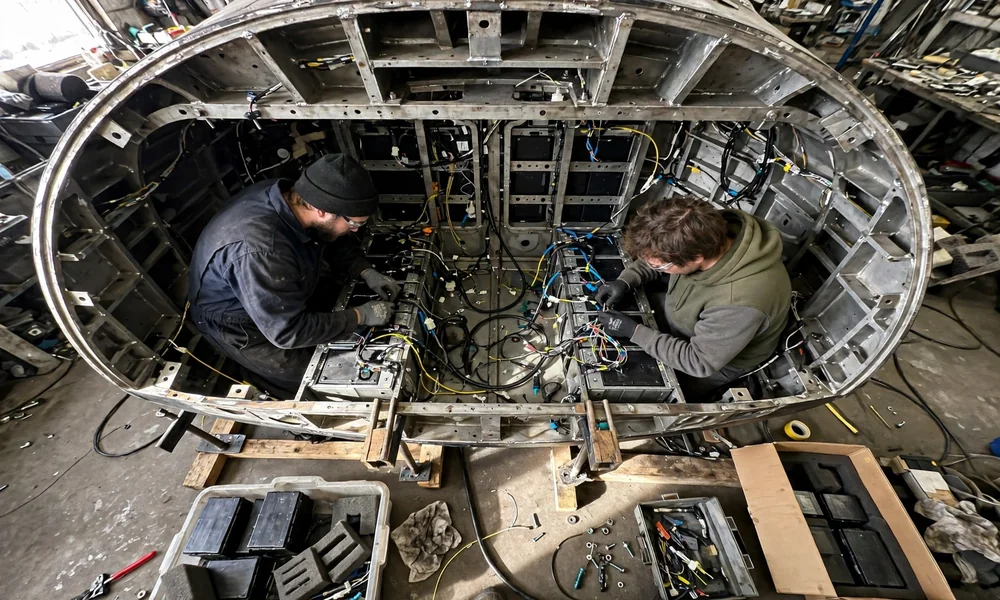
An autonomous submarine runs on batteries, because there is no air underwater for a diesel engine and no cable back to the surface. The battery pack is one of the largest and heaviest parts of the vessel, often taking up a third of the space inside the hull. Modern vessels use lithium-ion cells, packed into sealed modules with their own cooling and safety systems, because they store more energy for their weight than older battery types.
Step 4: Adding ballast, buoyancy and trim
A submarine sinks and rises by changing its weight, and an autonomous one does it with ballast tanks and pumps. To dive, it floods tanks with seawater or pumps oil out of buoyancy bladders, making itself heavier than the water around it. To rise, it does the opposite, pushing water out with compressed air or pumping oil back in. Small trim tanks at the front and back let the vessel stay level, which matters because a tilted submarine wastes energy and gives its sensors a crooked view.
Step 5: Installing propulsion and steering
Quietness matters for two reasons. First, a noisy vessel disturbs the very sensors it carries, especially the acoustic ones that listen to the seabed. Second, a quiet motor uses less power and leaves more energy for the mission. The propeller, the motor and the hull are all shaped to keep the water flowing smoothly, and the whole assembly is balanced and tested in a tank before it is fitted. The propeller work follows the same careful approach used on crewed boats, as shown in a guide to how a submarine propeller works.
Step 6: Fitting sensors, computers and navigation
Navigation is the hardest problem. Satellite signals do not reach underwater, so the vessel navigates by dead reckoning, measuring its speed and heading and adding them up, with an inertial system that senses every turn and acceleration. Every so often it surfaces to take a satellite fix and correct its position, or it uses acoustic beacons on the seabed as reference points. The sensors it carries depend on the job: sonar to map the bottom, cameras for close inspection, and instruments that measure temperature, salinity and currents. The sonar side of the work is covered in a guide to how a submarine sonar array works.
Step 7: Testing, trials and the first deep dive
Before a new autonomous submarine is trusted, it is tested in stages. First comes the pressure chamber, where the sealed hull is taken to its rated depth. Then comes the test tank, where the motor, steering and ballast are run through their paces in calm water. Then come harbour trials, short runs close to the support ship, with engineers watching every reading. Only then does the vessel go to sea for a real mission, and even then the first missions are short and shallow.
Specifications at a Glance
| Feature | Typical Large Autonomous Submarine |
|---|---|
| Length | 5 to 10 metres |
| Diameter | 0.8 to 1.5 metres |
| Weight | 2,000 to 8,000 kilograms |
| Maximum depth | 1,000 to 6,000 metres |
| Endurance | 24 hours to 30 days |
| Cruising speed | 2 to 4 knots |
| Power | Lithium-ion battery pack |
| Navigation | Inertial, with satellite fixes at the surface |
What an Autonomous Submarine Costs
Autonomous submarines are expensive, and the price rises steeply with depth and endurance. As an estimate, a small survey vessel built for shallow coastal work might cost roughly $500,000 to $1 million. A large, deep-rated vessel with a full sensor suite, long endurance and the ability to dive to several thousand metres could cost an estimated $3 million to $10 million, and the most capable research and defence vessels cost considerably more.
Those are estimates, and the sensors are often a large part of the bill. A high-resolution sonar system alone can cost hundreds of thousands of dollars, and the support ship, the launch and recovery gear, and the team of engineers who run the missions add to the cost of every deployment. Even so, an autonomous submarine is often cheaper than a crewed one for the same job, because it needs no life support, no crew quarters, and no rescue system for people.
A Rare Fact
Some autonomous submarines spend more time underwater on a single mission than many crewed submarines spend submerged in a whole year of training. Because they carry no crew, they do not need to surface for air, food or rest, and their only limit is battery power. The longest missions last for weeks, with the vessel quietly crossing hundreds of kilometres of ocean on its own, surfacing only at the end to phone home.
An autonomous submarine is a machine built around patience. It does not rush, it does not tire, and it does not need to be watched. It simply dives, works, and returns, and in a world that is mostly ocean, that quiet reliability is what makes it so valuable.