At first light in a busy harbour, a small boat with an outsized job pushes against the flank of a ship many times its own size. The big ship is barely moving, its engines idling, its crew waiting for the harbour pilot’s orders. The little boat leans into the hull, its fenders squeaking, its engines working hard, and slowly, almost gently, the giant begins to turn. That little boat is a tug, and the luxury version of it is one of the most carefully built working boats on the water.
A luxury tugboat is not a yacht dressed up as a workboat. It is a real working tug, built to tow, push, escort and rescue, but finished to a standard that would not look out of place in a marina full of superyachts. The owner might be a private individual who wants a rugged expedition vessel, a harbour company that wants its flagship to impress clients, or a shipyard that builds showcase tugs for wealthy buyers. Whatever the owner, the boat has to do two jobs at once: work hard every day, and look beautiful while doing it.
How a Luxury Tugboat Is Made, Step by Step
Step 1: Designing the hull and the towing gear
Every tug starts on paper, or rather on a computer screen, where naval architects shape the hull. A tug needs a wide beam and a deep draught, because stability matters more than speed. The hull is drawn with a rounded, full shape that lets the boat lean into a tow without rolling over, and with a skeg, a fin under the stern, that protects the propeller and helps the boat steer straight while pushing. The designers also plan where the towing gear will sit, because the towing point, the place where the towline pulls, has to be close to the boat’s centre of turning, or the tug could be pulled sideways and capsized by its own tow.
Step 2: Cutting and shaping the steel
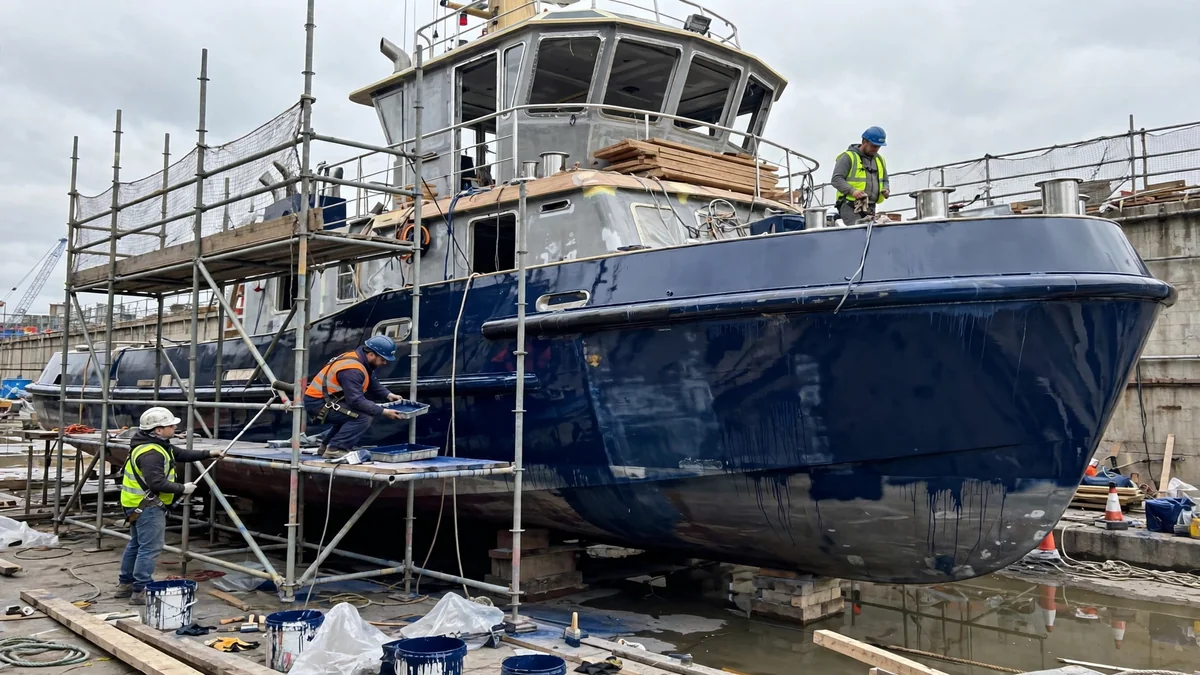
Once the shell is complete, the frames, decks and bulkheads are welded in, turning a hollow shell into a stiff structure. The hull is then blasted clean and painted with a protective coating system, several layers of primer and topcoat that keep seawater from eating the steel. The dark, glossy paint on a luxury tug is not just for show; it is the first line of defence against rust. The way the steel is worked here follows the same careful approach used in larger vessels, as shown in a guide to how a superyacht steel hull is made.
Step 3: Installing engines and propulsion
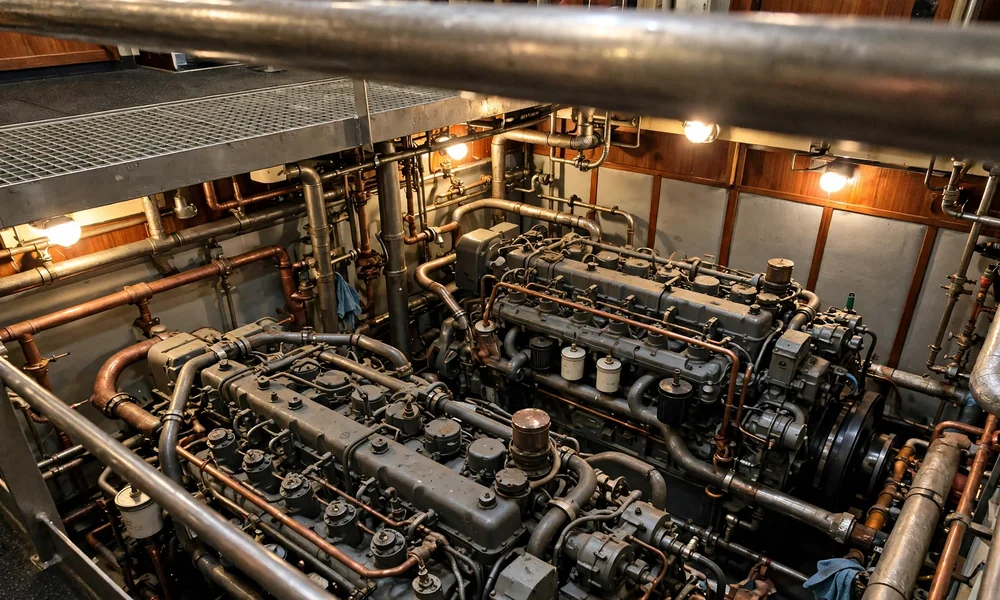
With the hull painted, the main engines are lowered in by crane. A modern luxury tug usually has two diesel engines, each driving its own propeller, which gives the captain the ability to turn the boat almost on the spot by running one propeller forward and the other astern. The engines are mounted on flexible mounts that cut down vibration, and the whole engine room is lined with sound insulation, because a luxury tug is expected to be quiet below decks.
Step 4: Fitting the towing winch and deck gear
Around the winch, the deck is fitted with towing pins, staples and fendering. The fenders on a working tug are heavy rubber, often old tyres or purpose-made cylindrical fenders, but on a luxury tug they are chosen and fitted neatly, so the boat looks tidy even while it works. The anchor gear goes in at this stage too, and the deck is fitted with its winches, hatches and safety rails. For the wider picture of how anchor gear fits into a working boat, the guide to how a yacht anchor system works covers the same principles at a smaller scale.
Step 5: Building the wheelhouse and navigation systems
The wheelhouse of a luxury tug is built for long, careful work. It has windows on all sides, often with glass that runs almost to the deck so the captain can see the towline and the fenders. Inside, the consoles hold radar, chart plotters, radios, a dynamic positioning display and the controls for the engines, thrusters and winch. The whole room is arranged so one person can see everything and reach everything, because harbour work often happens at close quarters, in poor visibility, with very little room for error.
Step 6: Wiring, plumbing and safety systems
Behind the panels, the tug is full of systems. Electrical cables run from generators to every light, pump and instrument, with separate circuits so a fault in one place does not take out the whole boat. Freshwater tanks, a watermaker, sewage treatment and a fire-fighting system are all fitted and plumbed in. The fire system is taken seriously on a tug, because an engine-room fire at sea is one of the worst emergencies a crew can face, so extinguishers, detectors and a fixed suppression system are all part of the build.
Step 7: Sea trials and finishing
Before delivery, the tug goes through sea trials. The builders take it out and test everything: full-speed runs, turning circles, crash stops, and bollard pull, the standard test of a tug’s strength, where the tug pulls against a fixed point on the quay while a load cell measures the force. A good harbour tug might pull thirty or forty tonnes, and the trial proves the engines, thrusters and winch can deliver that force safely and repeatedly.
Specifications at a Glance
| Feature | Typical Luxury Tugboat |
|---|---|
| Length | 20 to 30 metres |
| Beam | 9 to 12 metres |
| Engine power | 2,000 to 5,000 horsepower |
| Bollard pull | 30 to 60 tonnes |
| Top speed | 11 to 13 knots |
| Crew | 4 to 8 people |
| Hull material | Marine-grade steel |
| Propulsion | Twin screw or azimuth thrusters |
What a Luxury Tugboat Costs
A new luxury tugboat is an expensive machine, and the price depends mostly on size, power and finish. As an estimate, a smaller harbour tug of around 20 metres, built to a good standard with comfortable accommodation, might cost roughly $3 million to $5 million. A larger, more powerful tug of 25 to 30 metres, with azimuth thrusters, a full luxury interior and the latest navigation equipment, could cost an estimated $8 million to $15 million as a new build.
Those are estimates, and the final price can rise sharply with custom work. A bespoke interior, a hybrid propulsion system, or ice-strengthened steel can each add hundreds of thousands of dollars. Running costs are significant too: fuel, crew wages, insurance and maintenance on a working tug can run to hundreds of thousands of dollars a year, which is why most luxury tugs are bought by companies or by owners who plan to work the boat as well as enjoy it. The propulsion choice is a big part of the cost, and the production of that gear is covered in a look at inside ship propeller production.
A Rare Fact
Some of the most powerful tugs in the world are barely longer than a bus, yet they can pull a ship that weighs a hundred thousand tonnes. They do it not with speed but with grip: their wide, heavy hulls and deeply set propellers bite into the water so effectively that almost all of their engine power becomes pulling force. It is one of the few machines where being short, fat and slow is the whole point.
A luxury tugboat is a reminder that a working boat can also be a beautiful one. It is built like a tank, finished like a yacht, and tested like a rescue vessel, and when it leans into the side of a great ship in the early morning, it is doing exactly what it was designed to do.


