It begins as a flat sheet of steel, grey, dull, and no wider than a doorway. Stacked in a shipyard yard, these plates look like nothing at all — raw material, waiting. A year later, the same steel will be the gleaming hull of a superyacht, a floating palace worth tens of millions, cutting through the Mediterranean at twenty knots with a helicopter on its deck. The journey from plate to hull is one of the slowest, heaviest, and most skilful builds in all of engineering.
Unlike a car or a phone, a superyacht hull is not stamped out by a machine. It is built by hand, plate by plate, by welders and shipwrights who read the shape of a curve the way a sculptor reads stone. Every hull is a one-off, drawn for one owner, and the steel has to be bent, welded, and finished to a standard where a flaw the width of a hair would show through the paint. This is how that flat plate becomes a ship.
How It’s Made
Step 1: Cutting the plates
Construction starts in the plate shop, where steel plates — usually marine-grade steel between 8 and 20 millimetres thick — are cut to shape. The shapes come from the naval architect’s drawings, transferred to the plate by computer-controlled plasma or laser cutters that follow the curves of the hull to within a millimetre. Each plate is marked with its position in the hull, like pieces of a giant jigsaw, because once cutting begins there is no spare: a hull can need hundreds of plates, and every one has a single correct home. The edges are bevelled so that when two plates meet, the weld can bite deep into the joint.
Step 2: Bending the curves
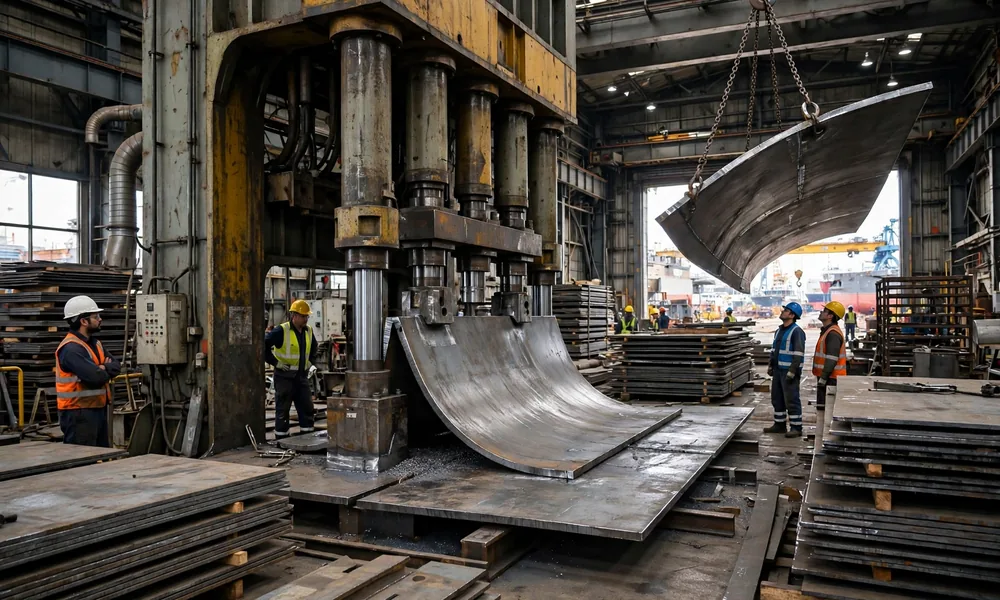
A ship’s hull is almost all curves, and flat steel does not bend itself. Plates are fed through enormous rollers or pressed in hydraulic presses that coax them into the gentle sweep of the bow or the hard turn of the bilge. The operators work from wooden templates — full-size patterns of the hull’s shape — checking the plate against the template again and again until the curve matches. Get it wrong and the plate is scrap; get it right and it will sit against its neighbours with barely a gap. The compound curves near the bow, where the hull bends in two directions at once, are the hardest of all and are often shaped with heat, the steel warmed until it can be persuaded into shape.
Step 3: Building the skeleton
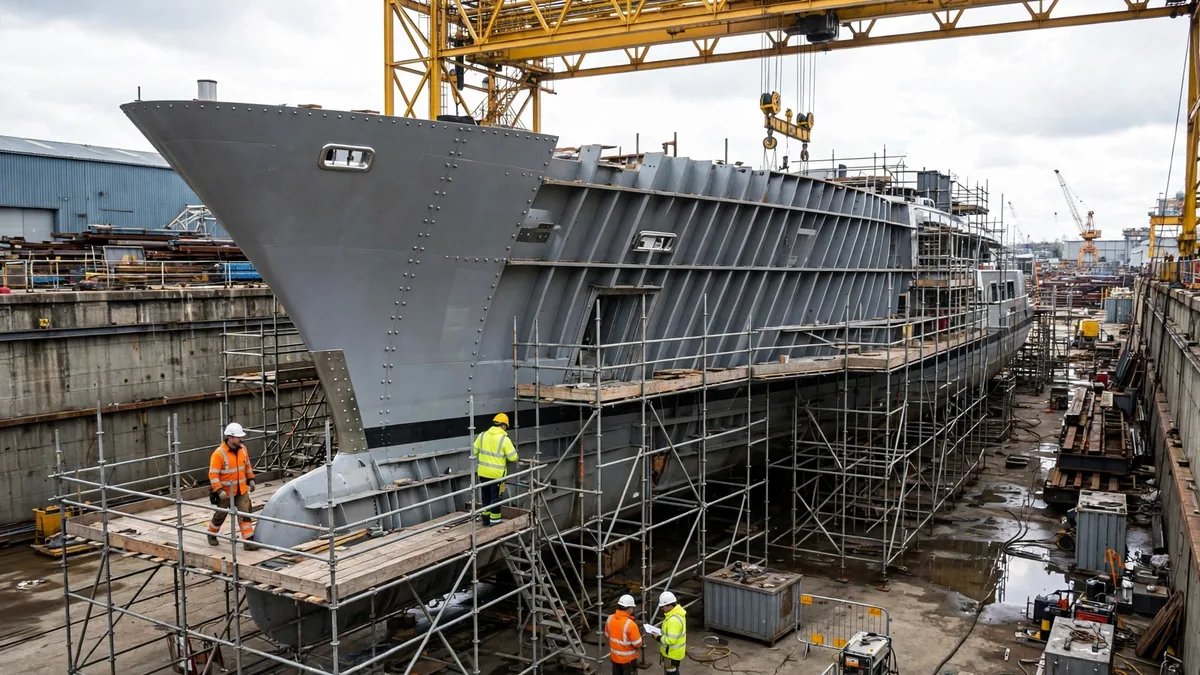
Before any outer plate goes on, the hull’s skeleton is built: a spine called the keel, with transverse frames rising from it like ribs. This framework is assembled upside down or on its side in the build hall, then turned upright when complete. The frames define the hull’s shape and give it the strength to survive a lifetime of waves, so they are welded with the same care as the shell itself. Long girders run fore and aft between the frames, tying the whole structure together into a rigid cage. When the skeleton is finished, it already looks like a ship — an open, skeletal ghost of one.
Step 4: Plating the hull
Now the plates are lifted into place, one by one, and tack-welded to the frames. Cranes swing each curved plate over the skeleton while fitters guide it in, adjusting with wedges and clamps until the edges line up. This stage is slow: a single large plate can take a day to fit. The plating usually starts at the keel and works upward, row by row, so the hull grows like a shell closing around its frame. It is here that the yard’s skill is most visible — on a well-built hull, the plates flow into each other so smoothly that from a distance the steel looks poured rather than assembled. The techniques are cousins of those used in modular ship construction, where whole sections are built separately and joined together.
Step 5: Welding it solid
With the plates tacked in place, the welders take over. Every seam is welded along its full length, often from both sides, using submerged arc or flux-cored welding that lays down a deep, clean bead. A superyacht hull can contain kilometres of weld, and each metre must be perfect: a bad weld is a weak point that salt water will find. Welders work in pairs, one on each side of the plate, and inspectors follow behind with ultrasound and dye-penetrant tests, checking for hidden flaws the eye cannot see. Any weld that fails is cut out and done again — there are no shortcuts in a hull that must hold the sea out for decades.

Step 6: Fairing and finishing
Once the shell is watertight, the long job of fairing begins. The hull is checked for fairness — the smoothness of its curves — using long straightedges and, increasingly, laser scanning. Low spots are filled and high spots are ground down until the surface is true. Then comes blasting, priming, and the famous mirror finish: layer after layer of filler, primer, and paint, each one sanded before the next, until the steel disappears under a surface like black glass. A fair hull is not just pretty; it is faster and quieter through the water. Only after the paint cures is the hull launched, sliding down the slipway or floated out of the dry dock to meet the sea for the first time.
Specs
| Specification | Typical figure |
|---|---|
| Hull material | Marine-grade steel, 8–20 mm plate |
| Typical length | 50–100 metres for a steel superyacht |
| Hull weight | Several hundred tonnes of steel alone |
| Plate count | Hundreds of individually cut plates |
| Weld length | Kilometres of weld per hull |
| Build time | 18–36 months from first plate to launch |
| Paint system | Multiple coats of filler, primer, and topcoat |
| Design life | 30 years or more with proper maintenance |
Price
A steel superyacht hull is never sold on its own, but its cost is a large share of the finished yacht. As an estimate, a 50-metre steel superyacht typically costs roughly $30 million to $50 million complete, with larger or more elaborate yachts running well past $100 million — these are estimates, and the final price depends on size, outfitting, and the yard. The hull steel itself is only a small part of that figure; most of the money goes into the thousands of hours of skilled labour that shape, weld, and fair it.
A Rare Fact
When a superyacht hull is launched, the yard holds its breath — because the first time the hull touches water, it is also the first time anyone can prove the calculations right. Shipyards still launch with a bottle of champagne and a crowd, but behind the ceremony is a serious engineering moment: a hull that floats a few centimetres off its designed waterline means the weight estimate was wrong, and the whole yacht’s balance must be corrected before it ever leaves the yard.
From flat plate to floating palace, the steel hull is the foundation everything else depends on. The same obsession with the hull’s shape continues in the wider story of superyacht hull construction, and the comfort of life aboard owes much to the systems that steady the ship once it is afloat — including the gyroscopic stabilizers that keep a yacht level at sea. Steel, fire, and patience: that is what a superyacht is really made of.


