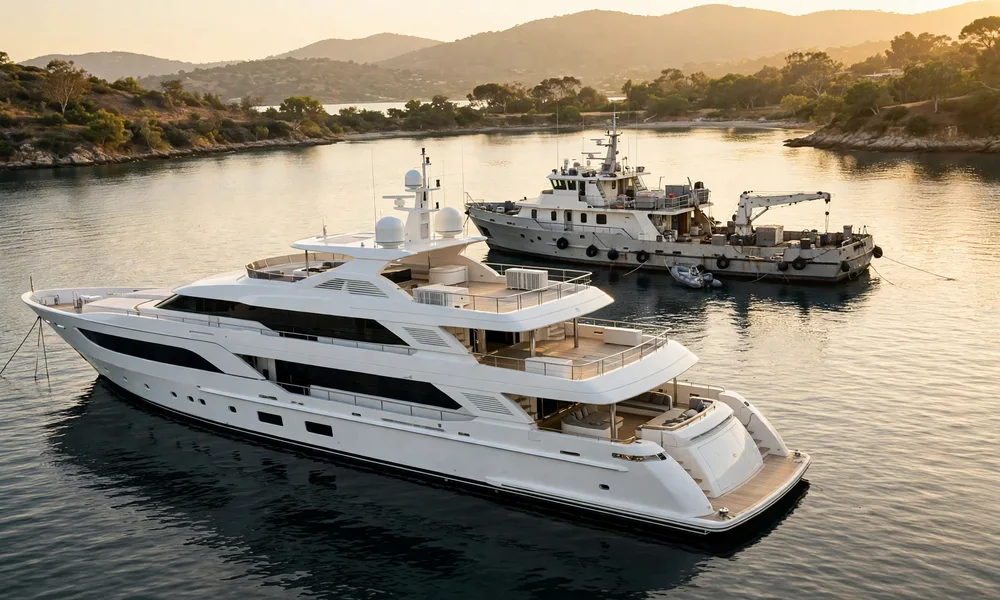
The superyacht is already beautiful when it slides into the bay at dawn, white hull gleaming, crew in pressed shirts lining the rails. What nobody on the quay photographs is the ungainly shadow following a respectful distance behind it: a long, flat-decked workhorse with a crane on its stern, a helicopter pad on its roof, and a garage full of jet skis, tenders, and diving gear. That is the support yacht, and without it the floating palace ahead could not carry half the toys, crew, and equipment its owner expects. It is a machine built for service, not for show, and its construction is a different kind of boatbuilding altogether.
A support yacht is part cargo ship, part garage, and part floating hotel for the people who keep the main yacht running. It carries the big tender that will not fit in the mothership’s garage, the submarine that needs its own crane, and the extra crew who cook, clean, and maintain everything while the guests never see a uniform out of place. Building one means solving a puzzle the main yacht never faces: how to pack maximum working space into a hull that can still keep up with a superyacht, cross oceans, and look respectable when it ties up alongside. This is how that puzzle gets solved.
How It’s Made
Unlike a superyacht, where the interior is the star, a support yacht is designed from the deck down. The build starts with what it must carry, and the hull, engines, and accommodation are all shaped around that cargo list. Six stages take it from steel plate to sea trials.
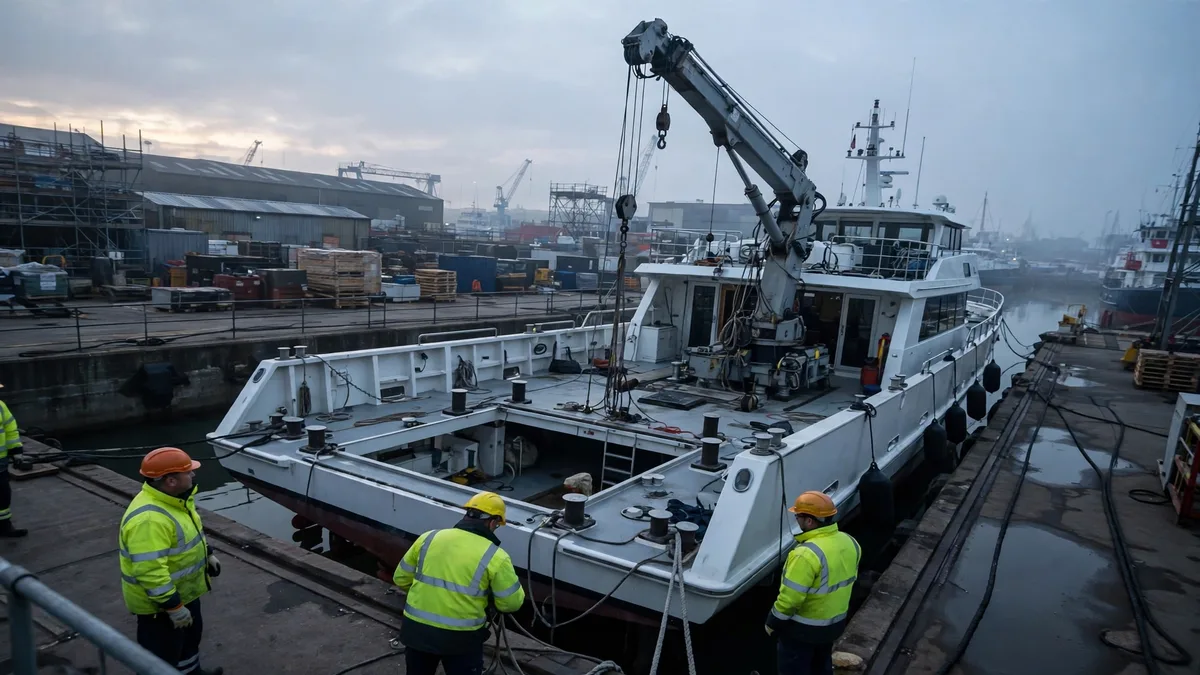
- The hull is built for deck space, not speed. The build begins with a steel or aluminium hull that is wider and squarer than a yacht hull, because the whole point is a vast open aft deck. Plates are cut by computer-guided machines, welded into sections, and joined in a dry dock while the yard checks every seam. The hull is given a reinforced stern and a wide transom door that opens like a garage, so tenders can float straight in and out. It will never be the fastest hull in the harbour, but it is designed to carry weight that would sink a prettier boat.
- The crane and handling gear go in early. Before the decks are closed up, the yard installs the machine that defines the vessel: a heavy crane, often able to lift ten tonnes or more, mounted where it can reach every corner of the working deck. Winches, tie-down rails, and a launch-and-recovery system for the submarine or tender are fitted at the same time, because retrofitting them later would mean cutting through finished steel. Engineers test the crane with dead weights while the hull is still in the shed, checking that the deck can take the load without flexing.
- The engines and power systems are fitted. Support yachts need range more than speed, so they usually get efficient diesel engines paired with large fuel tanks, giving them ocean-crossing endurance at a steady cruising pace. Generators, water makers, and fuel systems follow, sized to run the cranes, the workshops, and the air conditioning for weeks away from port. The engine room is built for access rather than beauty, with walkways and lifting beams so engineers can pull a pump or a turbo without dismantling the room around it.
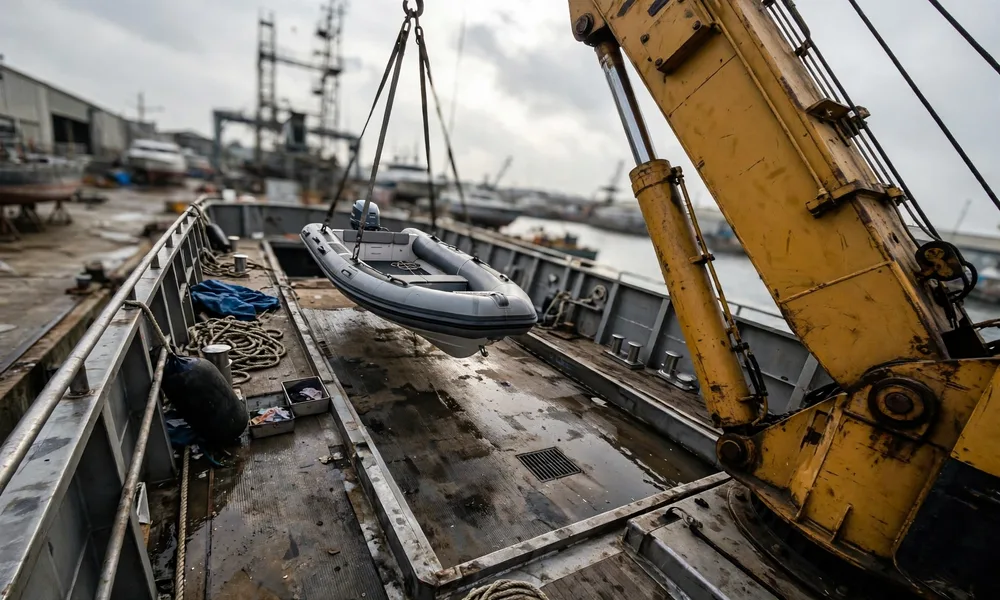
- The garages, workshops, and toy storage take shape. The open deck is divided into zones: a flooded garage for the tender, racks for jet skis and diving equipment, and a proper workshop with a bench, tools, and spares. Some support yachts carry a small submarine in a cradle on deck, launched by the crane through a side door. Every item gets a fixed home with straps and chocks, because anything loose on an ocean crossing becomes a battering ram. Choosing what goes aboard is a bigger job than it sounds, and our ranking of the best superyacht tenders shows just how much hardware a big yacht family expects to carry.
- The crew accommodation is built to a different standard. A support yacht can house twenty or more extra crew, and their cabins, mess, and laundry are built to a practical standard rather than a luxury one. Cabins are compact but well ventilated, the galley is sized for round-the-clock cooking, and there is a gym and a small lounge because a rested crew is a safe crew. The bridge gets the same navigation and communication kit as the mothership, so the two vessels can operate as a pair, sharing charts, weather, and plans in real time. The contrast with a private submarine build, where every cubic metre is fought over, is stark, as our look at how a private submarine is made shows.
- Sea trials prove the working deck. The finished vessel goes to sea with its decks loaded as they will be in service: tender aboard, crane swinging, helicopter landing on the pad. Trials test the crane at full reach in a swell, the tender launch in open water, and the engines at full load for hours. The crew practises recovering a tender in rough weather, because that is the manoeuvre that matters most at three in the morning in a remote anchorage. Only when the deck crew can launch and recover everything smoothly does the yard hand over the keys. The choice of hull material shapes how all of this performs, which is why builders study carbon fibre versus aluminium for superyachts before cutting a single plate.
The Numbers That Matter
A support yacht is judged by what it can carry and how far it can go, not by how fast it looks. The figures below are typical for a modern vessel in the sixty to eighty metre class.
| Specification | Typical figure |
|---|---|
| Length overall | 60 to 80 metres |
| Open deck area | 300 to 500 square metres |
| Crane capacity | 8 to 15 tonnes |
| Maximum speed | 18 to 22 knots |
| Cruising range | 5,000 to 6,000 nautical miles |
| Crew capacity | 18 to 28 people |
| Fuel capacity | 150,000 to 250,000 litres |
| Helicopter capability | Touch-and-go or full landing pad |
What It Costs
A support yacht is a serious purchase even by superyacht standards, because it is effectively a second ship. As an estimate, a sixty-metre support yacht costs roughly $35 million to $50 million to build, while an eighty-metre vessel with a full helicopter hangar, submarine cradle, and large crane can reach $70 million to $90 million as an estimate. Running costs are lower than the mothership’s, but they are still substantial: crew wages, fuel, insurance, and maintenance commonly add up to $4 million to $7 million a year as an estimate. Owners accept that because the support yacht does something no extra cabin on the main yacht can do: it lets the mothership stay clean, quiet, and uncluttered, with all the machinery, toys, and working crew carried a polite distance behind.
A Rare Fact
Here is something few people outside the industry know: some support yachts carry their own submarine, and the crew trains to launch it in open ocean. The little submersible sits in a cradle on the working deck, is lifted over the side by the crane, and dives with two or three guests to depths a scuba diver can never reach. The mothership’s guests step from a tender into the submarine as casually as boarding a lift, and an hour later they are watching the seabed slide past a viewport a thousand metres down. It is the most expensive toy in the fleet, and it lives not on the superyacht but on the workhorse behind it.


