The hypercar pulls away from the pit lane, and the sound is unlike anything else on the grid. It is sharper than steel, almost metallic in its ring, and as the driver lifts off, the exhaust pipes behind the car glow faintly blue and gold in the evening light. The car is lighter than its rivals by the weight of a grown man, and a good part of that saving hangs right at the back, in a system most people never see.
That system is a titanium exhaust, and it is one of the most demanding parts of a performance car to design. It must carry exhaust gas at hundreds of degrees, survive vibration that would crack lesser metals, and do it all while weighing roughly half as much as the steel system it replaces. Titanium is strong, light, and stubbornly hard to work, and shaping it into an exhaust is a test of welding, bending, and patience.
Yet the reward is real: less weight over the rear axle, faster responses, and a sound no other metal can make. From Formula 1 to the fastest road cars, titanium exhausts have become the signature of machines built without compromise. Here is how one works.

How It Works
Step 1: Hot gas leaves the engine
Everything starts in the cylinders, where burning fuel produces exhaust gas at temperatures that can pass 900 degrees Celsius. That gas must escape quickly and cleanly, because any gas left behind chokes the next combustion cycle and steals power. The exhaust manifold, a set of curved pipes bolted to the cylinder head, collects the gas from each cylinder and funnels it into a single stream. In a performance engine the length and diameter of each manifold pipe are tuned so that pressure waves from one cylinder help pull gas out of the next, a phenomenon called scavenging.
Step 2: Titanium takes the heat
The pipes themselves are made from titanium alloy, most often a grade that balances strength, heat resistance, and weldability. Titanium is about 45 percent lighter than steel for the same strength, and it keeps its strength at temperatures that would soften aluminium. It also resists corrosion from the inside, where hot gas and condensation attack the metal every time the engine warms up and cools down. The journey from raw metal to finished pipes is described in how titanium exhaust system is made.
Step 3: Bends tuned like an instrument
An exhaust is not a simple tube. Every bend changes the speed and pressure of the gas, and engineers shape the pipes the way a musician shapes an instrument, using diameter, length, and curvature to tune both power and sound. Wider pipes flow more gas at high revs but lose the low-speed pull; narrower pipes keep the low end strong but strangle the top end. The titanium is bent on mandrel machines that keep the tube perfectly round through the curve, because a kinked pipe would create turbulence and cost horsepower.
Step 4: Silencing without strangling
Before the gas leaves the car, it passes through the muffler and the resonator, chambers that cancel sound waves without blocking the flow. Inside, perforated tubes and absorption material break up the pressure pulses, turning a raw bark into a tuned note. The trick is to silence the car enough for the road while keeping the gas moving freely, and titanium’s thin walls make the job harder: the metal rings more easily than steel, so the muffler design must tame a sharper, brighter sound.
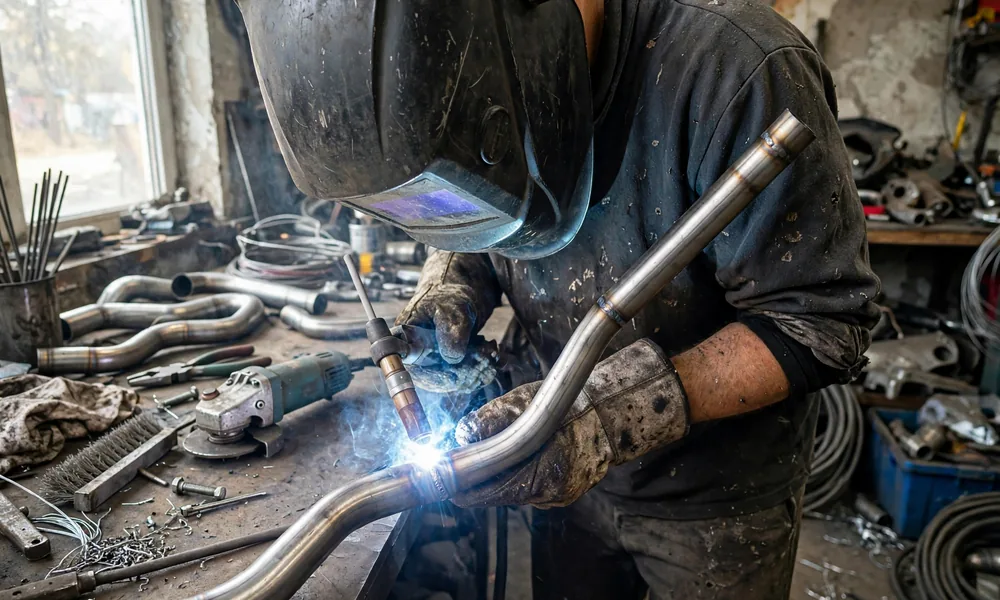
Step 5: Valves that change the car’s voice
Many titanium exhausts carry active valves, flaps inside the pipe that open and close on command. At low speed or in a quiet neighbourhood, the valves shut and force the gas through a longer, quieter route. At full throttle, they swing open and let the gas take the shortest, loudest path straight out. The change is instant, and it is why the same car can whisper through a village and scream on a circuit. The valves are driven by small electric motors or vacuum actuators, and they must survive the same heat and vibration as the rest of the system, opening and closing thousands of times without sticking.
Step 6: Holding on through the shaking
The finished system is hung from the car on flexible mounts, because an engine that twists on its mounts would tear a rigidly bolted exhaust apart. Rubber and spring hangers let the pipes move with the engine while keeping the tailpipes exactly aligned with the bodywork. Heat shields protect the body, the fuel tank, and the wiring from the glowing pipes, and the whole system is checked for clearance as the suspension moves through its full travel. The full factory line, from bending to final assembly, is shown in inside titanium exhaust system production.
| Main material | Titanium alloy, usually a grade chosen for heat resistance and weldability |
| Weight saving | Roughly 40 to 50 percent lighter than an equivalent steel system |
| Gas temperature | Up to around 900 degrees Celsius at the manifold on a hard-driven engine |
| Wall thickness | Often under one millimetre, far thinner than a steel exhaust |
| Key parts | Manifold, collectors, catalytic converter, resonator, muffler, tailpipes |
| Sound control | Active valves that switch between quiet and open exhaust paths |
| Mounting | Flexible rubber and spring hangers that move with the engine |
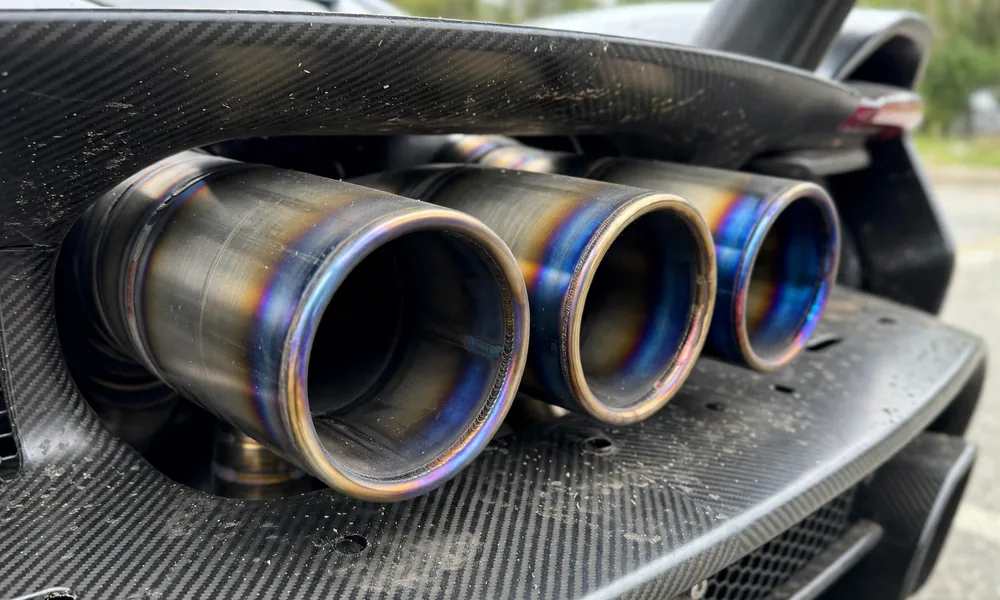
| Finish | Natural heat tint in blue, gold, and purple, or polished and coated |
What Does a Titanium Exhaust System Cost?
An aftermarket titanium exhaust for a performance car is estimated at roughly $2,000 to $8,000, while a full titanium system for a hypercar is estimated at $10,000 to $30,000 or more. The price reflects the cost of the metal itself, the skilled welding it demands, and the hours of tuning that go into the pipe shapes. A steel system does the same basic job for far less money, so titanium is a choice made for weight, sound, and pride rather than necessity. For a car where every kilogram matters, though, the saving at the very back of the car is worth more than the same weight saved anywhere else.
A Rare Fact
The blue and gold colours on a titanium exhaust are not paint. They are heat tint, a thin oxide layer that forms on the metal as it heats, changing colour with temperature the way oil shimmers on water. Each shade marks the temperature that part of the pipe reached, so an experienced eye can read the exhaust like a thermometer: straw gold near the engine, deep blue further back. The colours are also a signature. No two titanium exhausts age exactly alike, because no two engines heat them in quite the same way, and owners prize the pattern as proof that the car has been driven hard.
A titanium exhaust is a contradiction: a system built to be as light as possible that must survive the hottest, most violent part of the car. It saves weight, sharpens the sound, and wears its working life on its surface in bands of blue and gold. Steel does the job. Titanium makes it an event, and for the cars that wear it, that is exactly the point. The metal itself begins its life in a very different process, as titanium forging materials engineering explains.


