Stand behind a hypercar at full throttle and the sound hits you in the chest before you hear it in your ears — a sharp, metallic scream that seems too loud for anything made of metal. Part of that sound comes from the engine. But a surprising amount of it comes from the pipes behind it: a titanium exhaust system, a sculpture of bent tubes that weighs less than a suitcase and costs more than many cars. It is one of the most labour-intensive parts on a hypercar, and almost all of it is made by hand.
Titanium is the reason. It is about 45 per cent lighter than steel, it shrugs off the extreme heat of exhaust gas, and it turns blue, purple, and gold as it is welded — colours that owners pay extra to see. But titanium is also stubborn: it cannot be bent like steel, it cracks if it is worked cold, and a single speck of oxygen in a weld can ruin a pipe. So the factories that build these systems look less like car plants and more like jewellers’ workshops, full of skilled welders, jigs, and patience.
This is a look inside one of those workshops, and the long road from a flat sheet of titanium to an exhaust that sings.
How a Titanium Exhaust System Is Made
Step 1: Cutting and forming the titanium
Production begins with thin sheets and tubes of aerospace-grade titanium, usually the alloy Ti-6Al-4V. Sheets are laser-cut into precise shapes, and tubes are bent on computer-controlled mandrel benders that support the inside of the tube so it does not collapse or wrinkle. Some bends are so tight that the tube must be heated first, because cold titanium resists bending and can crack. Every piece is cut slightly long, so the final trimming can be done by hand to fit the jig exactly.
Step 2: Building the jig
Before a single pipe is welded, the factory builds a jig — a steel frame that holds every tube in exactly the right position in three dimensions. The jig is made from the car’s own digital model, and it is the only way to guarantee that an exhaust built by hand will bolt straight onto the car without forcing or bending. Pipes are clamped into the jig one by one, checked against the model, and adjusted until the gaps between them are even. A good jig is reused for hundreds of systems; a bad one is thrown away.
Step 3: Tack welding the sections
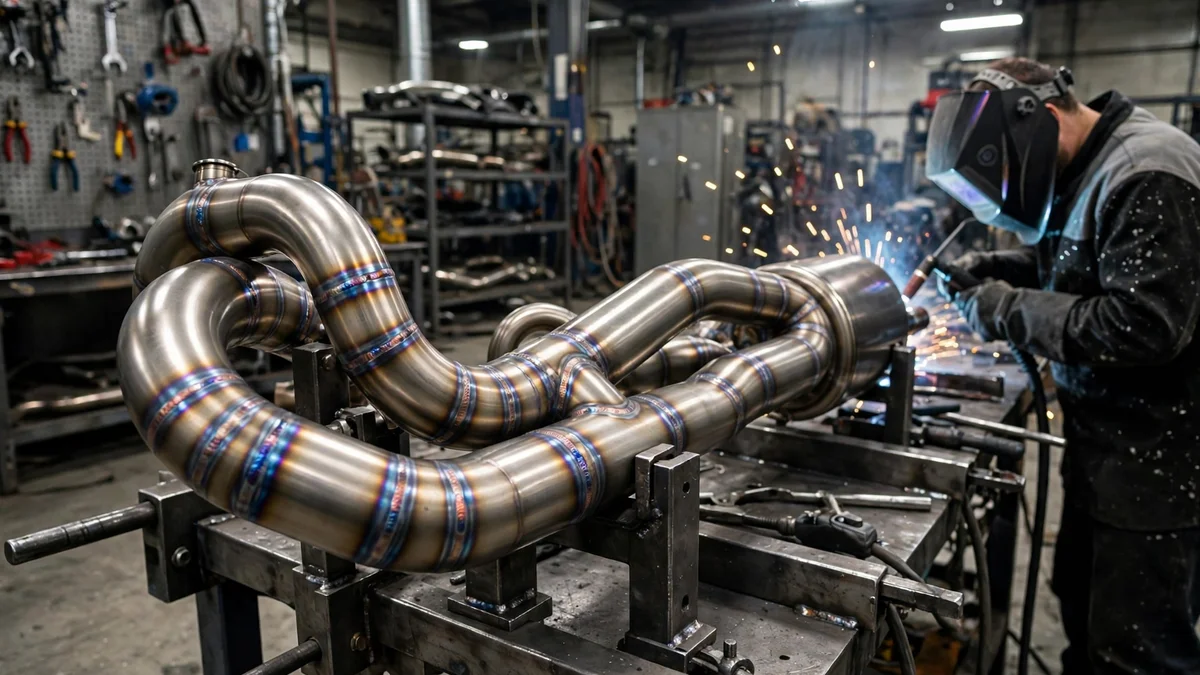
With the pipes held in the jig, the welder tacks them together — small, temporary welds that hold the shape while the full welds are done. Titanium welding is done with a TIG torch under a flow of argon gas, because hot titanium grabs oxygen from the air and becomes brittle. The welder works in short runs, letting each section cool, because too much heat in one place can warp the whole assembly. The blue and gold colours that appear on a finished titanium exhaust are the visible sign of this heat: a thin oxide layer that forms as the metal cools, and one that buyers love so much that factories take care to keep it even.

Step 4: Full welding and the muffler
Once the shape is tacked, the welder completes every seam in full, often spending several hours on a single system. Meanwhile, the muffler — or silencer — is built separately: a titanium canister packed with sound-absorbing material and fitted with internal chambers and valves that open and close to change the exhaust note. Some systems have electronically controlled valves, so the car can be quiet in a neighbourhood and loud on a track. The muffler is welded into the system last, and its valves are tested for smooth, silent movement.
Step 5: Fitting the tips and brackets
The exhaust tips — the visible ends — are polished, rolled, and sometimes engraved, because they are the only part most owners ever see. Mounting brackets are welded on, each one positioned so the system hangs from the car on flexible mounts that absorb vibration. Every bracket is checked for alignment on the jig, since a bracket a few millimetres out would put stress on the pipes every time the engine moves.
Step 6: Testing for leaks and sound
A finished system is pressure-tested: the pipes are sealed and filled with air, and a gauge watches for any drop that would betray a pinhole leak. Then it is fitted to a test engine or a finished car and run through its rev range, while engineers listen for the note the customer ordered — deep at low revs, sharp at high revs, with no drone or rattle at cruising speed. Systems that fail the sound test go back for adjustment; the valves, the muffler packing, or even a pipe length may be changed.
Titanium Exhaust System Specs
| Specification | Typical range |
|---|---|
| Material | Titanium alloy, usually Ti-6Al-4V |
| Weight saving vs steel | About 40 to 50 per cent lighter |
| Typical system weight | About 7 to 15 kilograms |
| Max exhaust gas temperature | About 800 to 900 degrees Celsius |
| Wall thickness | About 0.8 to 1.2 millimetres |
| Power gain vs stock | About 5 to 15 horsepower, depending on car |
| Welding method | TIG, under argon shielding gas |
| Valve control | Electronic or vacuum-actuated |
What Does a Titanium Exhaust System Cost?
Titanium exhausts are among the most expensive bolt-on parts in the car world. A titanium system for a sports car is estimated to cost roughly $3,000 to $8,000, while a full system for a hypercar is estimated to cost roughly $10,000 to $30,000 or more, with some factory options exceeding that. Prices are estimates only and vary by car, brand, and whether the system is a factory option or an aftermarket part. The cost is mostly labour: hours of skilled welding on a metal that punishes mistakes. It is the same kind of hand-built philosophy behind how a hypercar V12 engine is made, and the weight saving matters for the same reason it does in how carbon-ceramic brakes are made — every kilogram saved is performance gained. For the numbers behind the engine it serves, see Bugatti W16 engine specs explained.
A Rare Fact
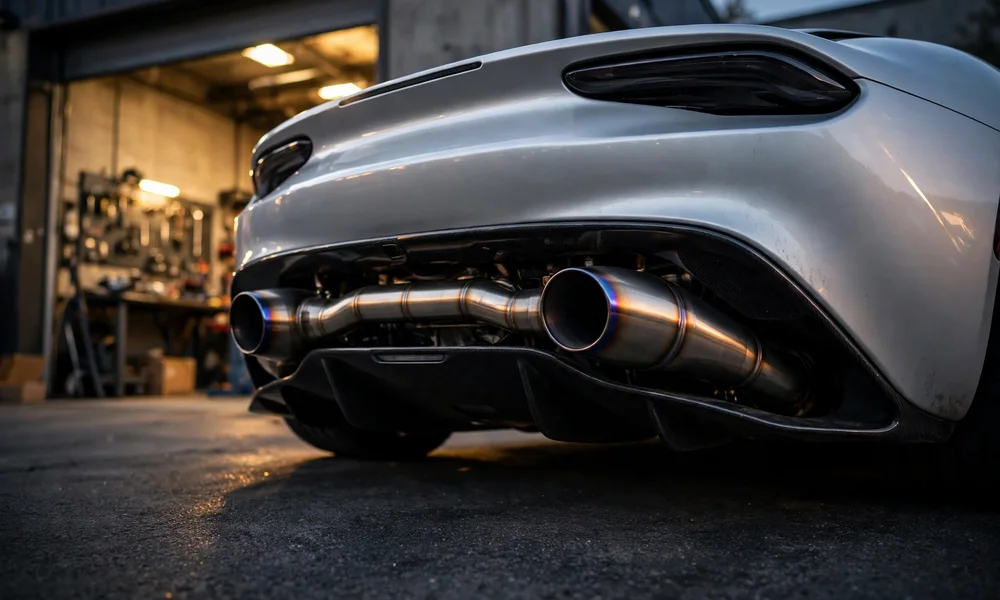
Titanium exhausts have a racing secret: in Formula 1, exhausts were once made from an exotic nickel alloy called Inconel, but titanium’s lightness and heat resistance made it the material of choice for many top teams, and some F1 exhausts are so thin — about 0.5 millimetres — that they glow cherry red at full throttle and can be seen glowing through the bodywork at night races. A few road-car systems are built to the same standard, which is why a hypercar’s exhaust tips can shimmer blue and gold after a hard drive: the colours are the metal’s own record of the heat it has survived.
A titanium exhaust is easy to dismiss as a noise-maker, a toy for people who like loud cars. But it is really a piece of aerospace engineering bolted to the back of a car: a hand-welded, heat-tinted sculpture that weighs almost nothing, survives temperatures that would melt lesser metals, and changes the character of the car every time the valves open. The sound is just the part you can hear.


