Start a hypercar fitted with a titanium exhaust and the sound is different before you even see the car: sharper, higher, almost metallic, like a struck bell. The pipes behind that sound weigh less than a suitcase, glow faintly blue and gold when they are hot, and cost more than many whole cars. They are bent, welded, and polished by hand, and no two are exactly alike.
Titanium is the metal of jet engines and spacecraft, and it is famously stubborn to work with. It is light and strong, but it cracks if it is bent cold, it catches fire if it is machined carelessly, and it must be welded in a blanket of argon gas, because a breath of ordinary air will ruin the joint. An exhaust made from it is as much a piece of sculpture as it is a piece of engineering.
This is how a titanium exhaust system is made.
How It’s Made
Step 1: Choosing and cutting the titanium
Exhaust builders work with thin-walled titanium tubing, usually a grade chosen for heat resistance and formability, and thin sheet for the silencer casings. The tubes arrive straight and are cut to length on a cold saw, which keeps the metal cool enough to avoid changing its structure. Every cut is measured against the car it will fit, because a titanium exhaust is built for one model only, and its pipes must snake around the engine, the suspension, and the bodywork with millimetres to spare. Offcuts are kept, because titanium is expensive enough that even short pieces are worth saving for brackets and hangers.
Step 2: Bending the pipes
Straight tube becomes an exhaust through bending, and titanium demands a mandrel bender: a steel rod is pushed inside the tube as it bends, stopping the thin wall from collapsing or wrinkling. Some bends are made on computer-controlled machines, but the tightest curves, the ones that hug the engine bay, are often bent by hand over wooden or steel formers, heated gently until the metal yields. The bend is checked against a full-size template of the car, and a pipe that is a few millimetres out is scrapped rather than forced into place. The forging that gives titanium its strength in the first place is described in titanium forging materials engineering.
Step 3: Welding in argon
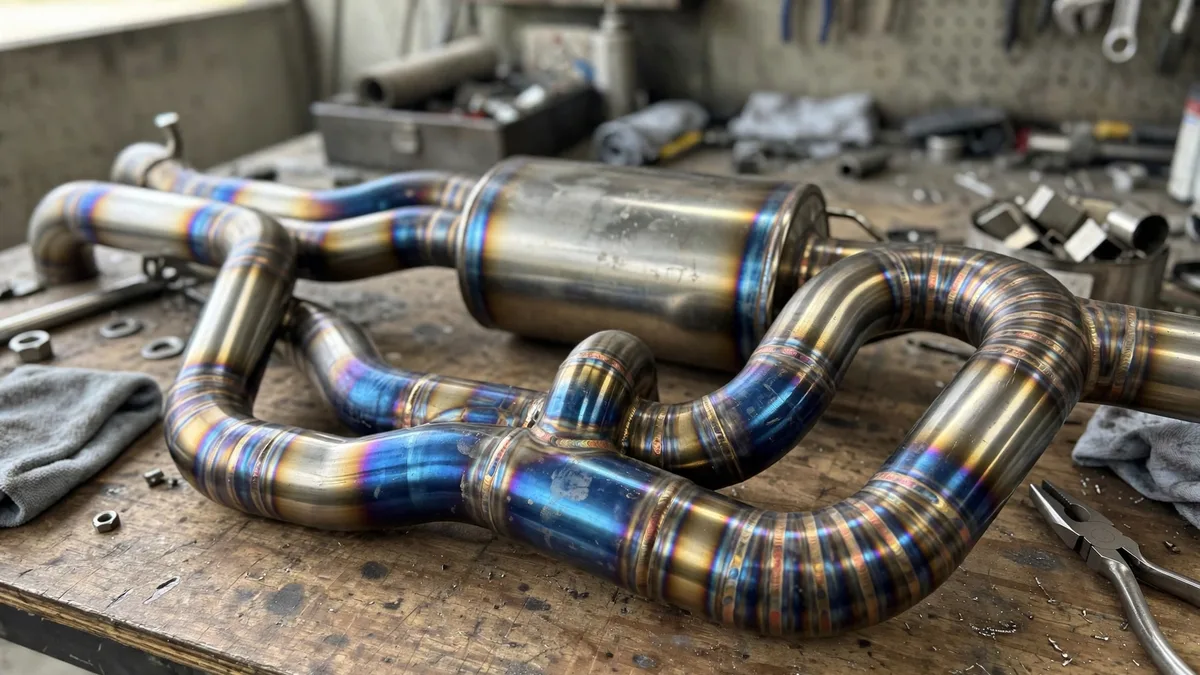
Where pipes join, they are welded by hand with a tungsten inert gas torch, and the work is done inside a flow of argon gas that shields the molten metal from oxygen. Titanium absorbs oxygen when it is hot, turning brittle, so the welder shields both the front and the back of every joint, sometimes filling the whole pipe with argon as it is welded. The weld beads are famously neat, overlapping like fish scales, and a good titanium welder is prized enough to be named in the sales brochure of the exhaust itself. A single system can take a full day of welding alone.

Step 4: Building the silencers and valves
The silencer, or muffler, is a titanium canister packed with stainless steel wool and perforated tubes that break up the sound waves. Its casing is rolled from sheet, welded, and fitted with internal baffles whose positions are tuned by ear and by measurement. Many modern systems add a butterfly valve inside the pipe, driven by a small electric motor, that opens at high revs and closes for quiet cruising. The valve, its actuator, and the linkages are assembled and tested on the bench before they are welded into the system, because a stuck valve would ruin the sound the customer paid for.
Step 5: Fitting, tuning, and heat tinting
The finished system is bolted to the car it was made for, or to an exact jig of its engine and chassis, and every hanger and flange is checked for fit. Then the engine is run, and the exhaust note is measured and tuned: baffles are adjusted, pipe lengths are checked, and the sound is compared against the target. The heat of the first run paints the titanium in its signature colours, blue, purple, and straw gold, as the surface oxidises in thin layers. Some builders polish these tints away and some leave them, because the colours are proof that the metal is real titanium and that it has been properly run in. The engine at the front of the system is itself a masterpiece of hand building, as how hypercar V12 engine is made shows.
Step 6: Inspection, polishing, and packing
Before it leaves the workshop, the whole system is inspected joint by joint. Welds are checked for cracks with dye penetrant, a coloured liquid that seeps into any flaw and makes it visible. Flanges are checked for flatness, because a warped flange will leak exhaust gas and whistle. The pipes are polished, wrapped in protective film, and packed in a custom crate with every gasket, bolt, and clamp the fitter will need. The complete factory process, from raw tube to boxed system, is laid out in inside titanium exhaust system production. A titanium exhaust is one of the few car parts that is unpacked like a piece of art.
| Main material | Thin-walled titanium tubing and sheet, with stainless steel silencer packing |
| Weight saving | Often 40 to 60 percent lighter than an equivalent steel system |
| Welding | Hand tungsten inert gas welding under argon gas shielding |
| Wall thickness | Often under a millimetre on the thinnest pipes |
| Heat resistance | Withstands exhaust gas temperatures of several hundred degrees |
| Sound control | Perforated baffles and an electric valve for quiet and loud modes |
| Manufacturing time | Several days of hand work for a single bespoke system |
| Testing | Dye penetrant weld inspection, fit check, and a full engine run |
What Does a Titanium Exhaust System Cost?
A titanium exhaust for a sports car is estimated at roughly $3,000 to $8,000, while a bespoke system for a hypercar is estimated at $10,000 to $30,000 or more. The price reflects the cost of the metal itself, the slow hand welding, and the fact that each system is built for one car and cannot be mass produced. A dented or cracked titanium exhaust is usually repaired by the maker rather than replaced, because the replacement costs as much as the original. Buyers pay for lightness, for sound, and for the blue-gold shimmer that tells everyone what the pipes are made of.
A Rare Fact
Titanium exhausts change colour as they age, and the colours are a map of temperature. The pipes nearest the engine turn deep blue, the middle sections fade to purple and straw, and the tailpipes stay bright silver, because each part of the system runs at a different heat. Mechanics can read that map like a thermometer: a pipe that has turned grey and dull has been overheated, while a pipe with sharp, vivid bands has been run hard but never beyond its limits. No other exhaust material wears its history so visibly.

A titanium exhaust is the last thing the engine makes before its work is done, and the first thing a bystander hears. It weighs almost nothing, it survives heat that would destroy steel, and it sings. It is also, pound for pound, one of the most expensive things on the whole car, and every gram of it was bent, welded, and polished by a person, not a machine.


