The lights went green and the hypercar left the line without a sound. For the first few metres there was only the whine of electric motors and the rush of air, and then the V8 behind the driver’s shoulders woke up with a crack, and the car simply vanished down the straight. People in the grandstand laughed, because it felt like a trick: a car that launches in silence and then arrives like thunder.
That is the party piece of a hybrid hypercar, but it is not the point of one. The point is the numbers. A hybrid hypercar pairs a petrol engine with electric motors, and the result is a machine with more power, more grip, and more speed than either half could manage alone. The specification sheet reads like a physics exam, and every figure on it explains a different part of how the car works.
What follows is a reading of those numbers: what the power figures mean, what the battery can and cannot do, and why a car with two hearts is faster than a car with one.
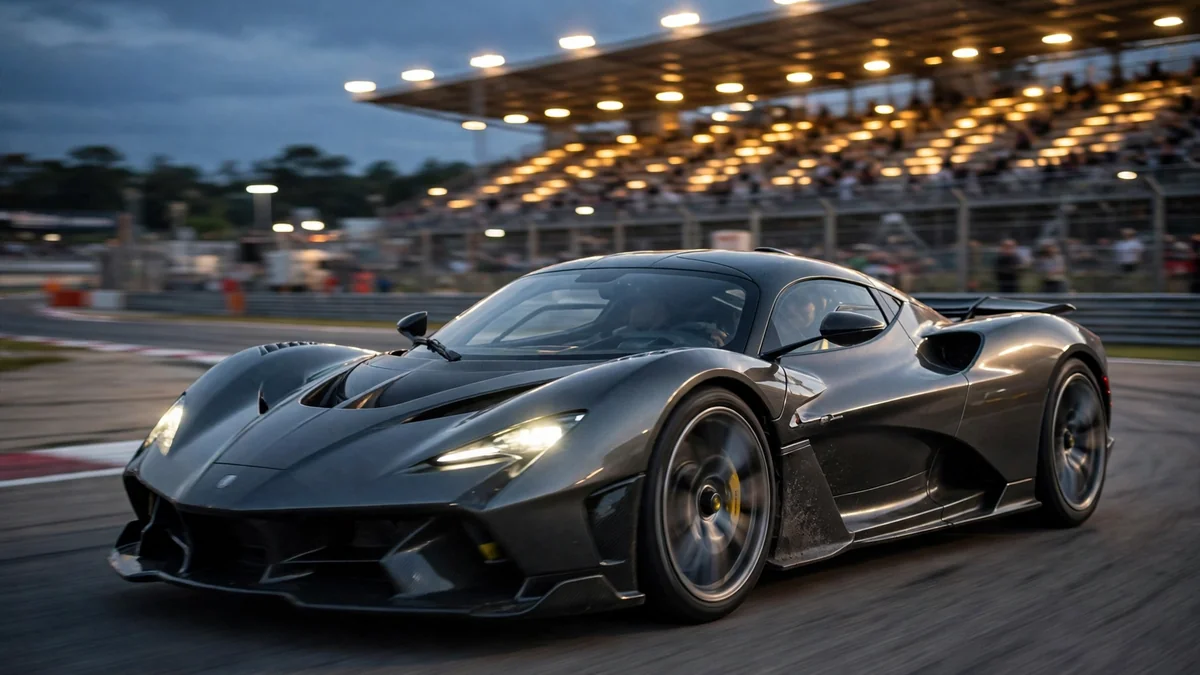
Hypercar Hybrid Specs Explained
1. Combined power output
The headline number for any hybrid hypercar is its combined power, usually between 1,000 and 1,200 horsepower. That figure is the engine and the electric motors working together at full effort, and it is what puts these cars in a class of their own. The engine on its own typically makes 600 to 900 horsepower, and the motors add another 150 to 350, filling in exactly where the engine is weakest. The combined figure is not just the two numbers added together, because the car rarely asks for everything at once, but it is the honest measure of what the car can do when the driver asks for all of it. The mechanism that blends the two power sources is explained in how a hypercar hybrid powertrain works, where the engine, motors, and battery are choreographed hundreds of times a second.
2. The combustion engine
At the centre of most hybrid hypercars sits a twin-turbo V6 or V8, mounted behind the driver and tuned to rev high. It is smaller than the engines in the hypercars of twenty years ago, because it no longer has to do everything on its own. The engine gives the car its noise, its character, and its range, and it is the reason a hybrid hypercar still feels like a petrol car rather than a silent appliance.
3. The electric motors
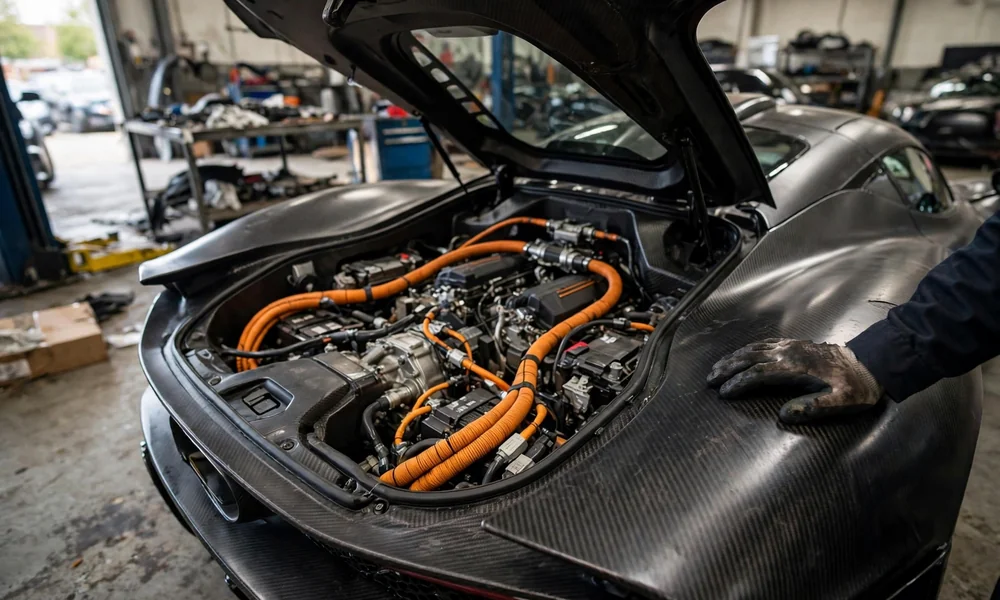
Most hybrid hypercars carry two or three electric motors. One usually sits between the engine and the gearbox, adding torque directly to the rear wheels, and one or two more drive the front axle, which gives the car all-wheel drive without any mechanical connection between front and rear. The motors do two jobs the engine cannot: they deliver full torque instantly, from a standstill, and they let the front wheels spin at different speeds in a corner to help the car turn. That instant torque is the reason the launch feels so violent, and it is also the reason the car can fill the gap while the turbochargers spool up.
4. The battery
The battery in a hybrid hypercar is small by electric car standards, usually 6 to 8 kilowatt-hours, and it is built for power rather than range. It can discharge and recharge extremely quickly, which matters when the car needs a 200-horsepower boost for a few seconds and then wants it all back under braking. It is mounted low, in the centre of the car or behind the seats, where its weight helps balance the chassis, and it is liquid-cooled because it works hard: on a fast lap it can go from full to empty and back again several times. Pure electric range is usually only 20 to 30 kilometres, which is enough to leave a neighbourhood silently, and no more.
5. Acceleration and top speed
The numbers that sell these cars are the acceleration figures. Zero to 100 kilometres per hour typically takes between 2.3 and 2.8 seconds, and zero to 200 takes roughly 6 to 7 seconds, which is faster than most racing cars of a generation ago. Top speed is usually between 330 and 350 kilometres per hour, limited as much by the tyres and the aerodynamics as by the power.
6. Weight and chassis
A hybrid hypercar typically weighs between 1,500 and 1,800 kilograms, which is heavy for a supercar and light for what it contains. The battery, the motors, and the cooling systems add hundreds of kilograms, and the engineers fight that weight with a carbon fibre monocoque, aluminium subframes, and body panels so thin they flex under a fingertip. The materials chosen for that fight are compared in aluminium versus titanium hypercar materials compared, where every gram is a decision between strength, weight, and cost. Weight distribution is usually close to even between front and rear, and the low battery helps keep the centre of gravity near the ground.
7. Braking and energy recovery
Stopping a car this fast takes brakes the size of dinner plates, usually carbon-ceramic discs more than 400 millimetres across, gripped by six-piston callipers. The electric motors help here too: under braking they run in reverse, acting as generators and harvesting energy back into the battery, which is why the battery can recharge itself several times on a single fast lap. The suspension that keeps all of this planted is ranked in the best hypercar suspension systems ranked, where the cleverest systems read the road and adjust themselves in milliseconds. Together, the brakes and the suspension are what let a driver use all that power without the car falling apart underneath them.
Hypercar Hybrid Specs
| Specification | Typical range |
|---|---|
| Combined power | About 1,000 to 1,200 horsepower |
| Engine output | About 600 to 900 horsepower |
| Electric motor output | About 150 to 350 horsepower |
| Battery capacity | About 6 to 8 kilowatt-hours |
| Electric-only range | About 20 to 30 kilometres |
| Zero to 100 km/h | About 2.3 to 2.8 seconds |
| Top speed | About 330 to 350 km/h |
| Weight | About 1,500 to 1,800 kilograms |
| Brake discs | Carbon-ceramic, over 400 millimetres |
| Drive layout | All-wheel drive, mid-engine |
What Does a Hybrid Hypercar Cost?
A hybrid hypercar is estimated to cost roughly $2 million to $4 million, depending on the maker, the specification, and how many are built. The best-known models are estimated at the lower end of that band, while limited editions with bespoke bodies and one-off interiors are estimated well beyond it. Running one costs a great deal too, because the tyres, the brakes, and the servicing are all priced for a machine that is built in the dozens rather than the thousands, and a single service visit can cost as much as an ordinary family car.
A Rare Fact
Some hybrid hypercars can drive in pure electric mode so quietly that the car is fitted with an artificial sound, a soft hum played through speakers, just so pedestrians can hear it coming. The most powerful car in the showroom is, at walking pace, deliberately pretending to be a tram.

A hybrid hypercar is not a compromise between petrol and electric. It is a third kind of car, one that uses each power source for what it does best, and the specification sheet is the proof: two hearts, one car, and numbers no single-hearted machine can touch.


