The first thing you notice on a luxury electric ferry is the quiet. There is no diesel rumble through the deck, no vibration in the handrail, no exhaust haze drifting over the stern. The ferry pulls away from the quay with a soft hum, the water slides past, and passengers in the lounge keep talking at normal volume while the ship accelerates to cruising speed. It feels less like a ferry and more like a large, very calm living room that happens to be crossing the water.
That calm is the product of a completely different drivetrain. A conventional ferry burns fuel in big engines, turns that heat into rotation, and pushes it through gearboxes and shafts to the propellers. An electric ferry stores its energy in batteries, feeds it through power electronics to electric motors, and drives the propellers directly. There are fewer moving parts, far less noise, and no exhaust at all. The engineering challenge is not making it move — electric motors are superb at that — but carrying enough energy, charging it fast enough, and keeping a ship full of passengers safe around very large voltages.

How it works
Follow the energy from the shore to the propeller and the system is surprisingly simple in outline, even if every part of it is built to marine standards. Seven steps carry the ferry from a cold start at the terminal to full speed on open water.
Step 1: Charging at the terminal
Charging starts the moment the ferry docks, and on a luxury route it is automated. A shore-side charging arm or a plug connection links the vessel to a high-power supply at the terminal, often rated at several megawatts, and the batteries begin taking on energy while passengers walk off and on. The connection is interlocked, so power only flows when the coupling is fully seated and locked, and the whole process is supervised by the ship’s energy management system. On short crossings the turnaround may be only ten minutes, so the charger is sized to replace the energy of one crossing plus a reserve in that window.
Step 2: Storing energy in the battery rooms
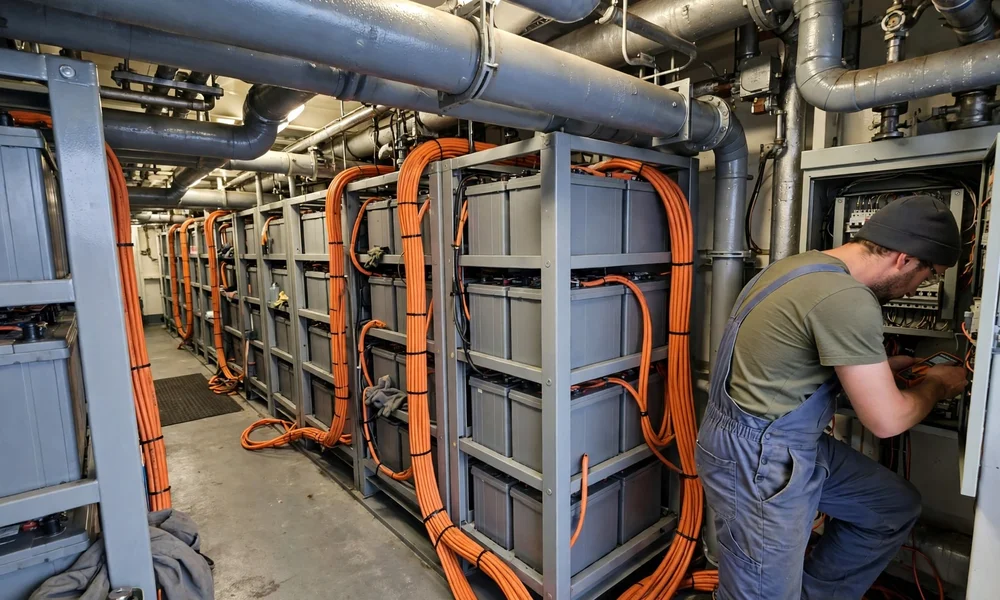
The energy lives in battery rooms deep in the hull, usually in racks of lithium-ion modules. A large electric ferry may carry several megawatt-hours of storage, split into separate compartments so that a fault in one bank cannot take out the whole ship. Each rack has its own cooling, its own fire detection, and its own disconnect, and the battery management system watches every cell group for voltage, temperature and state of charge. The best electric ferry batteries ranked shows how the chemistry choice shapes range and safety, and on luxury routes the priority is always the same: long life, stable chemistry and generous cooling.
Step 3: Converting the power
Batteries deliver direct current, but the big propulsion motors run on alternating current, so the power passes through inverters. These are the unsung heroes of the electric ferry: cabinets of power electronics that switch thousands of times a second to shape the current into exactly the waveform each motor needs. They also run the conversion in reverse during regenerative braking, when a slowing propeller becomes a generator and pushes energy back into the batteries. The inverters are liquid-cooled and heavily redundant, because losing one should never mean losing propulsion.
Step 4: Driving the propellers
The motors themselves are usually permanent-magnet or induction machines mounted in pods below the hull or on shafts inside it. Podded propulsors, often called azimuth thrusters, can rotate through 360 degrees, which gives the ferry extraordinary manoeuvrability: it can spin on the spot, slide sideways into a berth, and hold station in a crosswind without tugs. Electric motors deliver full torque from zero revs, so acceleration from the quay is smooth and immediate, and there is no gearbox to whine or clunk. The way an electric hydrofoil ferry works takes the same electric drive and adds lifting foils, but a conventional luxury ferry keeps its hull in the water and lets the motors do the work.
Step 5: Managing the hotel load
A luxury ferry is also a floating hotel, and the “hotel load” — lighting, heating, air conditioning, galleys, lounges and stabilisers — can consume a large share of the energy. The energy management system balances hotel demand against propulsion demand in real time, dimming non-essential loads when the ship needs full power for a manoeuvre and restoring them on the open-water leg. On the best routes the ship’s systems are so well integrated that the crew rarely touches a control; the software simply keeps the balance.
Step 6: Safety and redundancy
Safety is designed in layers. The battery system is split into independent strings, the propulsion is split across at least two independent drives, and the ship can keep moving on one drive if the other fails. Fire suppression in the battery rooms uses gas or water mist, and the battery management system can isolate a single faulty module in milliseconds. The crew trains for thermal events the way older crews trained for engine-room fires, and the ship carries a reserve of energy at all times, so a missed charging window never leaves it stranded. The way an electric ferry ramp works is part of the same safety story, since fast, reliable loading keeps the charging schedule on time.
Step 7: The crossing itself
On the water, the system settles into a rhythm. The motors draw a steady load, the batteries discharge smoothly, and the ship’s software picks the most efficient speed for the timetable. At the end of the crossing the motors regenerate as the ship slows, the ramp comes down, and the charging arm connects again. The whole cycle repeats, dozens of times a day, with no fuel burned and no exhaust released.
Key specifications
| Specification | Typical figure |
|---|---|
| Battery capacity | 2–8 MWh, lithium-ion |
| Charging power | 2–10 MW at the terminal |
| Propulsion motors | 2 × 1–3 MW electric, podded |
| Service speed | 12–18 knots |
| Passenger capacity | 200–600 passengers |
| Vehicle capacity | 40–120 cars |
| Range per charge | 10–40 nautical miles |
| Turnaround charging time | 10–20 minutes |
| Emissions at sea | Zero exhaust emissions |
| Hull material | Steel or aluminium, lightweight superstructure |
What it costs
A luxury electric ferry is expensive to build, and the batteries are the largest single cost after the hull. Estimates put a large electric ferry at roughly $30–80 million depending on size, route and fit-out, with the battery system accounting for a substantial share of that figure. The trade is in running costs: electricity is cheaper than marine diesel, maintenance is lower because there are fewer moving parts, and the ship avoids fuel price swings. Operators on short, busy routes typically estimate that the higher purchase price is recovered over the life of the vessel through fuel and maintenance savings, while passengers get a quieter, cleaner crossing from day one.
A rare fact
Some electric ferries are so quiet that marine biologists use them as reference vessels: the underwater noise of a well-designed electric ferry is far lower than a diesel ship of the same size, and on some routes porpoises and seals have been recorded approaching the hull out of curiosity.