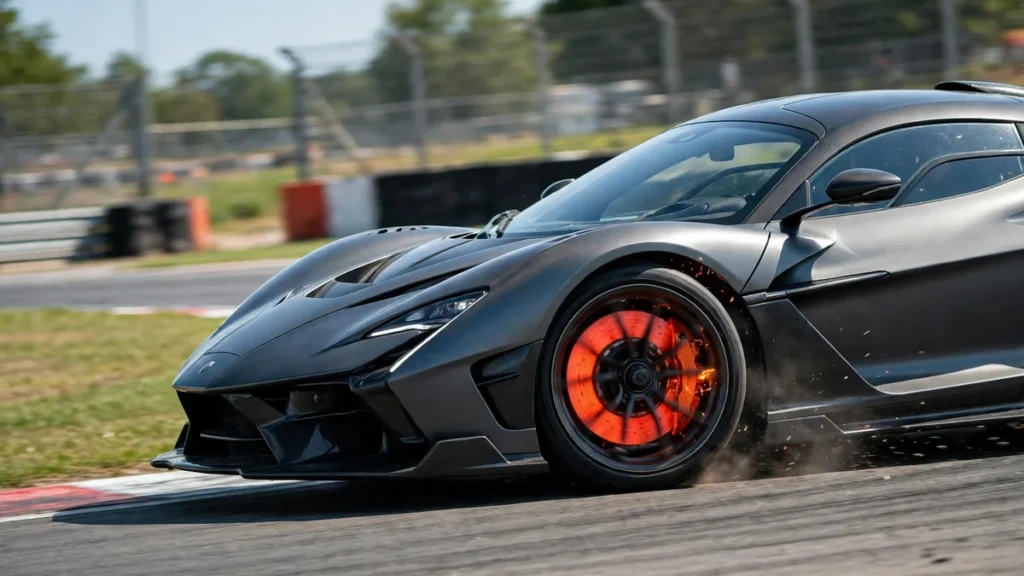
The corner arrives at 240 kilometres per hour, a fast right-hander that tightens halfway through. The driver turns the wheel a few degrees and the car holds its line as if the bend were a rail. There is no slack, no vagueness, no guessing where the front tyres are pointing. In a hypercar, the steering is not a suggestion to the wheels. It is a direct conversation with them.
That precision is the whole point of a hypercar steering system. These cars produce so much grip and change direction so quickly that an ordinary setup would feel numb, slow and frightening. The systems in cars like the McLaren P1, the Ferrari LaFerrari and the Bugatti Chiron are engineered to give the driver exact information about what the front tyres are doing, while needing only small movements of the wheel to place the car to the centimetre. Every number, from the steering ratio to the angle of the front wheels, is chosen to make a 1,000-horsepower car feel calm at speed.
The figures can look modest on paper. A steering ratio of 12:1 does not sound dramatic, and a wheel that turns less than two full turns from lock to lock seems almost ordinary. But those numbers sit inside a system of carbon-fibre structures, electro-hydraulic assistance, variable geometry and very wide tyres, and together they decide how the car behaves at the limit. This guide explains the numbers one by one, in plain English.
How a Hypercar Steering System Works
Step 1: The steering ratio
The steering ratio is the relationship between how far the driver turns the wheel and how far the road wheels turn. A ratio of 12:1 means the steering wheel must turn twelve degrees to move the road wheels by one degree. Most family cars use ratios of around 15:1 or 16:1, so a hypercar’s quicker ratio means less hand movement for the same change of direction. The trade-off is that a quicker ratio also makes the car more sensitive, so the rest of the system has to be tuned to keep it stable.
Step 2: The rack and pinion
Almost every hypercar uses rack-and-pinion steering, in which a small gear called the pinion, attached to the steering column, meshes with a toothed bar called the rack, which pushes the front wheels left or right. The rack is usually machined from a single piece of high-strength steel and mounted directly to a carbon-fibre monocoque, with almost no rubber bushes to absorb feel. That rigid mounting is deliberate: rubber would soften the vibrations and filter out the information the driver needs. The rack’s teeth are cut to extremely tight tolerances, so there is virtually no play when the driver changes direction. As our guide to how a hypercar steering system is made explains, the machining alone is one of the most demanding jobs on the car.
Step 3: Power assistance
Wide front tyres and enormous aerodynamic downforce make a hypercar’s steering extremely heavy without help, so every modern example uses power assistance. Most use electro-hydraulic systems, where an electric pump drives hydraulic pressure to the rack, because hydraulics give a more natural, progressive feel than a purely electric motor. The assistance is speed-sensitive: generous at parking speeds, where the tyres are hardest to turn, and fading away as speed rises, so the driver feels the road more clearly at 200 kilometres per hour.

Step 4: Variable ratio and rear steering
Many hypercars vary their steering ratio with speed or steering angle. Near the centre, the ratio is slower, so the car tracks calmly in a straight line. As the driver turns further, the ratio quickens, so tight corners need less arm movement. A few hypercars add rear-wheel steering, turning the rear wheels by up to a few degrees: in the same direction as the fronts at high speed, for stability, and in the opposite direction at low speed, to tighten the turning circle.
Step 5: The wheel itself
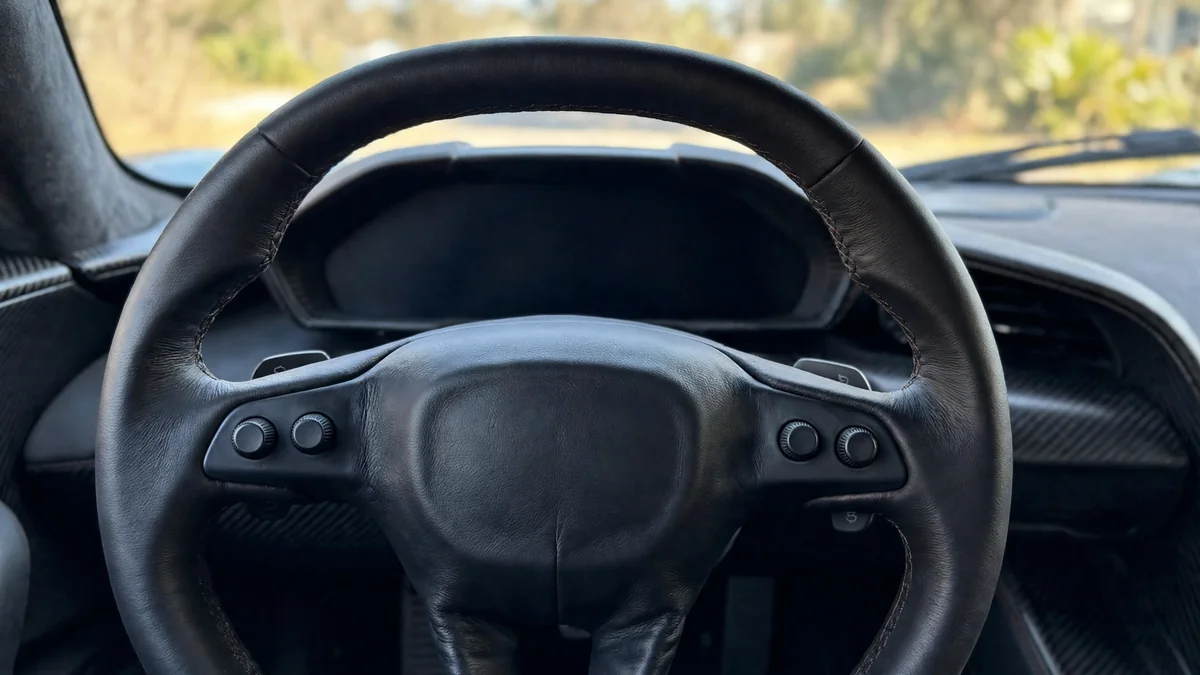
The steering wheel in a hypercar is a control centre as much as a steering device. It is usually a compact, flat-bottomed wheel about 360 millimetres across, wrapped in leather or Alcantara, with buttons and rotary dials for driving modes, suspension settings and, on hybrid cars, energy deployment. Its small diameter quickens the steering further, because a smaller wheel needs less hand travel for the same rotation. Paddle shifters for the gearbox sit behind it, fixed to the column so they stay in place when the wheel turns.
Step 6: Geometry — caster, camber and toe
The final step is the suspension geometry that the steering works through. Caster is the backward tilt of the steering axis, usually around 5 to 8 degrees on a hypercar, and it is what makes the wheel straighten itself after a corner. Camber is the inward lean of the front wheels, typically 1 to 2 degrees of negative camber, which keeps the tyre’s contact patch flat when the car leans in a bend. Toe is the slight inward or outward angle of the wheels, set to a fraction of a degree. Getting these angles right is a matter of testing, not theory, and it is why hypercar makers spend so many hours at the track. The suspension that carries all of this is explained in our guide to how hypercar active suspension works.
Hypercar Steering System Specs
| Specification | Typical range |
|---|---|
| Steering ratio | About 11:1 to 13:1, versus 15:1 to 16:1 on a family car |
| Lock to lock | About 1.8 to 2.2 turns of the wheel |
| Assistance type | Electro-hydraulic on most; electric on some newer models |
| Rack mounting | Rigidly mounted to the carbon-fibre monocoque |
| Steering wheel diameter | About 350 to 370 millimetres |
| Caster angle | About 5 to 8 degrees |
| Front camber | About 1 to 2 degrees negative |
| Rear-wheel steering | Up to about 2 to 3 degrees, on models that offer it |
What Does a Hypercar Steering System Cost?
A replacement steering rack for a hypercar is estimated to cost roughly $8,000 to $25,000 for the part alone, before labour, while a complete steering wheel with its integrated controls is estimated at $5,000 to $15,000. Prices are estimates only and vary by maker, model and availability. A full steering system rebuild, including the rack, pump, column and geometry setup, can be estimated at $30,000 or more on the most exclusive cars. Our guide to hypercar brake disc specs shows the same pattern in another system the driver relies on completely.
A Rare Fact
The steering wheel of a Formula 1 car is estimated to cost around $50,000, and it takes weeks to build: a carbon-fibre shell packed with buttons, rotary switches and a display, made to fit a single driver’s hands. The road cars have their own quirk. On the McLaren P1, the steering column is mounted so that the wheel sits noticeably off-centre from the driver’s seat, a trait shared by several mid-engined hypercars whose narrow footwells force the pedals and wheel into a slightly angled driving position. Owners rarely notice it until it is pointed out — and then they can never unsee it.

A hypercar’s steering is easy to overlook because it works so well. There is no drama in it, no wrestling, no noise — just a wheel that moves a little and a car that goes exactly where it is pointed. That calm is the product of hundreds of decisions about ratios, racks, assistance and geometry, each measured in degrees and millimetres.