At 300 kilometres per hour, a twitch of the steering wheel that would be harmless in a family car can put a hypercar into a wall. That is why the steering system of a hypercar is not a scaled-up version of an ordinary car’s steering. It is a precision instrument, built to give the driver exactly the right amount of feel at every speed: light and quick in a car park, heavy and calm at full speed, and always telling the driver what the front tyres are doing. There is no slack and no room for error.
A hypercar steering system has to survive forces that would bend ordinary parts, work flawlessly from freezing mornings to track days in the heat, and still feel alive in the driver’s hands. It is made from machined aluminium, titanium, carbon fibre, and steel, assembled by hand, and tested on rigs that simulate every bump a car will ever meet. This is how a hypercar steering system is made, from raw billet to the wheel the driver holds.

How It’s Made
Step 1: Designing the steering geometry
Everything starts with geometry. Engineers decide the steering ratio, how much the front wheels turn for each degree of steering wheel rotation, and how that ratio changes with speed. A hypercar needs a quick ratio for sharp corners but must not feel nervous at high speed, so many systems vary their assistance and effective ratio as speed rises. The steering axis, the castor, and the camber of the front wheels are tuned together, because the steering feel comes from the whole front suspension, not just the rack. The design is checked against the behaviour of the complete car, including the braking forces described in our guide to carbon ceramic brakes materials engineering.
Step 2: Machining the steering rack
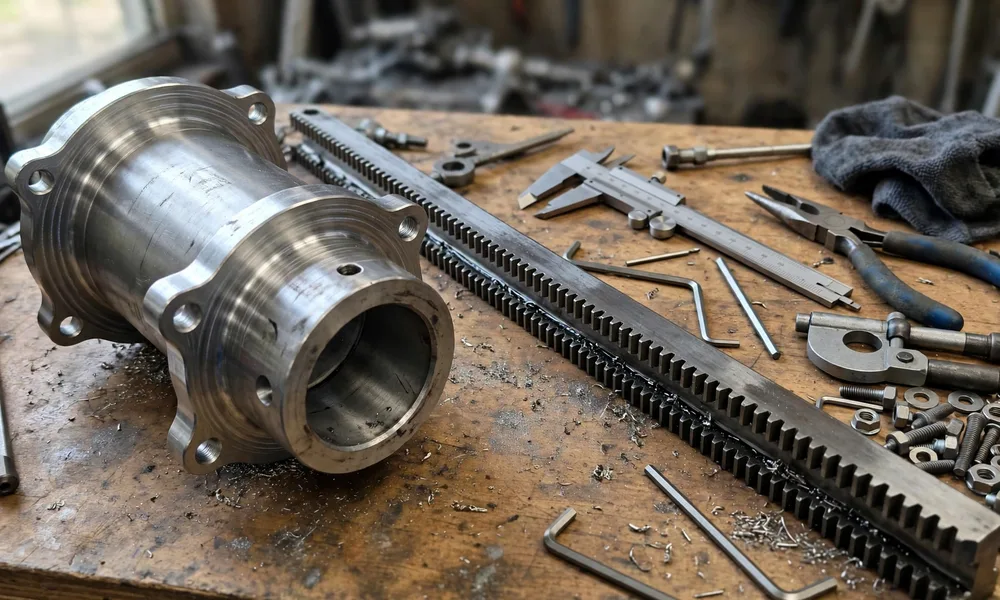
At the centre of the system is the steering rack, a precision bar with teeth cut along its length, housed in a machined aluminium casing. The rack bar is made from high-strength steel, ground and polished until it is straight to within a few hundredths of a millimetre, and the teeth are cut on a gear hobbing machine so that the pinion meshes with it smoothly and without backlash. The rack is assembled with preloaded bearings that hold the pinion tight against the teeth, removing backlash, the tiny dead movement when the wheel changes direction. The housing is machined from a solid aluminium billet on a CNC mill, then anodised to protect it from corrosion.
Step 3: Making the steering wheel
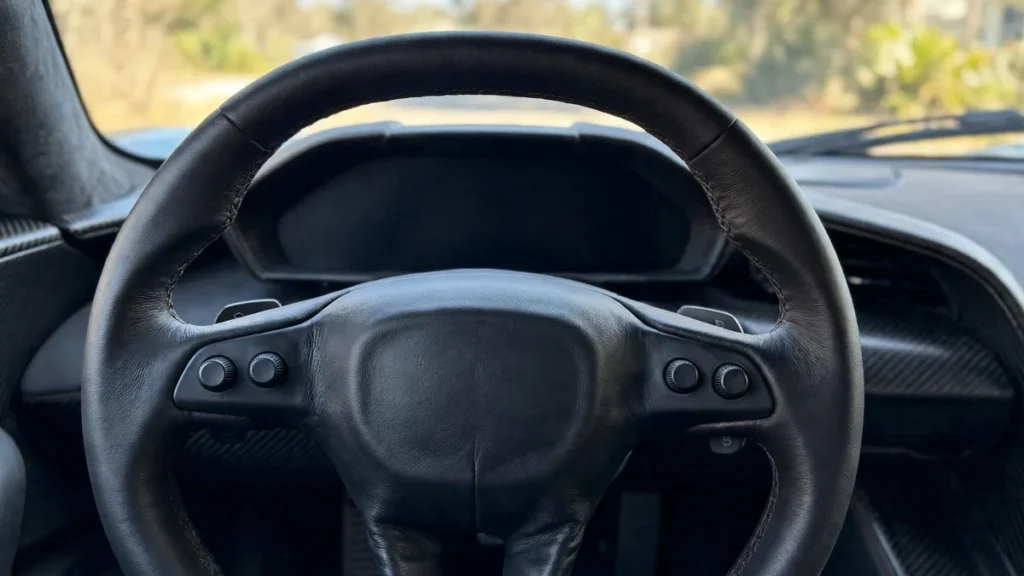
The steering wheel itself is a small structure of its own. Its core is usually magnesium or aluminium, cast and machined, and then wrapped in carbon fibre for the rim and spokes. The rim is shaped by hand, with the leather or Alcantara grips stitched over a moulded core, and the thickness is tuned so the driver can hold it firmly without fatigue. On a hypercar the wheel also carries the controls: drive-mode selectors, indicators, and sometimes the gearshift paddles, all wired through a clock spring that lets the wheel turn while the wires stay connected. The wheel is weighed and balanced. The finished car around it is a showcase of the same obsession with weight and precision, as seen in our look at Aston Martin Valkyrie materials engineering.
Step 4: Building the column and linkages
The steering column connects the wheel to the rack, and it has two jobs that pull in opposite directions: it must be perfectly rigid so the driver feels the road, and it must collapse safely in a crash so it does not spear the driver. The column is built from steel tubes with a designed crumple section, and universal joints at each end let it follow the angle between the wheel and the rack. Tie rods run from each end of the rack to the steering arms on the front wheels, with ball joints that allow the suspension to move up and down while the steering stays precise. Every joint is sealed and greased for life.
Step 5: Fitting the power assistance and electronics
Modern hypercars use electric power steering, with a motor mounted on the rack or the column that adds force when the driver turns the wheel. The motor is controlled by software that reads vehicle speed, steering angle, and lateral acceleration, and adjusts the assistance hundreds of times a second. At parking speed the assistance is strong; at high speed it fades away so the driver feels the tyres directly. The system is tuned on the road while engineers adjust the software maps. A hypercar’s steering is as much software as hardware, and the tuning is what separates a good system from a great one. The drivetrain it works with is equally specialised, including the gearboxes described in our guide to dual-clutch gearbox materials engineering.
Step 6: Testing on the rig and the road
Before a steering system is fitted to a car, it is tested on a rig that twists and pushes it through millions of cycles, simulating years of driving in days. The rig measures backlash, friction, and wear, and any part that drifts out of tolerance is rejected. Then the system goes into a prototype car for road testing: slow-speed manoeuvres, high-speed stability runs, and track laps that push the front tyres to their limit. Test drivers report on feel, engineers translate it into numbers, and the parts are adjusted until the two agree. Only then does the steering system go into production cars, where each one is checked again on a final alignment rig before delivery.
Specs
| Specification | Detail |
|---|---|
| Steering type | Electric power-assisted rack and pinion, speed-sensitive |
| Rack | High-strength steel rack bar in a machined aluminium housing |
| Steering wheel | Magnesium or aluminium core, carbon fibre rim, leather or Alcantara grips |
| Steering ratio | Typically around 12:1 to 15:1, varying with speed |
| Turns lock to lock | Typically 2.0–2.5 turns |
| Column | Steel column with a designed collapse section for crash safety |
| Assistance | Electric motor on rack or column, software-controlled |
| Tolerances | Rack straightness within a few hundredths of a millimetre |

Price
A hypercar steering system is hand-built from machined and composite parts, and its cost reflects that. A complete replacement steering rack for a hypercar typically costs around $5,000 to $15,000 as a part (estimate, based on typical pricing of high-performance steering components), and a full carbon fibre steering wheel with integrated controls can cost a similar amount on its own. The whole steering system is a small share of a hypercar’s price, commonly around $2 million to $3 million (estimate, based on typical pricing of current hypercars), but the driver touches it on every drive.
Rare Fact
Some hypercars have no mechanical connection at all between the steering wheel and the front wheels in certain modes, a system called steer-by-wire. Sensors read the wheel’s position and electric motors turn the wheels, with motors feeding artificial resistance back to the driver’s hands. The system can change the steering ratio on the fly, making the car feel nimble in a car park and stable at speed without any physical change. It sounds like science fiction, but it is already on the road, and it is the clearest sign that the steering wheel’s next century will be written in software as much as in steel.