The straight is long and the speedometer is climbing past 300 kilometres per hour. Then the braking zone arrives, a painted board at the side of the track that means only one thing: stop, now. The driver hits the pedal, and in less than three seconds the car sheds more than 200 kilometres per hour.
Nothing on the car works harder in that moment than two dinner-plate-sized discs of dark grey ceramic, spinning inside the wheels and glowing faintly at their edges. A hypercar brake disc is not a bigger version of the disc on a family car. It is made from carbon fibre woven into a ceramic matrix, baked in a furnace for days, and drilled with hundreds of holes.
It has to absorb the energy of a car weighing well over a tonne travelling at aircraft speeds, turn that energy into heat, and shed the heat before the next corner arrives. The specification sheet reads like a list of contradictions. Here is what each of those numbers means.

Hypercar Brake Disc Specs Explained
1. Disc diameter and thickness
Diameter is the first number on the sheet, and it is usually between 380 and 430 millimetres on a hypercar, with thickness between 32 and 40 millimetres. A bigger disc gives the brake pads a longer lever arm, so the same squeezing force produces more stopping torque. But diameter is limited by the wheel: the disc must fit inside the rim, and hypercar wheels are already enormous. Most hypercar discs are ventilated, with curved vanes between two friction faces that pump air outward as the disc spins.
2. Material: carbon-ceramic versus steel
Almost every modern hypercar uses carbon-ceramic discs, and the material is the reason the whole specification sheet looks the way it does. The disc starts as a woven carbon-fibre preform, soaked in resin and baked until the resin turns to carbon. It is then infiltrated with liquid silicon at temperatures above 1,400 degrees Celsius to form silicon carbide. The result weighs roughly half as much as a steel disc of the same size, resists temperatures above 1,000 degrees Celsius, and barely wears at all in normal road use. The way those discs are built is described in how carbon-ceramic brakes are made, from woven fibre to finished disc.
3. Operating temperature range
A hypercar brake disc lives in a temperature range that would destroy an ordinary brake. Normal road driving keeps the discs between about 100 and 300 degrees Celsius. Hard track driving pushes them to 600 or 700 degrees, and the surface can briefly pass 900 degrees during a maximum-effort stop from top speed. A disc that heats evenly and cools evenly will last; a disc with a hot spot will develop a crack that grows a little with every stop.
4. Weight and unsprung mass
A carbon-ceramic hypercar disc weighs roughly 6 to 8 kilograms, against 12 to 15 kilograms for a steel disc of the same size. That saving matters more than it sounds. The disc is unsprung mass, meaning it moves with the wheel rather than being carried by the suspension, so every kilogram saved lets the suspension react faster to bumps. Take away too much material and the disc overheats on the first hard stop, even if it is made from exotic ceramic. The bell, the aluminium centre hat that connects the disc to the hub, is where engineers save the remaining weight, machining it from a single billet.
5. Drilling, slotting, and surface design
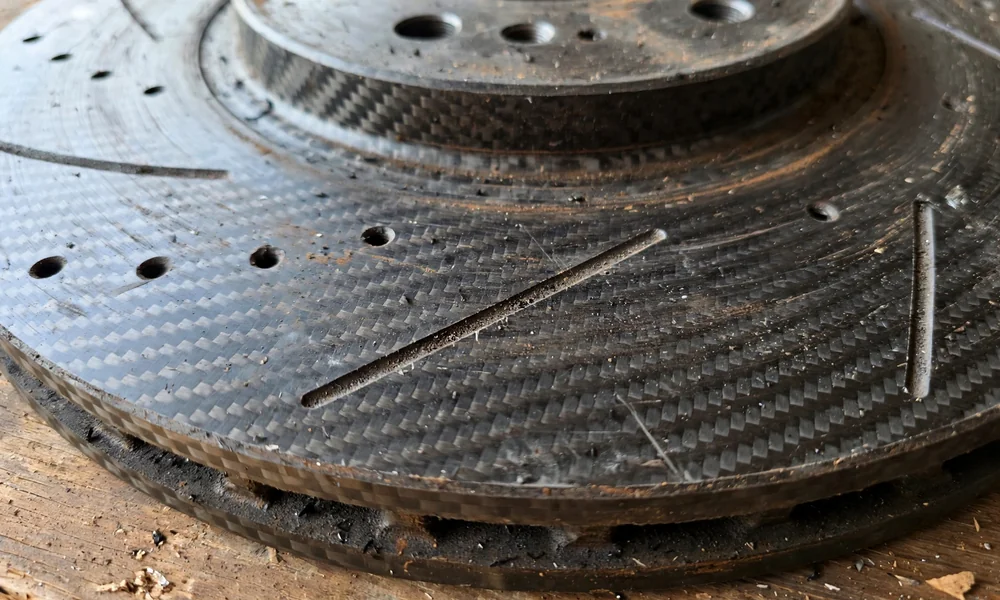
Look closely at a hypercar disc and the surface is never plain. Hundreds of small holes are drilled through the friction faces, and sometimes shallow slots are machined across them as well. The holes have a real job: as the pads press against the disc, they release gas and dust, and without somewhere for that gas to go, it forms a thin cushion between pad and disc that reduces friction. The holes give the gas an escape route, and they also wipe the pad surface clean, keeping the friction consistent. But every hole is also a stress concentrator, a place where a crack can start, so the holes are chamfered and their pattern is carefully spaced. The full working principle is set out in how a hypercar brake disc works, including how the pads and calliper turn hydraulic pressure into stopping force.
6. Friction coefficient and pad pairing
The friction coefficient, usually written as mu, is the number that says how much grip the pad has on the disc. For a hypercar it is typically between 0.4 and 0.6 once the brakes are warm. That number is not a property of the disc alone; it is a property of the disc and pad working as a pair, and changing the pads changes the number. The disc must be matched to the pad compound, because a pad that is too aggressive will chew through a carbon-ceramic disc, while a pad that is too soft will glaze over and lose friction when it gets hot.
7. Service life and wear
Service life is the specification that surprises people most. A carbon-ceramic hypercar disc can last more than 100,000 kilometres on the road, because the ceramic surface barely wears when it is used gently. On a racetrack, the same disc might last only a few thousand kilometres, because repeated stops from high speed wear the surface and oxidise the carbon. Discs are measured rather than guessed: a technician weighs the disc, because a carbon-ceramic disc loses mass as it wears, and compares it against a minimum weight stamped on the bell. Below that weight, the disc is scrap.
Hypercar Brake Disc Specs
| Specification | Typical range |
|---|---|
| Disc diameter | About 380 to 430 millimetres |
| Disc thickness | About 32 to 40 millimetres |
| Disc material | Carbon-ceramic, silicon carbide matrix |
| Disc weight | About 6 to 8 kilograms each |
| Operating temperature | About 100 to 700 degrees Celsius |
| Peak surface temperature | Up to about 900 degrees Celsius |
| Friction coefficient when warm | About 0.4 to 0.6 |
| Road service life | More than 100,000 kilometres |
What Does a Hypercar Brake Disc Cost?
A single carbon-ceramic brake disc for a modern hypercar is estimated to cost roughly $5,000 to $12,000, depending on the size and the manufacturer. A full set of four discs with pads is estimated at roughly $25,000 to $50,000 before labour. That figure is a large part of why a hypercar brake disc is so expensive, from the days-long furnace process to the tiny number of discs made each year.
A Rare Fact
Carbon brakes were first used on Concorde, not on cars. The supersonic airliner needed brakes that could stop a 180-tonne aircraft landing at more than 300 kilometres per hour, and steel brakes were too heavy and wore out too fast.

A brake disc never gets the attention the engine gets, yet it is the part that lets a hypercar be a hypercar. Read the diameter, the material, the temperature range, and the service life together, and the disc stops being a grey circle behind the wheel and becomes what it really is: the most honest safety device on the car.


