There is a metal that laughs at temperatures where ordinary steel goes soft and sags. It sits inside jet engines at the hottest point of the flame, it lines the exhausts of racing cars, and it holds together chemical plants full of acids that would dissolve most metals in days. It is called Inconel, and it is not a single metal at all. It is a family of nickel-chromium superalloys, cooked up in the 1940s and still unmatched for work that is too hot, too corrosive, or too stressful for anything else.
Inconel is expensive, difficult to machine, and famously stubborn in the workshop. Engineers put up with all of that because nothing cheaper survives where Inconel works. A turbine blade that runs at 700 degrees Celsius, spinning at thousands of revolutions per minute while hot gas tears at it, has no room for compromise. The story of Inconel is what happens when you stop asking a metal to be cheap and easy, and start asking it to be nearly indestructible.

The Materials Behind the Inconel Alloy
At its heart, Inconel is mostly nickel, typically more than half the alloy by weight, with chromium as the second major ingredient. Nickel gives the alloy its strength at high temperature and its resistance to corrosion, while chromium forms a thin, tough oxide skin on the surface that protects the metal underneath. Around that base, the recipe adds molybdenum, niobium, iron, aluminium, and titanium in carefully measured amounts, each one solving a specific problem. The result is a metal that keeps its strength when it is glowing dull red.
Step 1: Nickel, the metal that refuses to soften
Most metals lose their strength long before they melt, because heat lets their atoms slide past each other. Nickel is different: its crystal structure stays stable at high temperature, and it dissolves other elements without losing that stability. Inconel grades such as 625 and 718 are built on this foundation, with nickel making up roughly 60 percent of the mix. That high nickel content is also why Inconel is so expensive: nickel is costly, and when it makes up most of a part, the metal alone dwarfs the price of steel.
Step 2: Chromium and the invisible shield
Chromium is the second hero of the recipe, usually between 15 and 23 percent. When Inconel is exposed to air, the chromium reacts with oxygen to form a thin layer of chromium oxide on the surface. This layer is only a few atoms thick, but it is dense, stable, and self-healing: scratch it, and it reforms in seconds. Above about 600 degrees Celsius, the oxide skin on stainless steel breaks down; on Inconel, it holds, which is why the alloy can live inside a jet engine.
Step 3: Molybdenum and niobium, the strengtheners
Strength at temperature does not come from nickel alone. Molybdenum dissolves into the nickel and stiffens the crystal lattice, making it harder for atoms to slide. Niobium does something subtler: it forms tiny particles of a compound called gamma double prime, scattered through the metal like grit in concrete, which pin the structure in place. In Inconel 718, this precipitation hardening is the secret of its strength, and it is why the alloy must be heat-treated in a precise sequence of heating and cooling. Get the heat treatment wrong, and the part loses the strength it was bought for.
Step 4: Melting and casting without contamination
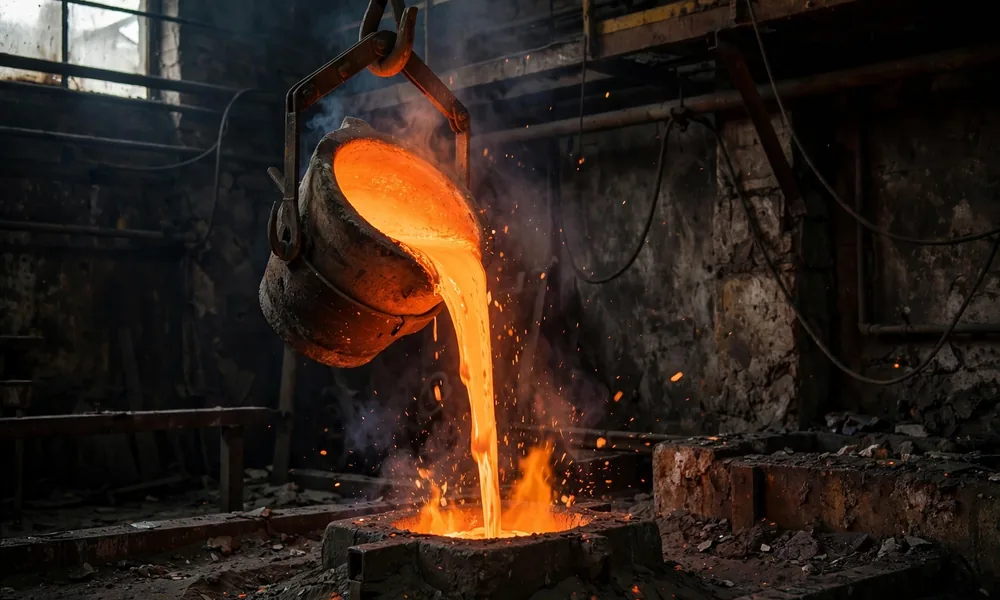
Making Inconel starts with melting the ingredients together, and the melting itself is a feat. The alloy is usually melted in a vacuum, in a process called vacuum induction melting, because at the temperatures involved, even a trace of oxygen or nitrogen can ruin the metal. The molten alloy is then cast into ingots or, for turbine blades, poured into ceramic moulds to make single-crystal castings, where the whole blade is one continuous crystal with no grain boundaries at all. The forging of titanium uses similar vacuum discipline, because the best high-performance metals all share the same enemy: contamination.
Step 5: Machining the unmachinable
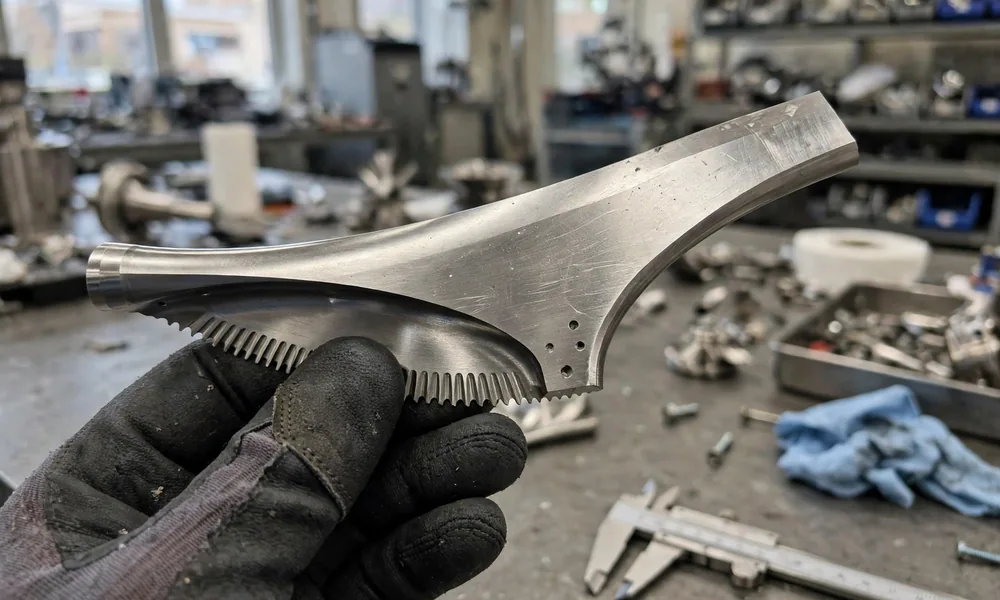
Inconel is notorious in the machine shop. It work-hardens as it is cut, which means the surface gets harder the more you cut it, and it holds its heat at the cutting edge instead of letting the chips carry it away. Tools wear out quickly, sometimes in minutes, and a careless cut can ruin a part worth thousands of dollars. Machinists therefore cut slowly, with rigid setups, ceramic or carbide tools, and floods of coolant. The difficulty is part of the price, and it is why Inconel parts are reserved for places where nothing else will do.
Step 6: Heat treatment and the final test
After shaping, an Inconel part is heat-treated to bring out its full strength. For Inconel 718, this means a solution treatment at around 950 degrees Celsius, followed by ageing at lower temperatures, which grows the strengthening particles to exactly the right size. The part is then inspected with ultrasound and X-rays, because a hidden flaw in a jet engine part is not an option. Only then is the part allowed into service, where it will spend its life at temperatures that would destroy the tools that made it.
Inconel Alloy at a Glance
| Specification | Detail |
|---|---|
| Base metal | Nickel, typically 50 to 70 percent |
| Key alloying elements | Chromium, molybdenum, niobium, iron, aluminium, titanium |
| Common grades | Inconel 625, Inconel 718, Inconel 600 |
| Maximum service temperature | Around 650 to 1,000 degrees Celsius, depending on grade |
| Melting method | Vacuum induction melting, often with vacuum arc remelting |
| Strengthening method | Solid solution plus precipitation hardening |
| Corrosion resistance | Excellent against oxidation, acids, and seawater |
| Main uses | Jet engines, gas turbines, chemical plants, racing exhausts |
What Does It Cost?
Inconel is one of the most expensive common engineering metals, and the price starts with the raw material. Nickel trades at many times the price of iron, and a kilogram of Inconel bar stock typically costs tens of dollars (estimate), compared with a dollar or two for ordinary steel (estimate). Finished parts cost far more, because machining is slow and tools wear out fast: a single turbine blade can cost hundreds of dollars (estimate), and a large Inconel exhaust manifold for a racing car can run into thousands (estimate). Welding it is a specialist job, so steel welding techniques must be adapted rather than copied. Even so, engineers keep buying it, because the alternative is a part that fails. A jet engine that shuts down in flight costs infinitely more than the alloy in its blades, and that simple arithmetic keeps Inconel in business after eighty years.
A Rare Fact
Inconel was born in the 1940s, not in a laboratory chasing a record, but in a practical search for a metal that could survive inside the first jet engines. The engineers who developed it were working with nickel and chromium, two metals that had been used separately for decades, and the breakthrough was realising that together, with a few carefully chosen additions, they made something neither could do alone. The name itself comes from the company that developed it, the International Nickel Company, and the alloy family has been growing ever since. Today there are dozens of grades, each tuned for a different job.